
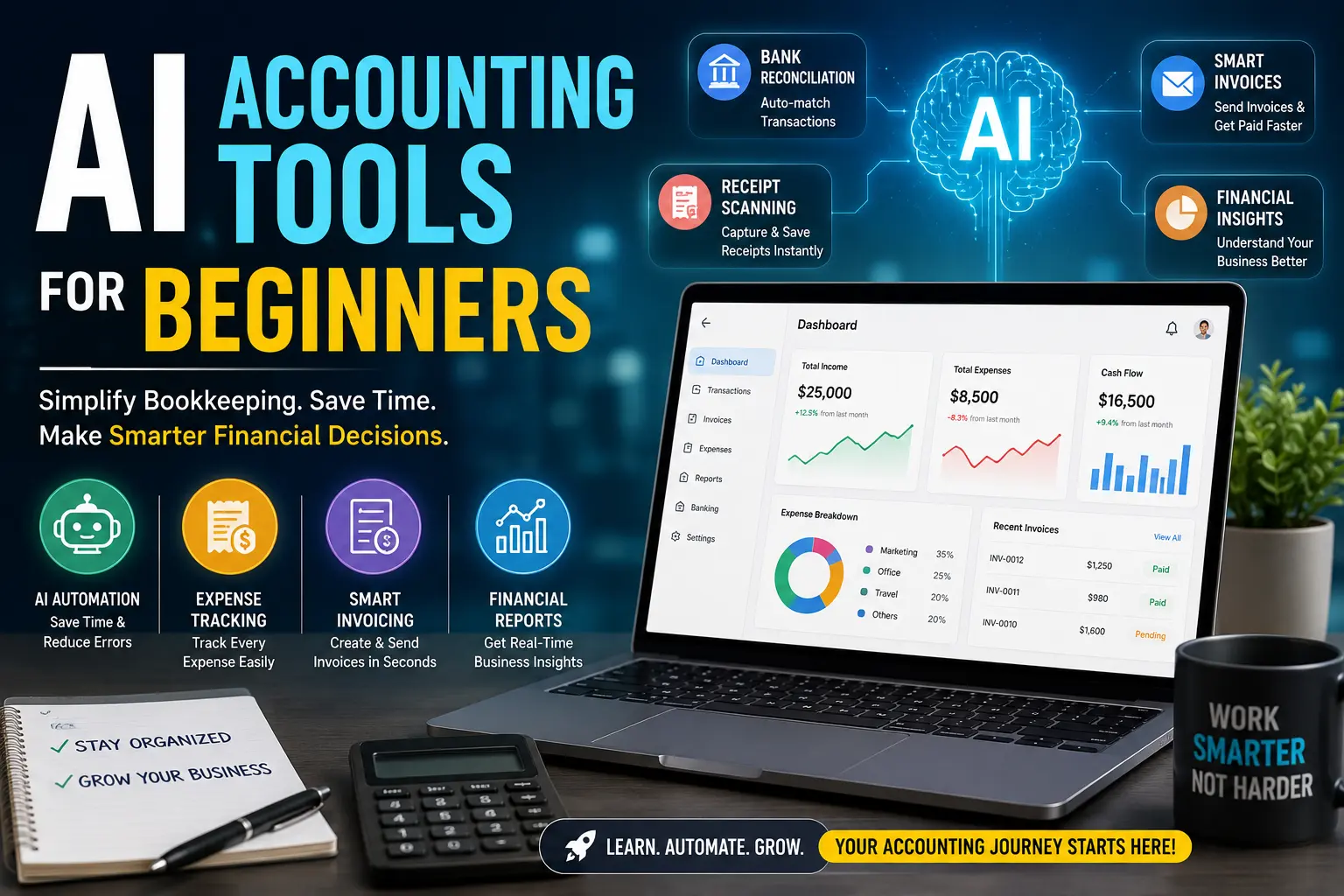
Accounting is one of the most important parts of running a successful business, but for beginners, it can also be one of the most challenging. Imagine being responsible for recording every transaction, tracking expenses, managing invoices, preparing financial reports, and filing taxes accurately. There is often immense pressure on the head of an accountant, especially during tax season or month-end closing, because even a small mistake can lead to financial losses or compliance issues. For someone who is just starting, this responsibility can feel overwhelming.
Fortunately, Artificial Intelligence (AI) has transformed the accounting industry. Instead of spending countless hours entering data manually, AI-powered accounting tools can automate repetitive tasks, organize financial records, identify potential errors, and generate reports within minutes. As a result, beginners no longer need to fear complicated bookkeeping processes. They can focus on learning accounting concepts while allowing AI to handle routine work efficiently.
In this comprehensive guide, you will learn what AI accounting tools are, why they are useful for beginners, their key benefits, and how they are changing the future of finance.
What Are AI Accounting Tools?
AI accounting tools are software applications that use Artificial Intelligence and Machine Learning to simplify everyday accounting tasks. Unlike traditional accounting software that relies entirely on manual input, AI-powered platforms can learn from financial data, recognize patterns, and automate repetitive activities with minimal human involvement.
For example, when you upload your bank transactions, the software can automatically identify whether a payment belongs to office expenses, travel costs, utilities, or customer income. Similarly, if you scan a receipt using your smartphone, the AI can read the information, extract important details, and save the expense without requiring manual typing.
Over time, these tools become more accurate because they continuously learn from your corrections and previous transactions. This intelligent automation helps beginners avoid common bookkeeping mistakes while significantly reducing the time spent on administrative work.
Why Beginners Should Use AI Accounting Tools
Many people assume accounting is difficult simply because it involves numbers. However, the real challenge lies in managing hundreds or even thousands of financial transactions accurately. Beginners often struggle because they are still learning accounting principles while simultaneously trying to maintain error-free financial records.
AI accounting tools remove much of this pressure by handling repetitive and time-consuming tasks automatically. Instead of manually entering every invoice or categorizing each expense, beginners can allow the software to perform these activities within seconds. This not only saves time but also improves confidence because the chances of making costly errors become much lower.
Moreover, AI provides useful financial insights that help beginners understand where money is being spent, how much profit the business is generating, and which expenses require better control. Rather than simply recording numbers, users begin understanding the financial health of their business more effectively.
The Biggest Challenges Beginners Face in Accounting
Starting a career in accounting or managing business finances for the first time can be stressful. One of the biggest difficulties is handling manual data entry. Recording every transaction individually requires patience, concentration, and attention to detail. Even experienced accountants occasionally make mistakes, so beginners naturally feel anxious about maintaining accurate records.
Another major challenge is meeting strict deadlines. Tax filing, payroll processing, and monthly financial reporting often create significant pressure. During these busy periods, accountants work under tight schedules where every minute matters. The responsibility of ensuring complete accuracy while working quickly can become mentally exhausting.
Many beginners also struggle with understanding financial statements and identifying accounting errors. When reports do not balance correctly, finding the source of the mistake can consume several hours. AI accounting software reduces these frustrations by automatically identifying unusual transactions and highlighting possible inconsistencies before they become larger problems.
Benefits of AI Accounting Tools
Want to grow your business beyond accounting? Learn how AI can automate content creation, scheduling, and audience engagement in our complete guide on AI for Social Media Marketing: AI for Social Media Marketing. It explains how AI helps businesses save time while improving their online presence.
The greatest advantage of AI accounting software is its ability to save valuable time. Tasks that previously required several hours can now be completed in just a few minutes. Automated bank reconciliation, invoice generation, receipt scanning, and expense categorization allow accountants to focus on more meaningful work instead of repetitive administrative duties.
Another important benefit is improved accuracy. Human errors are inevitable, particularly when dealing with hundreds of transactions every month. AI systems continuously analyze financial data and compare transactions against previous records. If something appears unusual or inconsistent, the software immediately alerts the user, helping prevent costly mistakes before financial reports are finalized.
AI also provides better financial visibility. Instead of merely organizing numbers inside spreadsheets, modern accounting tools generate meaningful insights about business performance. They can identify spending patterns, estimate future cash flow, monitor outstanding invoices, and help business owners make informed financial decisions. This level of analysis was once available only to experienced accountants but is now accessible even to complete beginners.
Furthermore, AI significantly increases productivity. Since repetitive bookkeeping tasks are automated, accountants can dedicate more time to financial planning, client communication, budgeting, and business growth strategies. This shift from manual work to strategic thinking is one of the biggest reasons why AI has become an essential part of modern accounting.
Features Every Beginner Should Look For
When selecting an AI accounting tool, beginners should focus on software that simplifies learning rather than adding unnecessary complexity. A good platform should automatically categorize bank transactions so users do not have to manually organize every expense. This feature alone can save several hours every month.
Receipt scanning is another valuable capability because it allows users to capture paper receipts using their smartphones. The AI extracts the necessary information and stores it digitally, eliminating the need for manual record keeping.
Invoice automation is equally important for freelancers and small businesses. Instead of creating invoices from scratch every time, AI software can generate professional invoices, send payment reminders, and even track whether clients have completed their payments. This improves cash flow while reducing administrative effort.
Another essential feature is cloud-based storage. Since financial records are securely stored online, users can access their accounting information from any device at any time. This flexibility is especially useful for business owners who travel frequently or work remotely.
Finally, beginners should choose software that generates financial reports automatically. Instead of manually preparing balance sheets, profit and loss statements, or cash flow reports, AI can create these documents instantly, making financial analysis much easier to understand.
How AI Works in Accounting
Although Artificial Intelligence may seem complicated, its role in accounting is actually quite simple. AI studies previous financial transactions and gradually learns how similar transactions should be classified in the future. For instance, if you consistently pay the same internet provider every month, the software recognizes this pattern and automatically categorizes future payments as internet expenses.
Similarly, AI uses Optical Character Recognition (OCR) technology to read invoices and receipts. Instead of manually typing vendor names, dates, tax amounts, and payment values, the software extracts this information automatically. Machine Learning algorithms then improve their accuracy each time users verify or correct transaction categories.
Because of this continuous learning process, AI accounting tools become more intelligent over time. The more frequently they are used, the better they understand individual business operations and accounting preferences.
Will AI Replace Accountants?
Many people worry that Artificial Intelligence will eventually replace accountants completely. However, this belief is largely based on misunderstanding how AI works. While AI is excellent at performing repetitive calculations and organizing financial information, it cannot replace professional judgment, ethical decision-making, or strategic financial planning.
Accountants do much more than record transactions. They advise businesses on tax strategies, analyze financial risks, ensure legal compliance, interpret financial statements, and help organizations make important investment decisions. These responsibilities require critical thinking, experience, and communication skills that AI cannot replicate.
Instead of replacing accountants, AI is transforming their role. By eliminating repetitive administrative work, accountants have more time to focus on solving complex financial challenges and providing valuable business advice. In other words, AI works alongside accountants rather than replacing them, making the profession more productive and efficient than ever before.
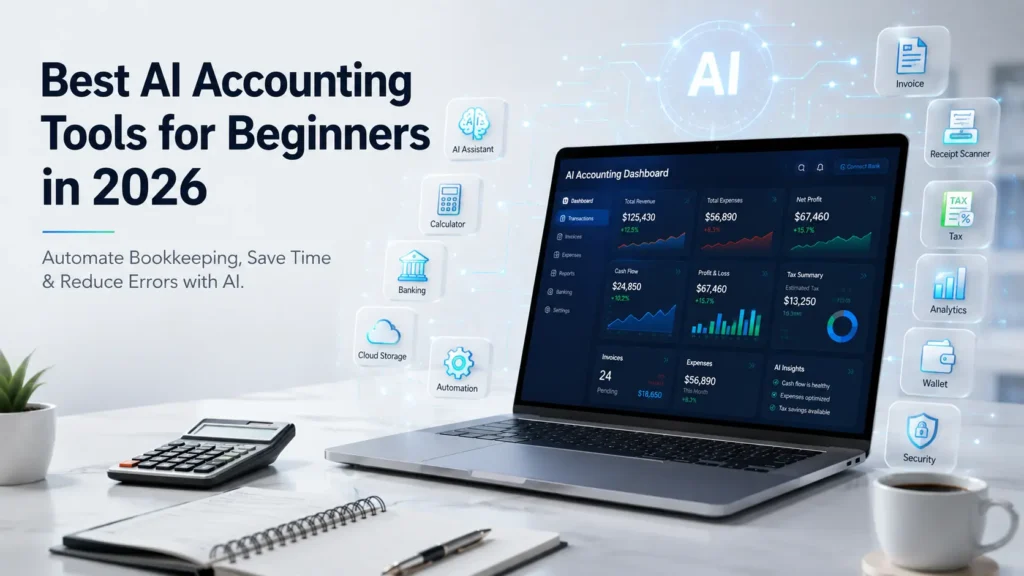
Best AI Accounting Tools for Beginners in 2026
Choosing the right AI accounting software can make a significant difference in how efficiently you manage your finances. Every tool offers unique features, pricing, and automation capabilities. While some platforms are designed specifically for freelancers and small businesses, others are built for growing companies that require advanced accounting functions. Below are some of the best AI accounting tools that beginners can start using in 2026.
1. QuickBooks Online
QuickBooks Online is one of the world’s most popular accounting platforms and is widely trusted by accountants, freelancers, and small businesses. Its AI-powered automation helps users categorize expenses, reconcile bank transactions, create professional invoices, and generate financial reports with minimal manual effort. The software also provides intelligent cash flow forecasting, allowing business owners to understand their financial position before problems arise.
One of the biggest advantages of QuickBooks Online is its user-friendly interface. Even if you have no prior accounting experience, the platform guides you through each process step by step. Beginners appreciate its automation because it reduces repetitive work while maintaining accurate financial records.
Best For: Small businesses, freelancers, and beginners.
2. Xero
Xero is another excellent cloud-based accounting solution that combines simplicity with powerful AI automation. The platform automatically imports bank transactions, categorizes expenses, manages invoices, and provides real-time financial insights. Its dashboard is clean and easy to understand, making it an excellent choice for people who are learning accounting for the first time.
Additionally, Xero integrates with hundreds of third-party business applications, allowing users to connect payroll, inventory management, payment gateways, and CRM software. This flexibility makes it suitable for businesses that expect to grow over time.
Best For: Small businesses and startups.
3. FreshBooks
FreshBooks focuses on freelancers, consultants, and service-based businesses that need simple yet powerful accounting software. The platform uses AI to automate invoicing, payment reminders, expense tracking, and financial reporting. Since many freelancers spend hours following up on unpaid invoices, FreshBooks automatically sends reminders to clients, helping improve cash flow without additional effort.
Its simple dashboard and intuitive navigation make it one of the easiest accounting platforms for complete beginners.
Best For: Freelancers, agencies, and consultants.
4. Zoho Books
Zoho Books is a cost-effective AI accounting solution designed specifically for small businesses. It automates bookkeeping, invoice generation, bank reconciliation, inventory management, and tax calculations. The software also offers intelligent workflow automation that reduces repetitive administrative work.
If your business already uses other Zoho applications, Zoho Books integrates seamlessly with the entire ecosystem, making financial management even more efficient.
Best For: Small businesses looking for affordable accounting software.
5. Sage Accounting
Sage Accounting is a professional accounting platform that combines AI automation with advanced financial reporting. It helps businesses manage invoices, payroll, VAT calculations, expense tracking, and cash flow forecasting. The software also provides valuable business insights that allow users to make smarter financial decisions.
Although Sage includes several advanced features, its beginner-friendly interface makes learning much easier than traditional accounting software.
Best For: Growing businesses and professional accountants.
6. Wave Accounting
Wave Accounting is one of the best free accounting solutions available for beginners. Despite being free, it offers essential features such as bookkeeping, expense tracking, invoice creation, and financial reporting. The platform automatically imports bank transactions and organizes financial data, helping users maintain accurate records without investing in expensive software.
For startups or entrepreneurs operating on a limited budget, Wave provides an excellent starting point before upgrading to premium accounting solutions.
Best For: Startups, students, and freelancers with limited budgets.
7. Oracle NetSuite
Oracle NetSuite is an enterprise-level cloud accounting platform powered by Artificial Intelligence. It automates financial planning, budgeting, revenue recognition, inventory management, and business analytics. Unlike beginner-focused software, NetSuite is designed for medium and large organizations that require advanced financial management.
Although beginners may find its features overwhelming initially, understanding NetSuite can be highly beneficial for anyone planning a career in corporate finance.
Best For: Medium and large enterprises.
8. Vic.ai
Vic.ai is an advanced AI-powered accounting platform that specializes in accounts payable automation. Instead of manually entering invoice details, the software reads invoices, verifies information, identifies duplicate payments, and recommends approval workflows automatically. This dramatically reduces processing time while minimizing human errors.
Businesses processing hundreds of invoices every month can save significant time using Vic.ai’s intelligent automation capabilities.
Best For: Finance teams handling large invoice volumes.
9. Botkeeper
Botkeeper combines Artificial Intelligence with professional bookkeeping services to automate financial management. The platform records transactions, reconciles bank accounts, generates reports, and continuously monitors financial activity. Businesses benefit from automated bookkeeping while still having access to accounting professionals whenever expert guidance is required.
This hybrid approach makes Botkeeper particularly attractive for companies that want automation without sacrificing human expertise.
Best For: Small businesses looking for automated bookkeeping.
10. Docyt
Docyt is an AI-driven accounting platform that automates bookkeeping, financial reporting, and expense management in real time. It continuously collects financial information from multiple sources and generates accurate reports with minimal manual intervention. Businesses using Docyt can monitor financial performance instantly instead of waiting until the end of each month.
The platform is especially useful for hospitality, retail, and multi-location businesses that handle large volumes of daily transactions.
Best For: Retail, hospitality, and multi-location businesses.
Which Tool Should Beginners Choose?
If you are completely new to accounting, QuickBooks Online, Xero, and FreshBooks are among the best options because they combine ease of use with powerful AI automation. If you are looking for a free solution, Wave Accounting is an excellent place to start. On the other hand, if you already use the Zoho ecosystem, Zoho Books offers outstanding value and seamless integration.
The ideal AI accounting tool ultimately depends on your business size, budget, and accounting requirements. However, regardless of the platform you choose, adopting AI-powered accounting software will help you save time, reduce manual errors, improve financial accuracy, and make more informed business decisions.
Conclusion
Artificial Intelligence has completely changed the way accounting is performed. What was once a time-consuming and stressful process has become faster, smarter, and significantly more accurate. For beginners, AI accounting tools provide an opportunity to learn accounting without feeling overwhelmed by repetitive tasks or the constant fear of making mistakes.
Although mastering accounting still requires knowledge and practice, AI serves as a powerful assistant that reduces workload and increases confidence. Whether you are a student, freelancer, entrepreneur, or aspiring accountant, adopting AI-powered accounting software can save time, improve financial accuracy, and help you focus on growing your career or business instead of getting lost in paperwork.
Official Websites of the AI Accounting Tools
- QuickBooks Online
- Xero
- FreshBooks
- Zoho Books
- Sage Accounting
- Wave Accounting
- Oracle NetSuite
- Vic.ai
- Botkeeper
- Docyt
Frequently Asked Questions (FAQs)
1. What are AI accounting tools?
AI accounting tools are software applications that use Artificial Intelligence to automate bookkeeping, expense tracking, invoice creation, bank reconciliation, and financial reporting. They reduce manual work, improve accuracy, and help beginners manage their finances more efficiently.
2. Which AI accounting tool is best for beginners?
For most beginners, QuickBooks Online, Xero, and FreshBooks are excellent choices because they offer simple interfaces, AI-powered automation, and easy-to-understand financial reports. If you’re looking for a free option, Wave Accounting is a great place to start.
3. Can AI replace accountants completely?
No. AI can automate repetitive accounting tasks, but it cannot replace the expertise, judgment, and strategic decision-making of professional accountants. Instead, AI works as a powerful assistant that helps accountants become more productive.
4. Are AI accounting tools safe to use?
Yes. Most reputable AI accounting platforms use bank-level encryption, secure cloud storage, and multi-factor authentication to protect financial data. However, users should always choose trusted software and follow good security practices.
5. Do AI accounting tools help with tax preparation?
Yes. Many AI accounting tools automatically organize financial records, categorize expenses, generate tax reports, and calculate tax obligations. This makes tax preparation faster, more accurate, and less stressful for beginners.