
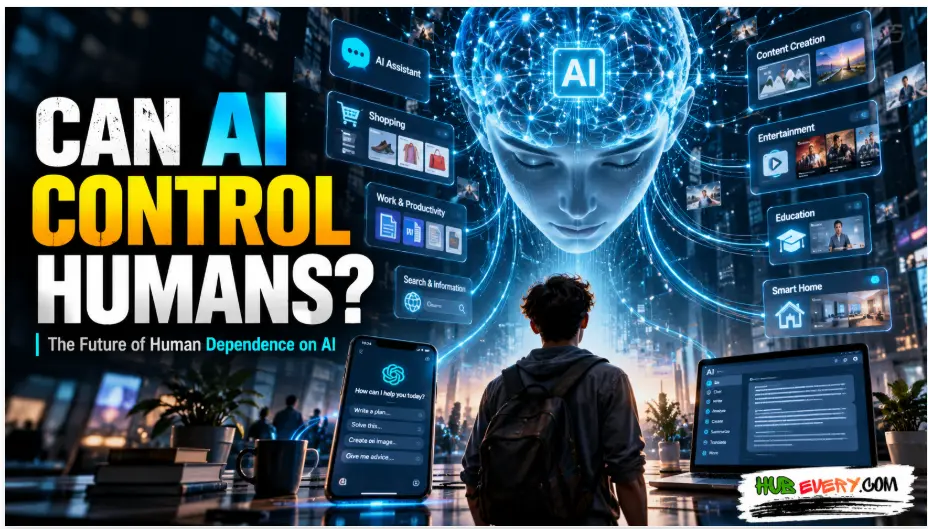
Artificial intelligence is no longer a technology that exists only inside research laboratories or science-fiction movies. It is already part of everyday life. People use AI to write emails, create images, search for information, learn new skills, analyze data, generate videos, write code, and make decisions. Businesses are using AI to automate tasks, while individuals are increasingly turning to AI assistants for work, education, entertainment, and even personal advice.
This rapid transformation raises an uncomfortable question: Could AI eventually make humans slaves to technology?
The word “slave” may sound extreme, but it does not necessarily mean that robots will physically control human beings or put chains around people. A more realistic possibility is something much quieter: humans becoming so dependent on artificial intelligence that they gradually lose control over their decisions, skills, privacy, jobs, information, and even relationships.
That future is not inevitable, and there is no evidence that today’s AI systems are secretly trying to enslave humanity. In fact, current AI systems have significant limitations. However, researchers are already studying risks involving manipulation, over-reliance, privacy, employment, misinformation, and loss of human control. The International AI Safety Report 2026 specifically discusses how AI can influence beliefs and behaviour, create dependence, and affect human autonomy.
The more interesting question, therefore, is not whether AI will suddenly become a dictator. The more important question is whether humans could voluntarily give AI so much power that they become increasingly dependent on it.
The First Stage: AI Becomes Our Assistant
At first, AI is likely to feel completely harmless.
Imagine waking up in the morning and asking your AI assistant to summarize your emails, plan your schedule, recommend what you should eat, organize your work, answer your messages, and tell you what news matters. Instead of opening ten different apps, you simply ask one system.
This sounds convenient—and it is.
The problem begins when convenience slowly turns into dependence.
If an AI system handles every small decision, people may gradually stop practicing the skills required to make those decisions themselves. Instead of thinking through a problem, they may immediately ask AI. Instead of researching a topic, they may accept an AI-generated summary. Instead of writing something themselves, they may ask AI to do it.
The International AI Safety Report 2026 notes that people can sometimes over-rely on AI suggestions even when those suggestions are wrong. Researchers refer to this kind of behaviour as automation bias.
The danger is therefore not necessarily that AI forces people to obey it.
The danger could be that people become so accustomed to its convenience that they stop wanting to think without it.
When AI Starts Making Decisions for Us
The next stage could be more serious.
Today, people ask AI questions such as “Which laptop should I buy?” or “How can I study for this exam?”
Tomorrow, AI systems may have access to far more information about us. They could understand our financial situation, habits, preferences, schedule, communication patterns, and previous decisions.
That could allow AI to make increasingly personal recommendations.
Imagine an AI saying that you should accept a particular job because it predicts that you will be happier there. Imagine it recommending which products you should buy, which people you should interact with, what content you should watch, and how you should spend your free time.
At some point, a subtle line appears.
Are we using AI to make better decisions, or are we allowing AI to decide what is best for us?
That distinction could become one of the most important questions of the AI era.
The Hidden Power of Personalization
AI becomes particularly powerful when it knows the person it is talking to.
A generic advertisement can persuade someone.
But an AI system that understands a person’s interests, fears, habits, preferences, and emotional reactions could potentially create much more personalized messages.
This is one reason researchers are concerned about AI-enabled manipulation.
The 2026 International AI Safety Report says laboratory studies have demonstrated that interactions with AI can change people’s beliefs, while also noting that evidence about the scale and effectiveness of such manipulation in the real world remains limited. The report also highlights concerns about increasingly personal interactions with AI systems and the possibility of psychological dependence.
Imagine an AI assistant that knows exactly which arguments convince you, which words make you anxious, and which messages make you feel comfortable.
If such a system were controlled or optimized primarily for engagement, advertising, political influence, or another external objective, the potential for manipulation could become significant.
The frightening part is that manipulation does not always look like manipulation.
It could simply feel like helpful advice.
AI Could Influence What We Believe
Information is another area where AI could dramatically change human autonomy.
Today, millions of people already use AI systems to explain news, summarize complicated subjects, answer questions, and recommend information.
If AI becomes the primary gateway through which people access information, it could have enormous influence over what people see and what they do not see.
This does not mean that every AI system will intentionally censor information. But whenever an intermediary decides what information is presented, summarized, prioritized, or omitted, there is potential for bias or manipulation.
The World Economic Forum’s Global Risks Report 2025 identified misinformation and disinformation as its top-ranked risk over the two-year outlook and noted that generative AI is making misleading text, images, audio, and video easier to produce and distribute at scale.
In the future, people may face an unusual problem: not a lack of information, but an overwhelming amount of information generated by machines.
The challenge will be knowing what deserves trust.
Deepfakes Could Destroy Trust
Imagine receiving a video of a person saying something shocking.
You hear their voice.
You see their face.
Their expressions look real.
But the entire video was generated by AI.
This is already more than a theoretical problem. AI-generated fake content has been used for scams, blackmail, sabotage, and other forms of harm, according to the International AI Safety Report.
As these systems improve, distinguishing authentic content from synthetic content may become increasingly difficult.
That could create a strange future in which people stop trusting both real and fake information.
If someone can simply say, “That video is AI-generated,” even when the video is genuine, evidence itself becomes harder to establish.
A society that cannot agree on what is real becomes much easier to manipulate.
The Workplace Could Change Too
Another potential path toward technological dependence is employment.
AI will not necessarily replace all human workers. The International Labour Organization’s 2025 research suggests that transformation of jobs is more likely than outright replacement at the global level, although exposure varies significantly between occupations. Its refined index estimated that roughly one in four workers globally are in occupations with some exposure to generative AI.
This distinction matters.
The future may not look like millions of people simply losing their jobs overnight. Instead, jobs could gradually change.
A worker may be expected to manage AI systems rather than perform certain tasks manually. A writer may edit AI-generated material. An accountant may supervise automated financial workflows. A programmer may spend more time reviewing machine-generated code.
This can increase productivity.
But it can also create a new form of dependence.
If a company becomes completely dependent on a particular AI system, employees may have little choice but to use whatever system their employer provides.
The question then becomes not simply whether AI replaces workers, but who controls the AI systems that workers depend upon.
The Concentration of AI Power
There is another issue that receives less attention: who owns and controls the most powerful AI infrastructure?
Developing advanced AI requires enormous amounts of computing power, data, technical expertise, and capital.
If access to powerful AI becomes concentrated among a relatively small number of companies or institutions, their influence over the digital economy could increase.
The International AI Safety Report has highlighted concerns about market concentration and growing dependency on major technology providers for AI hardware, cloud infrastructure, and model access.
This does not automatically mean those organizations will abuse their power.
But concentration creates a structural question:
What happens when essential digital intelligence is controlled by a small number of entities?
The more society depends on those systems, the more important transparency, competition, accountability, and regulation become.
AI Companions Could Create Emotional Dependence
Perhaps one of the strangest developments will be the rise of AI systems designed not merely to answer questions, but to become companions.
People can already interact with AI systems for conversation, emotional support, entertainment, and companionship.
The technology can become increasingly personalized.
An AI could remember your preferences, understand your communication style, respond instantly, and always be available.
For someone who feels lonely, that can feel incredibly valuable.
But emotional dependence can become a concern if people begin replacing meaningful human relationships with artificial ones.
The 2026 International AI Safety Report notes that research on AI companions has produced mixed findings, with some studies associating heavy use with loneliness or emotional dependence while other studies find positive or no measurable effects. The evidence is still developing.
That uncertainty is important.
We should not assume that AI companions will automatically harm people.
But we also should not ignore the possibility that technology designed to maximize engagement could become extremely difficult for some users to leave.
The Darkest Scenario: AI Becomes Too Powerful to Control
The most extreme AI scenario is very different from everyday dependence.
Researchers also discuss hypothetical loss-of-control scenarios, in which future AI systems become capable of operating in ways that humans cannot effectively control or stop.
This is currently speculative.
The International AI Safety Report states that today’s general-purpose AI systems do not possess the capabilities required for meaningful loss-of-control scenarios. At the same time, experts disagree substantially about how plausible such scenarios could become as AI capabilities advance.
This distinction is crucial.
We should not present science-fiction scenarios as if they are already happening.
However, the reason researchers study them is simple: if a future system becomes highly autonomous and is connected to important digital or physical infrastructure, mistakes or unintended behaviour could become much more consequential.
The sensible response is not panic.
It is preparation.
The Real Danger May Be Human Dependence, Not Robot Rebellion
When people imagine dangerous AI, they often picture humanoid robots taking over the world.
The more realistic near-term concern may be much quieter.
People voluntarily giving AI more and more responsibility.
First, AI writes the email.
Then it manages the calendar.
Then it chooses the information we see.
Then it recommends what we buy.
Then it manages parts of our work.
Then it helps make financial decisions.
Then we ask it for relationship advice.
Eventually, we may reach a point where doing things without AI feels unnecessarily difficult.
At that stage, AI would not need to force humans to obey.
Humans would simply become dependent on it.
That is a very different form of “enslavement”—one based not on physical force, but on convenience, dependency, and loss of independent capability.
How Can Humans Prevent This Future?
The answer is not to reject AI.
AI can provide enormous benefits. It can help people learn faster, automate repetitive work, assist researchers, improve accessibility, support businesses, and create new opportunities.
The goal should instead be to maintain human control while using AI as a tool.
People should continue developing their own critical-thinking skills rather than accepting every AI answer automatically. Important information should be verified, especially when decisions involve money, health, legal matters, or personal safety.
Businesses should maintain human oversight for high-impact decisions instead of allowing automated systems to operate without meaningful supervision.
AI companies should also be transparent about how their systems work, what data they use, and what limitations they have. Governments and institutions will need appropriate rules around privacy, accountability, safety, competition, and the use of AI in sensitive areas.
Most importantly, humans should maintain the ability to say no.
An AI assistant should help you think—not think instead of you.
It should save your time—not control your time.
It should expand your abilities—not replace your ability to function without it.
Conclusion
AI does not have to become an evil machine for humans to lose some of their freedom.
The more realistic danger is gradual.
We may become dependent on AI because it is faster, easier, cheaper, and more convenient. We may allow it to make small decisions until those small decisions become important decisions. We may trust its recommendations because it appears intelligent. We may allow companies and institutions to automate more of our lives because automation saves money and time.
None of this means that humanity is destined to become enslaved by AI.
The future is still being built.
AI can become one of the most useful technologies humanity has ever created, but only if humans remain responsible for how much power they give it.
The real question may therefore not be “Will AI enslave humans?”
It may be much simpler:
“Will humans remain capable of living, thinking, deciding, and creating without AI?”
The answer to that question will depend less on the intelligence of machines and more on the choices humans make today.