
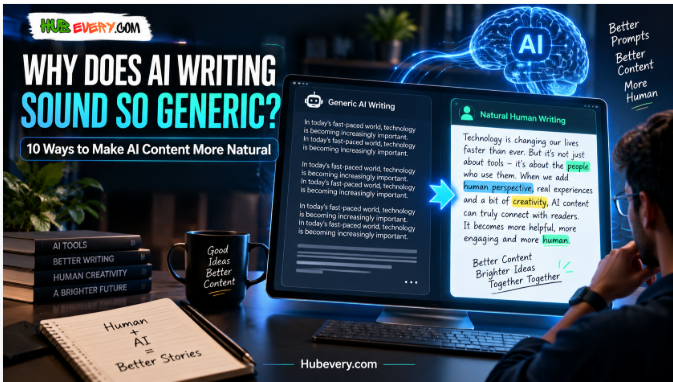
Have you ever asked an AI tool to write an article for you, only to read the finished piece and think, “This sounds like every other article on the internet”? The grammar is perfect, the information looks useful, and the structure seems professional, yet something feels missing. The writing doesn’t sound terrible—it just doesn’t sound like a real person wrote it.
This is one of the biggest problems with AI-generated content today. AI can produce an article in seconds, but speed doesn’t automatically create personality. When you give an AI tool a simple instruction such as “Write a blog post about artificial intelligence,” it has very little information about who you are, who your readers are, or how you normally communicate. As a result, it tends to produce safe and predictable language that could fit almost any website.
You may have noticed certain phrases appearing again and again in AI-generated articles. Expressions such as “in today’s fast-paced digital world,” “it is important to note,” “let’s dive in,” and “whether you’re a beginner or an expert” have become so common that readers can sometimes recognize AI-style writing without even knowing exactly why it feels different.
The interesting thing is that the problem isn’t necessarily AI itself. In many cases, the real problem is how we use AI. If you give an AI a vague prompt, you are likely to receive a vague article. But if you give it context, examples, a clear audience, a specific voice, and your own ideas, the result can be much more useful and much less generic.
Why Does AI Writing Sound So Generic?
AI writing often sounds generic because language models are designed to recognize patterns and generate text that fits those patterns. When you ask an AI to explain a familiar topic, it has access to countless ways that similar subjects have been discussed. Without additional instructions, it naturally tends to choose language that is broadly appropriate and easy to understand.
That can be useful when you simply need a quick explanation. The problem appears when you want content that has a distinct personality. A professional blogger isn’t just transferring information from one place to another. They are making choices about what to explain, what examples to use, what opinions to include, and how to connect with a particular audience. AI can help with those things, but it doesn’t automatically know your preferences.
Imagine asking two writers to create an article about AI tools for college students. One writer has spent the last year experimenting with AI for studying, assignments, presentations, and research. The other writer has never personally used those tools and is simply explaining the topic from general information. Even if both writers produce grammatically correct articles, their content will feel different. The first writer has experiences and observations that make the article specific.
This is exactly what is often missing from AI-generated content: specificity.
1. Give AI More Context Before Asking It to Write
One of the easiest ways to make AI writing more natural is to give the AI enough information before it starts writing. Instead of simply saying, “Write an article about AI tools,” explain who the article is for, what the reader already knows, what problem the article should solve, and what kind of tone you want.
For example, an article written for a software developer should not sound the same as an article written for a college student who has never used an AI tool before. The information may overlap, but the explanations, examples, vocabulary, and level of detail should be different.
The more context you provide, the fewer assumptions the AI has to make. Instead of producing a general-purpose article that could belong on almost any website, it has a clearer direction. This is one of the simplest ways to move from generic AI writing toward content that feels intentionally written for a specific reader.
2. Give AI a Writing Style to Follow
Another common mistake is asking AI to “make the article sound human” without explaining what that actually means. Human writing doesn’t have one universal style. A technology journalist, a college blogger, a financial writer, and a casual YouTuber can all sound completely different while still sounding natural.
If you already have articles that represent your preferred writing style, you can use them as a reference. Ask AI to study the structure, sentence rhythm, vocabulary, and tone of your sample without copying the actual sentences. This gives the AI a much clearer idea of what you mean by “natural.”
For example, perhaps your writing style uses short paragraphs, simple English, occasional questions, and practical examples. Maybe you prefer explaining technical concepts as if you’re talking to a friend. Those details are much more useful than simply saying “write naturally.”
The goal isn’t to make every article identical. The goal is to establish a consistent voice so that your readers gradually recognize your website’s style.
3. Add Your Own Experiences and Observations
This is where AI-assisted content can become genuinely different from mass-produced content. Your own experiences give an article information that isn’t simply generic advice.
Suppose you are writing about using AI for blogging. AI can explain that artificial intelligence can help with research, outlines, keyword ideas, and editing. That’s useful, but thousands of articles can make the same statement.
Now imagine adding something you personally discovered while blogging. Maybe you found that AI was excellent at creating outlines but often made your introductions too repetitive. Perhaps you discovered that giving AI your target audience before generating an outline produced much better results. That small observation suddenly gives the article a real point of view.
You don’t need to turn every article into a personal story. Even a few genuine observations can make a major difference. Readers are not only looking for information; they also want to understand what actually happens when someone applies that information in the real world.
4. Use Specific Examples Instead of General Statements
Generic writing often makes broad statements without showing the reader what they actually mean. For example, saying that “AI can improve productivity” is technically correct, but it doesn’t tell the reader much.
A better explanation would describe what productivity improvement actually looks like. A freelancer might use AI to turn rough notes into an article outline. A small business owner might use it to create different versions of a product description. A student might use it to turn a difficult chapter into a set of practice questions.
The difference is simple: the first sentence tells the reader an idea, while the second approach allows the reader to imagine using that idea.
Specific examples also make your writing more memorable. Instead of filling an article with abstract statements, show the reader what those statements look like in practice.
5. Remove the Phrases That AI Uses Too Often
Sometimes an article sounds like AI simply because it contains too many familiar AI phrases. The problem isn’t that these phrases are grammatically wrong. It’s that they have become predictable.
Phrases such as “in today’s digital age,” “let’s dive in,” “unlock the power of,” and “in conclusion” can make an article feel formulaic when they appear repeatedly. A human writer might use one of them occasionally, but AI-generated articles often rely on them as convenient transitions.
The solution is not to create a strict list of words that can never be used. Instead, read the article and ask whether each sentence actually adds something. If a sentence exists only to introduce the next paragraph, it may not be necessary at all.
Often, the most natural transition is simply no transition. Instead of writing “Now let’s dive into the key benefits of AI,” you can simply begin explaining the first benefit.
That small change makes the writing more direct.
6. Mix Short and Long Sentences
AI-generated writing often has a predictable rhythm. Sentences may be similar in length and follow similar grammatical structures. After several paragraphs, that rhythm can start to feel mechanical.
Human writing tends to be less uniform.
Sometimes a writer explains an idea in a longer sentence. Then they make a short observation. Maybe they ask a question. Then they continue with the explanation.
That variation makes the article easier to read because the reader isn’t hearing the same rhythm over and over again.
You don’t need to deliberately make your writing messy. Good writing can still be grammatically correct and polished. The important thing is to avoid making every sentence sound as if it came from the same template.
7. Don’t Over-Explain Everything
Another reason AI content can feel unnatural is that it often explains obvious points multiple times. AI wants to be helpful, so it may introduce an idea, explain it, provide another explanation, and then summarize it again.
For a reader, that can become tiring.
If you have already explained an idea clearly, move forward. You don’t need three paragraphs to convince the reader of something that could be understood in one.
Good blogging isn’t about making an article longer. It’s about making every section useful.
A 1,500-word article in which almost every paragraph provides something valuable can be much better than a 3,000-word article filled with repetition.
8. Write for One Real Reader
One of the best ways to make AI content feel more natural is to imagine that you’re writing for one specific person rather than “everyone on the internet.”
Think about the person who will actually search for your article. What are they confused about? What have they already tried? What would they ask next? What would make the explanation easier for them?
Once you understand that reader, your writing naturally becomes more specific.
For example, instead of saying that “AI tools are useful for businesses,” you might write for a small business owner who doesn’t have a large marketing team. That immediately changes the examples you use and the problems you discuss.
The article becomes less like a general information page and more like a useful conversation.
9. Tell AI What You Don’t Want
Most people focus entirely on telling AI what to write. But telling it what to avoid can be just as useful.
If you don’t want corporate jargon, say so. If you don’t want exaggerated claims, say so. If you don’t want repetitive introductions or unnecessary conclusions, tell the AI.
You can even instruct it to avoid phrases that appear too frequently in your existing articles.
For example, you might tell AI to use straightforward language, avoid clichés, avoid repeating the same point, and avoid making claims that cannot be supported. These instructions give the model boundaries and reduce the chance of receiving a generic first draft.
This doesn’t mean the AI will follow every instruction perfectly. You should still edit the result. But giving clear negative instructions can make the first draft much closer to what you actually want.
10. Edit the AI Draft Instead of Publishing It Immediately
Perhaps the most important rule of AI-assisted blogging is this: don’t treat the first AI draft as the final article.
AI can give you a strong starting point, but the editing stage is where your personality enters the content.
Read the article slowly. Look for sentences that you would never say yourself. Remove unnecessary explanations. Replace generic examples with specific ones. Add your own observations. Check facts and numbers. Rearrange paragraphs if the argument doesn’t flow naturally.
You may even discover that some sections don’t need to exist at all.
This is not a failure of AI. It’s simply the difference between generating text and creating finished content. A first draft is supposed to be improved.
The Real Secret to Making AI Content Sound Natural
There is no magic “humanize this text” button that can automatically give every article a unique voice.
The real solution is much simpler: give AI better input and then bring your own judgment to the output.
AI is very good at helping you get started. It can generate ideas when you’re stuck, organize information, suggest examples, create outlines, and produce a first draft. But your perspective determines whether the final article feels like something worth reading.
Think of AI as a very fast writing assistant. It can do a lot of the repetitive work, but you are still the editor.
That’s especially important if you’re building a long-term website. Readers eventually notice when every article follows the same structure and uses the same phrases. They may not know exactly why the content feels repetitive, but they can sense it.
Your goal shouldn’t be to make AI writing look “human” by adding random mistakes or awkward sentences. Your goal should be to make the content useful, specific, original, and relevant to your audience.
Final Thoughts
AI has changed the way people create content. A task that once required hours of staring at a blank document can now begin with a simple prompt. That’s a huge advantage for bloggers, businesses, students, and creators.
But faster writing doesn’t automatically mean better writing.
If you want your AI-assisted content to stand out, don’t rely on generic prompts and don’t publish the first draft without reading it. Give the AI context, define your audience, provide examples, remove clichés, and most importantly, add something that comes from you.
The best AI-assisted articles don’t feel like machines trying to pretend they’re human. They feel like human-created content that happens to use AI as part of the writing process.
And that’s a much more useful way to think about AI blogging.
Frequently Asked Questions
1. Why does AI writing sound so generic?
AI writing often sounds generic because it relies on common language patterns and has limited information about your personal writing style, experiences, and target audience. When the prompt is too general, AI usually produces safe and predictable content that can sound similar to many other articles online.
2. How can I make AI-generated content sound more natural?
You can make AI content more natural by giving detailed instructions about your audience and tone, using specific examples, varying sentence length, removing common AI phrases, and adding your own experiences or observations. Most importantly, edit the AI-generated draft before publishing it.
3. Should I use AI to write my entire blog post?
AI can help with research, brainstorming, outlining, drafting, and editing, but it is better not to depend on it for the entire writing process. Adding your own insights, examples, and expertise can make the final article more useful, original, and relevant to your readers.
4. What AI phrases should I avoid in blog writing?
There is no fixed list of phrases that must always be avoided, but frequently repeated expressions such as “in today’s fast-paced world,” “let’s dive in,” “it is important to note,” and “unlock the power of” can make content feel predictable. The better approach is to use direct, specific language that fits the topic.
5. Can AI-generated content still have a unique writing style?
Yes. AI-generated content can have a distinctive style when you provide clear instructions about tone, audience, vocabulary, sentence structure, and examples. Adding your own perspective and editing the final draft can make the content feel much more personal and consistent with your website’s voice.