
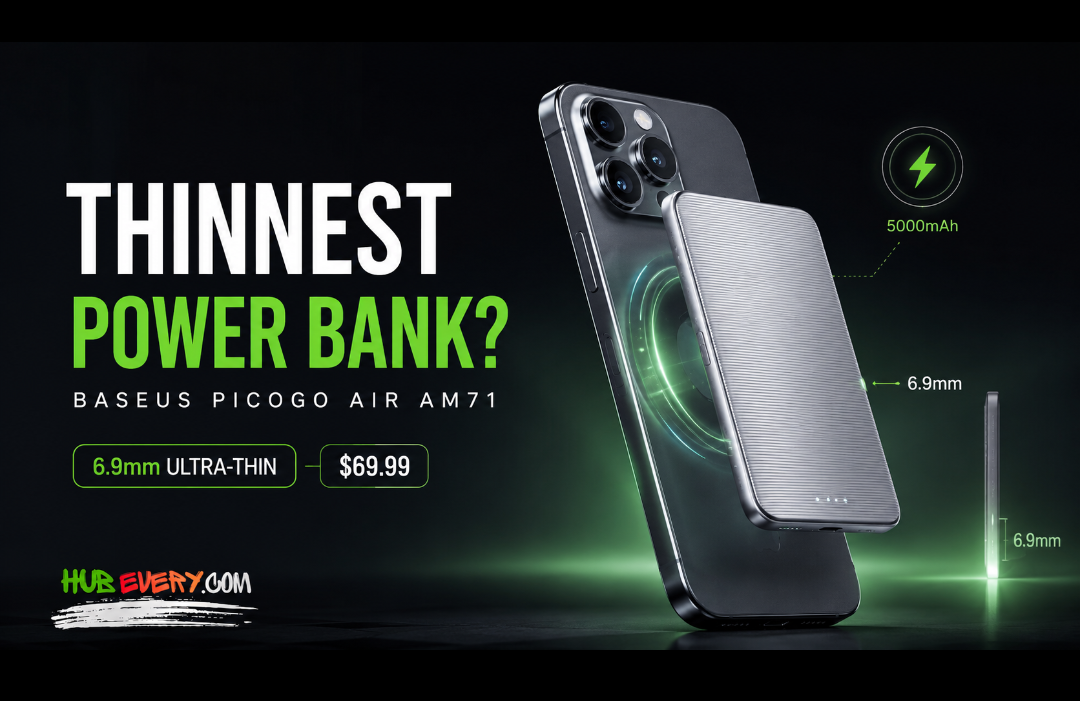
Imagine carrying a power bank that is almost as thin as your smartphone.
No bulky battery brick. No heavy charger pulling down your pocket. And no long cable wrapped around your phone while you are trying to answer a text.
That is exactly the idea behind the Baseus PicoGo Air AM71, a new ultra-thin magnetic power bank designed for people who want extra battery life without adding unnecessary bulk to their iPhone.
With a 5,000mAh battery, an ultra-slim 6.9mm body, magnetic wireless charging, up to 22.5W wired charging, and NFC-based battery monitoring, the PicoGo Air AM71 is one of the more interesting portable chargers to arrive in 2026.
But there is one big question:
Is an ultra-thin 5,000mAh power bank really worth around $70?
In this detailed Baseus PicoGo Air AM71 review, we will look at its design, charging performance, battery capacity, smart features, advantages, drawbacks, and whether American buyers should consider adding it to their everyday carry.
Baseus PicoGo Air AM71: Quick Overview
The Baseus PicoGo Air AM71 is a compact magnetic portable charger built around one simple idea: make a power bank as easy to carry as possible.
Instead of competing with massive 10,000mAh or 20,000mAh battery packs, Baseus has focused heavily on portability.
The power bank measures approximately 6.9mm thick and carries a 5,000mAh battery. Its thin profile makes it noticeably different from many traditional magnetic battery packs.
It attaches magnetically to a compatible iPhone and can provide wireless power while you continue using the phone.
For faster charging, the USB-C connection supports wired output of up to 22.5W.
Baseus PicoGo Air AM71 Specs
| Feature | Specification |
| Product | Baseus PicoGo Air AM71 |
| Battery Capacity | 5,000mAh |
| Thickness | Approximately 6.9mm |
| Weight | Around 3.7 oz |
| Charging Type | Magnetic wireless and USB-C wired |
| Maximum Wired Output | Up to 22.5W |
| Wireless Charging | Magnetic Qi charging |
| Power Bank Input | Up to 20W via USB-C |
| Smart Feature | NFC battery information |
| Battery Monitoring | Charge level, temperature and battery health |
| Material | Aluminum exterior |
| Colors | Black and Silver |
| US Price | Around $69.99 |
| Target Users | iPhone users and frequent travelers |
The specifications immediately reveal what Baseus is trying to achieve.
This is not a maximum-capacity power bank.
It is a portable battery designed for convenience.
The Biggest Feature: An Incredibly Thin Design
The most important reason to consider the PicoGo Air AM71 is its design.
At approximately 6.9mm thick, this is an exceptionally slim magnetic power bank.
Most traditional power banks feel like a second device in your pocket. Even compact magnetic chargers can significantly increase the thickness of a smartphone when attached.
The PicoGo Air takes a different approach.
Its thin body is designed to sit behind your phone without making the entire setup feel excessively bulky.
For commuters, business travelers, students, and anyone who carries their phone all day, that difference matters.
You can attach the battery pack to your phone and continue:
- Sending messages
- Browsing social media
- Reading emails
- Watching videos
- Using navigation
- Taking calls
The aluminum construction also gives the power bank a more premium appearance than cheap plastic battery packs.
Baseus has clearly treated design as one of the product’s main selling points.
And for many buyers, that may be enough to justify the higher price.
5,000mAh Battery: Enough for a Full Charge?
This is where buyers need to set realistic expectations.
The Baseus PicoGo Air AM71 has a 5,000mAh rated battery capacity.
However, a 5,000mAh power bank does not deliver the entire 5,000mAh directly to your smartphone.
Energy is lost during voltage conversion, heat generation, and wireless power transfer.
Real-world usable output has been estimated at roughly 2,750mAh to 3,250mAh, depending on charging conditions.
That means you should think of the PicoGo Air as a battery extender rather than a full replacement for a traditional high-capacity power bank.
Baseus claims the battery can provide a substantial partial recharge to compatible iPhones, but the exact percentage will depend on the phone model, battery condition, background activity, and whether you use wired or wireless charging.
For example, an independent test using a Samsung Galaxy S24 Ultra with a 5,000mAh battery found that the phone went from 15% to around 60% during normal use while charging wirelessly.
That is a useful real-world example of what this power bank is designed to do.
It gives your phone enough extra battery to survive the rest of the day.
If you need to recharge multiple devices or fully charge your phone several times, a 10,000mAh or 20,000mAh power bank will be a better choice.
Magnetic Wireless Charging Makes Daily Use Easier
One of the main advantages of the PicoGo Air AM71 is magnetic charging.
With a compatible iPhone or magnetic case, you can attach the battery pack directly to the back of the phone.
There is no need to connect a charging cable every time your battery gets low.
This makes the charger especially useful in situations where you are constantly using your phone.
Imagine walking through an airport while checking your boarding pass.
Or using Google Maps during a trip.
Or recording videos and taking photos throughout the day.
A traditional wired power bank usually means holding both the phone and the battery pack while managing a cable.
A magnetic charger creates a much cleaner setup.
However, there is an important limitation.
Independent testing suggests the PicoGo Air’s magnetic holding strength may feel slightly weaker than some other MagSafe-style accessories.
The power bank reportedly remained attached during testing, but the reduced magnetic strength was noticeable.
This is something buyers should consider if they frequently use their phone while running or performing intense physical activities.
Up to 22.5W Wired Charging Is the Faster Option
Wireless charging is convenient.
Wired charging is faster.
The PicoGo Air AM71 supports up to 22.5W wired output through USB-C.
In independent testing, peak output reached 22.5W, although charging power generally stabilized around 17W to 18W.
That is still useful for a compact 5,000mAh battery pack.
If your phone battery is critically low and you need power quickly, connecting a USB-C cable will generally be the better option.
The power bank itself can also recharge through USB-C.
A recent hands-on test found that fully recharging the PicoGo Air took approximately 90 minutes under the test conditions.
This gives users two charging options:
Magnetic wireless charging for convenience.
USB-C wired charging when speed matters.
That flexibility is one of the strongest aspects of the PicoGo Air AM71.
NFC Battery Monitoring Is Surprisingly Useful
The PicoGo Air AM71 has another feature that separates it from many basic power banks: NFC-based battery information.
Using NFC and the Baseus app, users can access information about the battery pack.
Available information can include:
- Remaining battery charge
- Battery temperature
- Battery cycle information
- Overall battery health
To use the feature, you need the Baseus app and a Baseus account.
The NFC system does not turn the power bank into a revolutionary smart device, but it provides useful information that most portable chargers simply do not show.
Traditional power banks often use four small LED lights.
One light might mean 25% battery.
Two lights might mean 50%.
The information is extremely basic.
The PicoGo Air’s NFC feature gives users a better look at the condition of the battery.
This could be particularly useful for people who plan to keep the power bank for several years.
Battery health information may help users understand when the internal battery has started to degrade.
Baseus Focuses Heavily on Heat Management
Ultra-thin electronics face a major problem: heat.
Wireless charging naturally produces heat, and a thin battery pack has less physical space to manage that heat.
Baseus has used several thermal management techniques in the PicoGo Air AM71.
The internal structure reportedly includes a graphene layer and aerogel-based thermal protection.
The exterior also features a grooved design intended to help with passive heat dissipation.
These features are particularly important because excessive heat can affect both charging performance and long-term battery health.
The NFC battery monitoring feature can also display battery temperature through the Baseus app.
Of course, some warmth during wireless charging is normal.
Buyers should not expect an ultra-thin magnetic charger to remain completely cold during operation.
But Baseus appears to have made thermal management a significant part of the product’s design.
Can You Charge the Power Bank and Your Phone at the Same Time?
The PicoGo Air AM71 supports pass-through charging behavior.
This means the power bank can wirelessly charge a smartphone while the battery pack itself is connected to power.
For example, you could connect the PicoGo Air to a USB-C charger and leave your compatible phone magnetically attached.
The battery pack can then provide wireless power to the phone.
However, independent testing indicates that the AM71 cannot simultaneously charge two separate external devices.
That limitation makes sense considering the compact 5,000mAh capacity and ultra-thin design.
Again, this is a personal smartphone accessory rather than a multi-device charging station.
Who Is the Baseus PicoGo Air AM71 Designed For?
The PicoGo Air is not the right power bank for everyone.
Its ideal buyer is someone who prioritizes size, weight, and convenience over maximum battery capacity.
The PicoGo Air May Be Perfect for You If:
You use an iPhone and regularly finish the day with a low battery.
You travel frequently and want a small charger for airports and flights.
You hate carrying bulky 10,000mAh or 20,000mAh power banks.
You frequently use navigation while traveling.
You want a magnetic battery pack that is easy to use while holding your phone.
You appreciate premium aluminum accessories.
You want more detailed battery information through NFC.
For these users, the PicoGo Air makes a lot of sense.
You Should Probably Skip It If:
You need multiple full smartphone charges.
You want to charge several devices.
You prioritize battery capacity over portability.
You need the fastest possible charging speeds.
You want the cheapest 5,000mAh power bank available.
You expect full Qi2.2 support.
A larger traditional power bank will offer significantly more energy for the money.
Baseus PicoGo Air AM71 Pros and Cons
Pros
Extremely thin design
The approximately 6.9mm profile is the biggest reason to buy this power bank.
Lightweight and pocket-friendly
At around 3.7 ounces, it is easy to carry during daily commutes and travel.
Magnetic charging
The snap-on charging experience is convenient for compatible iPhone users.
Up to 22.5W wired output
USB-C provides a faster charging option when wireless convenience is not necessary.
NFC battery information
Battery charge, temperature, cycle information, and health data add a useful smart element.
Premium construction
The aluminum exterior gives the charger a high-quality feel.
Multiple charging options
Users can choose between magnetic wireless charging and USB-C wired charging.
Cons
Only 5,000mAh capacity
This is primarily a partial top-up battery.
Around $70 is expensive
There are larger power banks available for less money.
Magnetic strength could be better
Independent testing found the attachment slightly weaker than some competing magnetic accessories.
Not designed for multiple devices
This is a personal smartphone battery pack.
Qi2.2 is not supported
Buyers looking specifically for the latest Qi2.2 charging standard should consider alternatives.
Is the $69.99 Price Justified?
This is probably the most difficult question.
At around $69.99 in the United States, the PicoGo Air AM71 is not cheap.
You can easily find power banks with 10,000mAh or even larger capacities for less money.
But comparing the PicoGo Air purely on battery capacity misses the point.
You are paying for:
- The ultra-thin engineering
- Lightweight design
- Magnetic charging convenience
- Aluminum construction
- NFC battery monitoring
- Thermal management
- Compact everyday portability
The real question is not:
“How many milliamp-hours do I get for $70?”
The better question is:
“How much am I willing to pay for a power bank that I will actually carry every day?”
A cheap 20,000mAh battery sitting at home is useless when your iPhone reaches 10% battery at an airport.
A slim 5,000mAh charger in your pocket may be far more valuable.
That is the argument behind the PicoGo Air.
Baseus PicoGo Air AM71 vs Traditional Power Banks
| Feature | PicoGo Air AM71 | Traditional Power Bank |
| Portability | Excellent | Average |
| Thickness | Extremely slim | Usually thicker |
| Capacity | 5,000mAh | 10,000–20,000mAh or more |
| Magnetic Charging | Yes | Often unavailable |
| Wired Charging | Up to 22.5W | Varies |
| Battery Monitoring | NFC-based information | Usually LED indicators |
| Multiple Full Charges | No | Often possible |
| Everyday Carry | Excellent | Depends on size |
| Best For | Daily battery top-ups | Long trips and multiple charges |
The comparison makes the PicoGo Air’s purpose very clear.
This is an everyday carry power bank.
It is not a weekend camping battery.
Should You Buy the Baseus PicoGo Air AM71?
The Baseus PicoGo Air AM71 is one of the more interesting magnetic power banks of 2026, mainly because Baseus has focused on solving a problem many portable chargers ignore: bulk.
Its approximately 6.9mm body is impressively thin, and the combination of magnetic charging and USB-C wired output makes it flexible enough for everyday use.
The NFC battery information is also a clever addition.
However, the 5,000mAh capacity means buyers need realistic expectations.
This power bank is designed to extend your phone’s battery life, not recharge multiple devices for several days.
At around $70, it is also positioned as a premium accessory.
Our Verdict
Buy the Baseus PicoGo Air AM71 if you want an ultra-thin magnetic battery pack that is easy to carry every day.
Skip it if maximum battery capacity and value per dollar are your biggest priorities.
For travelers, commuters, and iPhone users who hate bulky power banks, the PicoGo Air AM71 could be one of the most practical charging accessories of 2026.
Frequently Asked Questions
Is the Baseus PicoGo Air AM71 MagSafe compatible?
The PicoGo Air uses magnetic wireless charging and is designed to attach to compatible iPhones and magnetic cases. Buyers should check their specific phone and case compatibility before purchasing.
How much battery capacity does the PicoGo Air AM71 have?
The power bank has a rated capacity of 5,000mAh. Real usable output is lower because of normal energy conversion losses.
Can the PicoGo Air fully charge an iPhone?
It depends on the iPhone model and charging conditions. The PicoGo Air is better viewed as a battery extender designed to provide a substantial partial recharge rather than multiple full charges.
Does the Baseus PicoGo Air support fast charging?
Yes. The USB-C connection supports wired output of up to 22.5W. Actual charging performance may vary depending on the connected smartphone and charging protocol.
What does the NFC feature do?
The NFC feature works with the Baseus app to provide battery information such as remaining charge, temperature, cycle data, and battery health.
How much does the Baseus PicoGo Air AM71 cost in the US?
The power bank has been listed at approximately $69.99 for the US market. Pricing and promotions may change over time.
Is the Baseus PicoGo Air AM71 worth buying?
It is worth considering if you prioritize an ultra-thin design, magnetic charging, and portability. Buyers who need maximum capacity for the lowest price should consider a larger traditional power bank instead.
Disclosure: Product specifications, pricing, and availability may change. Always check the latest product listing and manufacturer information before making a purchase decision.