
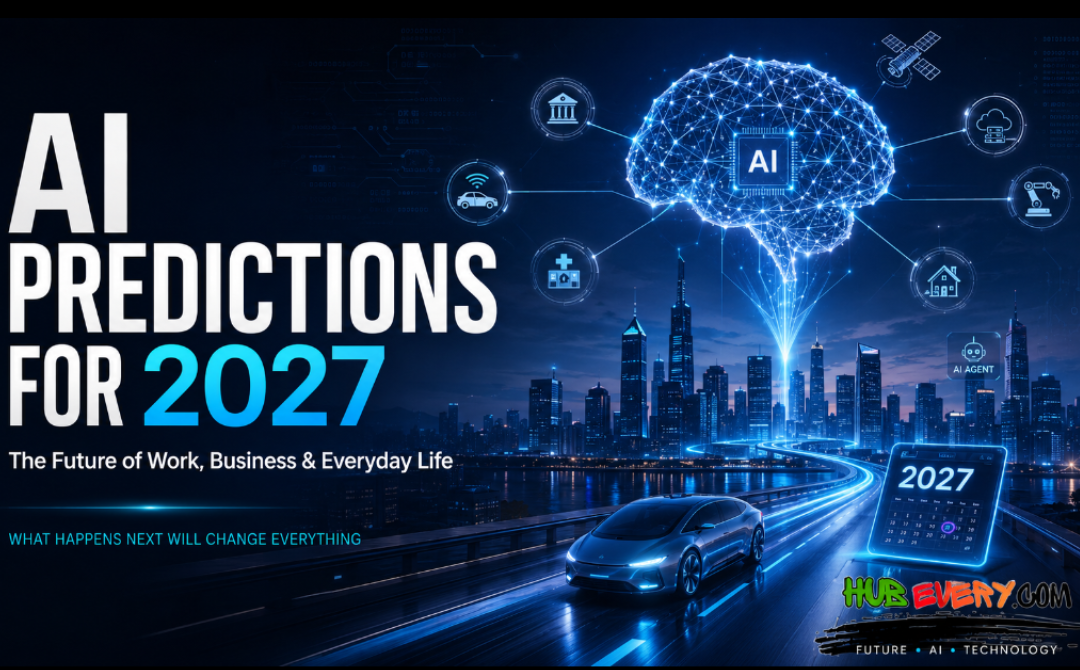
Artificial intelligence is evolving at a remarkable pace, and by 2027, its influence is expected to reach nearly every aspect of modern life in the United States. From the way businesses operate to how people learn, work, shop, and receive healthcare, AI is likely to become even more deeply integrated into daily routines. While no one can predict the future with complete certainty, current technological advancements, government initiatives, and industry investments provide strong indicators of where AI is heading.
As AI continues to mature, experts expect the technology to become more reliable, personalized, and accessible than ever before. Furthermore, businesses are investing billions of dollars in AI infrastructure, while governments are working to establish policies that encourage innovation without compromising public safety. Consequently, 2027 could represent a turning point where AI shifts from being a competitive advantage to becoming a standard part of everyday operations.
AI Agents Could Become Digital Coworkers
One of the most significant predictions for 2027 is the widespread adoption of AI agents capable of completing complex tasks with minimal human supervision. Unlike today’s chatbots that primarily answer questions, future AI agents are expected to manage schedules, conduct research, analyze business data, create presentations, write software, negotiate appointments, and coordinate multiple digital tools independently.
Businesses across the United States are likely to embrace these intelligent assistants because they can reduce repetitive work while improving productivity. Moreover, employees may increasingly rely on AI agents as digital coworkers rather than simple software applications. This transformation could allow professionals to spend more time on strategic thinking, creativity, and relationship building instead of administrative tasks.
Businesses May Operate with AI at Their Core
If you’re excited about what AI could achieve by 2027, it’s equally important to understand the common mistakes people make when using AI today. Read our guide on Biggest AI Mistakes Beginners Make to learn practical tips that will help you use AI more effectively and avoid costly errors as the technology continues to evolve: https://hubevery.com/biggest-ai-mistakes-beginners-make/
By 2027, AI is projected to become the foundation of many business operations rather than just an optional technology. Organizations are expected to integrate AI into customer service, marketing, finance, logistics, cybersecurity, and product development.
Additionally, predictive analytics could help companies forecast consumer demand more accurately, reducing waste and improving operational efficiency. Marketing campaigns may become significantly more personalized as AI analyzes customer preferences in real time. Consequently, businesses that successfully combine human expertise with AI-powered insights could gain a meaningful competitive advantage in increasingly dynamic markets.
Small businesses are also expected to benefit from affordable AI platforms. Instead of hiring large teams, entrepreneurs may use AI to automate bookkeeping, customer support, inventory management, and content creation, making advanced technology accessible even to startups with limited budgets.
The Workplace Will Continue to Evolve
Artificial intelligence is unlikely to replace every job, but it is expected to reshape countless roles across multiple industries. Rather than eliminating human workers entirely, AI will probably automate repetitive and data-intensive tasks while creating demand for new skills.
As a result, employees may need to develop stronger analytical thinking, communication, creativity, and AI collaboration skills. Companies are also expected to invest heavily in workforce training to help employees adapt to AI-powered environments.
Meanwhile, entirely new careers could emerge around AI governance, prompt engineering, AI security, model evaluation, AI auditing, and responsible AI implementation. Therefore, professionals who continuously upgrade their skills may find themselves better positioned for future career opportunities.
Healthcare Could Experience a Major AI Breakthrough
Healthcare is expected to remain one of the most transformative sectors for artificial intelligence. By 2027, AI could assist doctors in diagnosing diseases faster, identifying health risks earlier, and recommending more personalized treatment plans.
Advanced medical imaging systems may detect abnormalities with greater speed and accuracy, while AI-powered virtual assistants could improve patient communication and appointment management. Furthermore, hospitals may use predictive algorithms to optimize staffing, reduce wait times, and improve resource allocation.
However, human medical professionals will almost certainly remain essential. AI is expected to function as a decision-support system rather than a replacement for physicians, ensuring that critical healthcare decisions continue to involve expert human judgment.
Education May Become More Personalized Than Ever
Education is also likely to undergo substantial transformation. Instead of offering identical lessons to every student, AI-powered learning platforms may adapt educational content based on individual learning styles, strengths, and weaknesses.
Students could receive instant feedback, customized study plans, and interactive tutoring experiences available around the clock. Likewise, teachers may benefit from AI tools that automate grading, generate lesson materials, and identify students who require additional support.
Although AI will provide valuable assistance, educators are expected to remain central to developing critical thinking, emotional intelligence, collaboration, and ethical decision-making among students.
Cybersecurity Will Become an AI Battleground
As artificial intelligence becomes more powerful, cyber threats are also expected to grow increasingly sophisticated. Cybercriminals may leverage AI to automate attacks, generate convincing phishing campaigns, and exploit vulnerabilities more efficiently.
In response, cybersecurity companies are projected to rely heavily on AI-driven defense systems capable of detecting unusual behavior, identifying emerging threats, and responding to attacks in real time. Consequently, AI will likely play both offensive and defensive roles within the cybersecurity landscape.
Organizations that invest in advanced AI security systems may significantly improve their resilience against evolving digital threats.
AI Regulation Will Continue to Expand
The rapid growth of artificial intelligence is expected to encourage governments to introduce more comprehensive regulations. In the United States, policymakers may focus on transparency, consumer protection, privacy, copyright, and accountability for AI-generated content.
Businesses developing AI products will probably need to demonstrate responsible data practices and explain how their systems make important decisions. Furthermore, ethical AI development is likely to become an important competitive advantage rather than merely a regulatory requirement.
Companies that prioritize transparency and fairness may earn greater public trust, ultimately strengthening long-term customer relationships.
Consumer Technology Could Feel More Human
By 2027, AI-powered devices are expected to become considerably more conversational and context-aware. Smartphones, wearable devices, smart homes, and personal assistants may anticipate user needs with greater accuracy while delivering highly personalized experiences.
Voice assistants could understand natural conversations more effectively, remember long-term preferences, and seamlessly coordinate tasks across multiple applications. Additionally, AI-generated content, personalized shopping recommendations, and intelligent financial planning tools may become standard features for millions of consumers.
As these technologies improve, users may spend less time navigating software and more time interacting naturally with intelligent systems.
Responsible AI Will Shape Public Trust
Despite impressive technological progress, responsible AI development is expected to remain one of the defining priorities of 2027. Businesses, researchers, and policymakers will likely face increasing pressure to reduce algorithmic bias, protect personal privacy, and improve transparency.
Consumers are becoming more aware of how their personal information is collected and used. Therefore, organizations that prioritize ethical AI practices may enjoy stronger customer loyalty and greater market credibility. In contrast, companies that ignore responsible AI principles could face regulatory scrutiny and reputational challenges.
Building trustworthy AI will likely become just as important as building powerful AI.
Final Thoughts
Artificial intelligence is poised to reshape industries, redefine careers, and transform everyday experiences throughout the United States by 2027. While these developments remain predictions rather than guarantees, current investment trends, technological breakthroughs, and business adoption patterns strongly suggest that AI will continue expanding into nearly every sector of the economy.
Nevertheless, the future of AI will not depend solely on technological innovation. It will also depend on how responsibly businesses, governments, educators, and individuals choose to adopt and govern these powerful tools. Those who embrace continuous learning, remain adaptable, and prioritize ethical AI practices are likely to thrive in this rapidly evolving landscape.
As 2027 approaches, one reality appears increasingly clear: artificial intelligence is no longer a distant possibility. Instead, it is steadily becoming one of the most influential forces shaping the future of work, business, and everyday life. Organizations and individuals who prepare today will likely be in the strongest position to benefit from the extraordinary opportunities that tomorrow’s AI-driven world may offer.
Frequently Asked Questions (FAQs)
1. What are the biggest AI predictions for 2027?
The biggest AI predictions for 2027 include the rise of autonomous AI agents, broader adoption of AI across businesses, personalized healthcare and education, stronger cybersecurity powered by AI, and increased government regulation focused on transparency and responsible AI use.
2. Will AI replace jobs by 2027?
AI is expected to automate many repetitive and routine tasks, but it is unlikely to replace all jobs. Instead, many roles will evolve, creating demand for professionals with AI-related skills, critical thinking, creativity, and problem-solving abilities.
3. Which industries will benefit the most from AI in 2027?
Industries such as healthcare, finance, manufacturing, retail, education, logistics, cybersecurity, and customer service are expected to benefit the most from AI by improving efficiency, reducing costs, and delivering more personalized experiences.
4. How will AI impact everyday life by 2027?
AI is expected to make daily life more convenient through smarter virtual assistants, personalized shopping recommendations, intelligent healthcare services, advanced smart home devices, and AI-powered productivity tools that simplify everyday tasks.
5. Is AI expected to become more regulated by 2027?
Yes. Governments, including the United States, are expected to introduce more comprehensive AI regulations focused on privacy, transparency, copyright, accountability, and the ethical use of artificial intelligence while supporting continued innovation.
| AI Tool | Official Website | Best For |
|---|---|---|
| ChatGPT | https://chatgpt.com | Content writing, coding, research, brainstorming, and productivity |
| Google Gemini | https://gemini.google.com | AI search, writing assistance, and multimodal tasks |
| Claude AI | https://claude.ai | Long-form writing, document analysis, and programming |
| Microsoft Copilot | https://copilot.microsoft.com | Microsoft 365 productivity, coding, and business workflows |
| Perplexity AI | https://www.perplexity.ai | AI-powered search with real-time information and cited sources |