
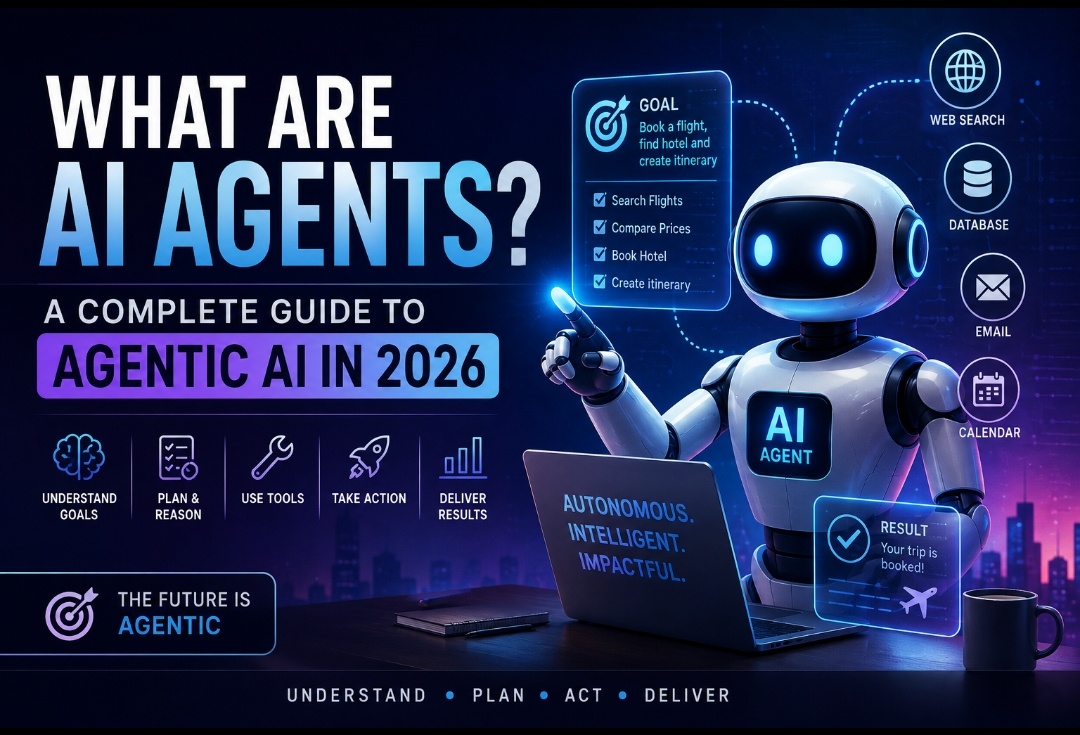
Artificial intelligence is entering a new phase. For years, most people experienced AI through chatbots and content-generation tools that could answer questions, write text, create images, summarize documents, or generate code. In 2026, however, the conversation is increasingly shifting from what AI can generate to what AI can actually do. This change is being driven by AI agents, a new generation of AI systems designed to understand goals, plan multiple steps, use external tools, interact with software, and take actions with varying degrees of autonomy.
If you’re planning to build a career in artificial intelligence, understanding AI agents is only the beginning. Check out our AI Career Roadmap 2026 to learn which AI skills to develop, what tools to learn, and how to prepare for AI jobs.
The idea sounds simple, but its implications are much bigger than another improvement in chatbots. An AI agent can potentially take a task that would normally require a person to move between websites, applications, databases, documents, and other tools and coordinate much of that process itself. Instead of giving an AI one instruction at a time, a user can increasingly give it a goal and allow the system to determine how that goal should be accomplished.
This is why AI agents and agentic AI have become some of the most important concepts in the technology industry. Major technology companies and AI developers are investing heavily in agent frameworks, tool use, computer interaction, security, and systems that allow AI models to perform longer and more complex tasks. Google Cloud describes AI agents as systems that can reason, plan, use memory and take actions, while OpenAI describes agents as systems that can independently accomplish tasks on a user’s behalf using models, tools and instructions.
But what exactly is an AI agent, how does it work, and why does it matter?
What Is an AI Agent?
An AI agent is a software system that uses artificial intelligence to pursue a specific goal by deciding what actions are necessary and then carrying out those actions through available tools or systems. Unlike a conventional chatbot that generally responds to a prompt, an agent is designed to manage a process.
Imagine that you ask an AI system to research the best project-management software for a small company. A conventional chatbot might explain which features you should compare and perhaps provide a list of products based on information already available to it. An AI agent could approach the same request as a task. It could identify the requirements, search for relevant information, compare available options, analyze pricing and features, organize the findings, and prepare a recommendation.
The important distinction is not simply that the agent produces a better answer. The important distinction is that the system can potentially take responsibility for multiple steps between the initial instruction and the final result.
Google Cloud describes this broader capability through the concepts of reasoning, planning, memory, tool use and autonomous action. In practical terms, an agent can receive a goal, determine an appropriate sequence of actions, use tools to obtain information or perform operations, observe what happens, and decide what should happen next.
This does not mean every AI agent is completely autonomous. In fact, the level of autonomy can vary considerably. Some agents may require approval before performing important actions, while others may be allowed to complete a workflow independently within a restricted environment.
Why Are AI Agents Different From Chatbots?
The easiest way to understand AI agents is to compare them with traditional chatbots.
A chatbot is primarily designed for conversation. You ask a question, and it generates a response. Modern chatbots can be extremely capable and may have access to tools, browsing, files, or other capabilities, but the concept of a chatbot is still centered around interaction through conversation.
An agent is centered more around task completion.
Suppose you tell a chatbot, “How can I organize a business trip to London?” It can give you suggestions about flights, hotels, transportation and restaurants. An agentic system could potentially take the request as a broader objective and work through the process of finding suitable options, comparing them and preparing an itinerary, assuming it has the required tools and permissions.
This distinction becomes even more important when tasks involve several applications. An agent may need to retrieve information from one system, process it using another tool, update a database and communicate the result through a third system. Traditional software automation can perform similar tasks, but usually through predefined rules. An AI agent can introduce a greater degree of flexibility because the AI model can help determine what action should be taken next.
Anthropic makes a useful distinction between workflows and agents. A workflow generally follows predefined steps, while an agent dynamically determines its process and tool use. The company also emphasizes that developers should not automatically choose an agentic architecture simply because it is possible; the simplest system that reliably solves the problem may often be the better choice.
How Do AI Agents Work?
Although AI agent architectures can vary significantly, the basic concept can be understood as a continuous decision-making loop.
First, the agent receives a goal or instruction. The system then interprets that goal and determines what needs to happen. Depending on the task, it may break the objective into smaller steps. It then selects an appropriate tool, performs an action, observes the result and uses that information to decide what to do next.
This can create a cycle that looks conceptually like goal, plan, action, observation, evaluation and next action.
The AI model is usually at the center of this process. Large language models can interpret natural-language instructions, reason about possible approaches, decide which tools may be useful and generate structured actions. But the model alone is not the entire agent. The surrounding software architecture provides tools, permissions, memory, data access, monitoring and safeguards.
OpenAI’s practical guidance for building agents identifies the model, tools and instructions as fundamental components. The model provides the reasoning capability, tools allow the system to interact with external services, and instructions define how the agent should behave.
For example, a customer-service agent might receive a request about a delayed order. Instead of simply writing a generic response, the system could retrieve the customer’s order information, check shipping data, determine whether the shipment is actually delayed, and then provide an appropriate response. If the problem requires a human decision, the agent could escalate the case instead of continuing autonomously.
That combination of reasoning and action is what makes agentic systems particularly interesting.
The Role of Tools in AI Agents
Tools are one of the most important parts of an AI agent.
An AI model can generate information, but tools allow an agent to interact with the world outside the model. Depending on how the system is built, these tools could include web search, databases, APIs, code execution environments, file systems, calendars, email services, customer relationship management systems or business applications.
Consider a coding agent. A language model can generate a piece of code, but a coding agent can potentially inspect an existing codebase, modify files, run tests, examine error messages and make additional changes. The ability to interact with the development environment turns the model from a text generator into part of a more complete software-development workflow.
The same principle applies to business agents. An AI system connected to a company’s CRM, internal database and communication tools can potentially do much more than answer questions about the business. It may be able to retrieve information, update records, create reports or initiate approved workflows.
However, tool access also introduces risk. Giving an AI system access to sensitive data or powerful external systems means that mistakes, malicious inputs or poorly designed permissions can have real consequences. For this reason, tool access needs to be treated as a security and governance issue rather than simply a technical feature.
What Is Agentic AI?
The phrase agentic AI is broader than the idea of a single AI agent.
Agentic AI generally refers to AI systems designed to operate with a degree of autonomy, making decisions, planning actions and working toward goals rather than simply generating a response to each individual prompt.
The difference can be understood through a simple example.
Generative AI might be asked to write a report about a company. It generates the report.
An AI agent might be asked to research the company, collect information from approved sources, analyze the findings and prepare the report.
A larger agentic system could potentially coordinate several specialized capabilities, such as research, data analysis, writing and quality checking.
The boundaries are not always strict, and different technology companies use the terminology somewhat differently. What matters is the underlying capability: the AI is being used as an active participant in completing a task rather than simply as a system that generates content.
AI Agents and Generative AI Are Not the Same Thing
Generative AI and agentic AI are closely related, but they solve different problems.
Generative AI is primarily concerned with creating something. That could be text, images, audio, video or software code. The system receives information or instructions and produces an output.
Agentic AI is concerned with accomplishing something.
An agent may use generative AI to write text or code, but it can also use search tools, databases, APIs and other systems to complete a broader workflow.
A useful way to think about the relationship is that generative AI provides part of the intelligence, while agentic architecture provides a framework for planning and action.
This distinction is becoming increasingly important as AI systems move into real-world applications.
What Can AI Agents Actually Do?
The potential applications of AI agents are extremely broad because an agent’s capabilities depend heavily on the tools and permissions it receives.
In business environments, agents can potentially assist with research, customer support, reporting, data analysis, sales operations and administrative workflows. Instead of employees manually gathering information from several systems, an agent could potentially collect and organize that information and present the result in a usable format.
Software development is another major area of interest. Coding agents can work with development environments to inspect code, generate changes, run tests and help investigate bugs. The growing use of coding agents is one example of how AI is moving from content generation toward longer-running work. OpenAI has described increasing use of coding agents for longer and more complex tasks across both technical and non-technical settings.
Research is another natural use case. A research-oriented agent can potentially search multiple sources, retrieve relevant information, compare findings and produce a structured summary. This does not eliminate the need for human judgment, especially when accuracy and source quality matter, but it can reduce the amount of repetitive information-gathering work.
Customer service could also change significantly. An agent connected to order systems, knowledge bases and support tools could potentially handle more complicated customer requests instead of simply responding to frequently asked questions.
The important point is that AI agents are not limited to one industry. Their usefulness comes from their ability to connect AI reasoning with existing digital systems.
AI Agents in the Workplace
The impact of AI agents on work may be more complicated than simply replacing people.
Most jobs consist of many different tasks. A software developer may spend part of the day writing code, part debugging, part reviewing pull requests and part communicating with colleagues. A marketing professional may conduct research, write content, analyze campaigns and attend meetings.
An AI agent may automate some of those tasks without replacing the entire job.
This suggests that one of the most realistic near-term possibilities is not humans versus AI, but humans working with AI agents.
A person might define the objective, provide context and review important decisions while an agent handles repetitive or time-consuming parts of the workflow.
This could change what people spend their working hours doing. Instead of manually performing every step of a process, employees may increasingly focus on defining goals, evaluating results, making important decisions and handling situations that require human judgment.
AI Agents and the Future of Search
Agentic AI may also change the way people use the internet.
Traditional search usually requires the user to perform several steps. A person enters a query, opens websites, reads information, compares options and then completes the desired action.
An agentic system could potentially compress several of those steps. Instead of searching for information manually, a user could describe the outcome they want and allow an agent to research, compare and interact with approved services.
This creates an important shift in the relationship between people, search engines, websites and software.
The future of search may increasingly involve AI systems that do not simply return information but help users complete tasks using information from the web.
Google has been actively developing more agentic capabilities for Search. Its 2026 announcements have described efforts to make Search capable of helping users with more complex tasks and interactions.
This could eventually affect not only search engines but also how websites themselves are designed. Businesses may increasingly need to make their services understandable and accessible to AI agents as well as human visitors.
The Rise of Multi-Agent Systems
Not every complex task needs to be handled by one giant AI agent.
An alternative approach is to create a system in which multiple specialized agents work together. One agent might conduct research, another might analyze the information, another might generate a report and another might review the result.
This is known as a multi-agent system.
The concept resembles a digital team in which each agent has a specific responsibility.
However, multi-agent architectures are not automatically better. Every additional agent introduces communication, coordination, monitoring and security challenges. For some tasks, a simpler single-agent or deterministic workflow may be more reliable.
The right architecture therefore depends on the problem being solved, the available tools and the level of autonomy that is actually required.
What Are the Benefits of AI Agents?
The biggest potential benefit of AI agents is their ability to automate processes rather than isolated actions.
Traditional automation works particularly well when the steps are predictable. But many real-world tasks involve ambiguity. A customer may describe a problem differently each time. A research project may lead to unexpected information. A software bug may require several attempts to diagnose.
AI agents can potentially handle some of this variability because the AI model can interpret information and determine the next step.
Another benefit is productivity. Instead of spending hours collecting information, moving data between systems or performing repetitive digital tasks, employees may be able to delegate parts of the process to an agent.
Agents can also operate continuously and at scale, making them potentially useful for workloads that involve large volumes of repetitive or time-sensitive activity.
But these benefits only matter if the system is reliable. An agent that performs tasks quickly but makes frequent mistakes can create more work rather than less.
What Are the Risks of AI Agents?
Greater autonomy comes with greater risk.
One major concern is that an AI agent can make an incorrect decision and then continue acting based on that mistake. In a simple chatbot conversation, a wrong answer may be inconvenient. In an agentic workflow, the same error could potentially trigger additional actions.
Security is another major concern. AI agents may be exposed to prompt injection, malicious instructions, compromised tools or untrusted data. If an agent has access to email, files, databases or other systems, an attack could have consequences beyond the AI conversation itself.
Privacy is equally important. Organizations need to understand exactly what information an agent can access, where that information goes and how long it is retained.
There is also the question of excessive autonomy. Not every action should be performed without human approval. Sending a draft email and transferring money are fundamentally different activities, even if both can technically be represented as software actions.
For this reason, responsible agentic systems need appropriate permissions, monitoring, testing, logging and human oversight. Anthropic’s research on trustworthy agents highlights security, transparency, privacy and human control as important considerations as AI systems become more autonomous.
What Is Prompt Injection and Why Does It Matter?
Prompt injection is one of the security problems that becomes especially important when AI systems can interact with external information and tools.
A prompt injection attack attempts to manipulate an AI system by placing instructions inside information that the system is processing. For example, an agent might retrieve a webpage containing malicious instructions designed to influence what the agent does next.
This creates a fundamental challenge because an agent must often process untrusted information while also following trusted instructions from its developer or user.
As agents become more capable of taking actions, protecting them from malicious inputs becomes increasingly important.
Security therefore cannot be treated as something added at the end of development. It needs to be considered when designing the agent’s tools, permissions, data access and decision-making process.
Are AI Agents Safe to Use?
AI agents can be useful and can be designed with strong safety controls, but they should not automatically be assumed to be safe.
The level of risk depends on what the agent can access and what it is allowed to do.
An agent that summarizes documents in an isolated environment has a very different risk profile from an agent that can send emails, modify production software or access sensitive customer information.
A sensible approach is to give agents only the permissions they actually need. High-impact actions can require human approval, while lower-risk tasks can be automated more freely.
Testing is also critical. Developers need to evaluate not only whether an agent succeeds under normal conditions but also how it behaves when information is incomplete, tools fail, users give ambiguous instructions or malicious content is encountered.
The goal should not be maximum autonomy.
The goal should be reliable autonomy within clearly defined boundaries.
Will AI Agents Replace Human Jobs?
The question of whether AI agents will replace jobs is difficult to answer because a job is rarely a single task.
AI agents are more likely to automate specific activities first. Some roles may change significantly as more tasks become automated, while other roles may grow because organizations discover new ways to use AI.
For workers, the important skill may increasingly become the ability to work effectively with AI systems.
That could include knowing how to define goals, verify AI outputs, manage automated workflows, evaluate risks and make decisions when AI systems are uncertain.
In other words, the future workplace may not simply be about knowing how to use AI. It may be about knowing how to delegate work to AI while remaining responsible for the outcome.
How Are AI Agents Changing Software Development?
Software development is one of the clearest examples of the transition toward agentic AI.
A conventional coding assistant may suggest a function or complete a piece of code while a developer remains in control of every step. A coding agent can operate at a higher level by working with a repository, examining files, making changes, running tests and responding to errors.
This creates a new workflow.
Instead of asking AI to write one function, a developer may ask an agent to investigate a bug, implement a fix and verify the result.
The developer can then review the changes rather than manually performing every step.
This does not eliminate the need for software engineers. Instead, it can shift some of their work toward architecture, review, testing, system design and higher-level decision-making.
At the same time, coding agents create new security considerations because they can potentially modify real software environments. This makes permission management, sandboxing and code review particularly important.
How Can Businesses Start Using AI Agents?
Businesses should generally avoid starting with the most complicated possible agent.
A better approach is to identify a repetitive process that consumes meaningful amounts of time and has measurable outcomes.
For example, a company might start with an internal research workflow. The agent could gather information from approved sources, organize it and prepare a draft report for an employee to review.
Once the system becomes reliable, the organization can gradually expand its capabilities.
This approach makes it easier to measure whether the technology is actually providing value.
Businesses should also define clear boundaries before deployment. Questions about data access, permissions, human approval, monitoring and failure handling should be answered before an agent is allowed to perform meaningful actions.
What Does the Future of AI Agents Look Like?
The development of AI agents is still in an early stage, but the direction is becoming increasingly clear.
AI systems are moving from isolated conversations toward more connected workflows. Models are becoming better at reasoning, tools are becoming easier to integrate, and new infrastructure is being developed to help agents interact with software and discover capabilities.
Google announced its Agentic Resource Discovery specification in 2026 as a way to help agents discover and verify tools, skills and other agents across the web. Developments like this suggest that the future agent ecosystem may depend heavily on interoperability and standards.
In the future, people may not interact with every software application directly. Instead, an AI agent could become an interface between the user and many of those services.
Rather than opening multiple applications and manually completing each step, users could increasingly describe the result they want.
The agent would then coordinate the required tools.
That does not mean humans disappear from the process. In many important situations, humans may remain responsible for defining objectives, approving sensitive actions and evaluating final results.
The most useful AI agents are therefore unlikely to be the systems that operate with unlimited freedom. They are more likely to be systems that combine autonomy with reliability, transparency and appropriate human control.
Final Thoughts
AI agents represent an important evolution in the way artificial intelligence is used.
The first major wave of generative AI taught computers to produce remarkably sophisticated text, images, audio, video and code. The next wave is increasingly focused on giving AI systems the ability to plan, use tools and perform tasks.
That shift could affect almost every part of the digital economy.
Software development, customer service, research, business operations, cybersecurity and search are all potential areas where agentic systems could change existing workflows.
But the technology should not be judged simply by how autonomous it is. The real measure of an AI agent is whether it can reliably solve a useful problem while operating within appropriate boundaries.
The future may therefore not belong to AI systems that simply answer questions faster.
It may belong to systems that can understand a goal, determine what needs to happen, use the right tools, learn from the results and know when a human should take over.
In other words, the evolution of AI is moving from “What can AI generate?” toward a much bigger question:
“What work can AI reliably accomplish?”
That question will likely define the next chapter of artificial intelligence.
Frequently Asked Questions About AI Agents
1. What is an AI agent?
An AI agent is an AI-powered system that can understand a goal, plan tasks, use tools and take actions to complete a task with limited human intervention.
2. What is agentic AI?
Agentic AI refers to AI systems that can reason, plan and take actions to achieve a specific goal instead of simply generating a response.
3. What is the difference between AI agents and chatbots?
Chatbots mainly answer questions, while AI agents can plan and execute multi-step tasks using tools and external systems.
4. How do AI agents work?
AI agents understand a goal, create a plan, use available tools, evaluate the results and decide what to do next.
5. Will AI agents replace human jobs?
AI agents can automate many tasks, but they are unlikely to replace every job. In many industries, humans and AI agents will increasingly work together.