
Google Search used to operate on a relatively simple promise: type a question, scan a page of blue links, and choose a website to visit.
That model is changing.
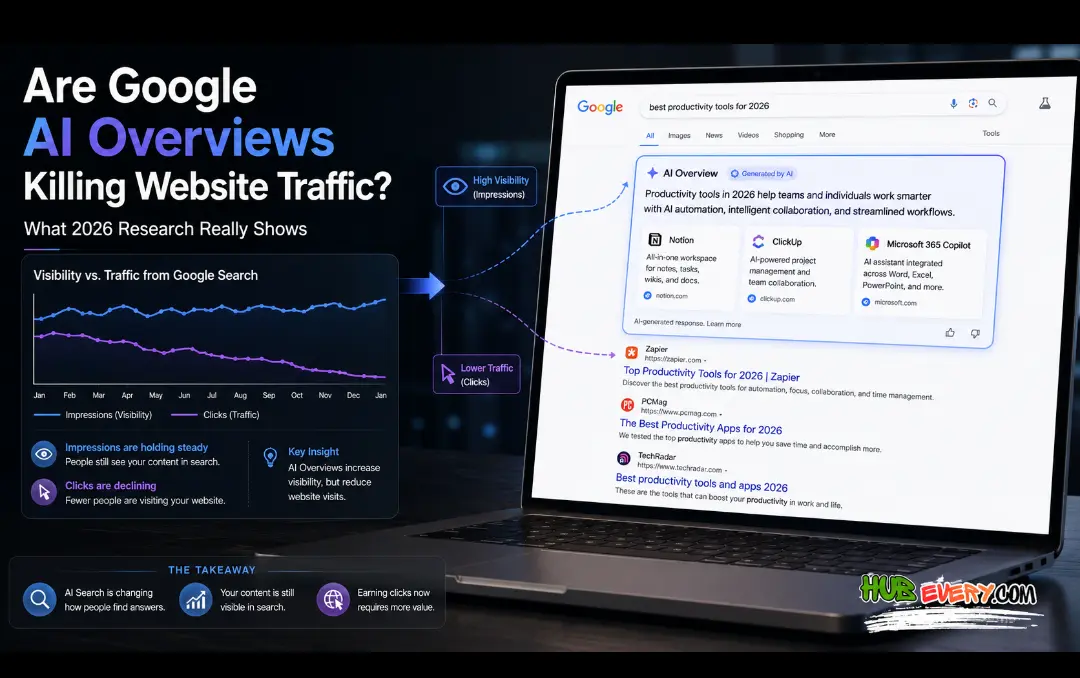
Google’s AI Overviews now place an AI-generated answer above traditional organic results for many searches. Instead of immediately sending users to several websites, Google can summarize information from multiple sources directly on the results page. The company has also expanded AI Mode, making Search increasingly conversational and capable of handling longer, more complex questions. By May 2026, Google said AI Mode had surpassed one billion monthly active users globally.
For publishers, bloggers and SEO-driven businesses, that creates an uncomfortable question: if Google answers the question before the user reaches a website, where does the click go?
Recent research provides a more complicated answer than either side of the debate suggests. Pew Research found substantially lower click rates when an AI summary appeared. A 2026 randomized field experiment found that AI Overviews reduced outbound organic clicks by 39.8%. Another 2026 academic study found roughly a 15% decline in English Wikipedia traffic after exposure to AI Overviews.
At the same time, Google says overall organic click volume to websites has remained relatively stable and that the clicks it sends are becoming higher quality.
So, are AI Overviews killing website traffic?
The evidence suggests something more precise: AI Overviews are taking clicks away from some traditional search results, especially when the AI answer can satisfy an informational query without requiring a website visit. But the effect is not uniform, and the bigger change may be that Google is redefining what “search visibility” means.
What Are Google AI Overviews?
Google AI Overviews are AI-generated summaries displayed within Google Search when Google’s systems determine that an AI response can add value beyond the traditional results page.
Instead of simply showing:
- Website A
- Website B
- Website C
Google can generate a synthesized answer and place supporting web links around it.
Google describes AI Overviews as a way to help people understand complicated questions quickly and then explore supporting websites. Its current documentation says the same foundational SEO practices still apply: pages need to be crawlable, indexable, useful and eligible for normal Google Search. There is no special “AI Overview schema” or secret markup required.
Google also uses a technique known as query fan-out in AI Search. Rather than treating a question as one simple keyword, the system can explore related searches and information sources before constructing a response.
A simple example
Imagine someone searches:
“What is the best way to start a blog in 2026?”
A traditional Google results page might send the person to five or ten articles.
An AI Overview can instead summarize the major considerations — niche selection, original content, SEO, distribution and monetization — while citing several websites.
If the searcher only wanted a quick overview, there may be no reason to click.
But if they want a detailed comparison, a template, first-hand experience, original research or a specific product recommendation, the cited websites can still become valuable destinations.
That distinction is at the heart of the traffic debate.
Why Might AI Overviews Reduce Website Clicks?
There are several straightforward reasons.
1. The answer is already visible
The most obvious explanation is substitution.
If somebody searches “How many calories are in an apple?” and Google provides a satisfactory answer immediately, opening a website adds little value.
The same principle existed before generative AI through features such as knowledge panels, calculators, weather results, featured snippets and sports scores. AI Overviews simply extend that answer-first model to much more complicated questions.
2. Users can consume information faster
AI summaries compress information.
A user might previously have opened three articles, skimmed them and compared their answers. An AI Overview can perform part of that synthesis on the search results page.
That reduces the number of individual browsing steps.
3. Mobile behavior favors quick answers
On a phone, every additional tap is friction.
An answer that appears immediately at the top of the screen can be especially effective for users who want a quick explanation rather than a deep reading experience.
4. Search journeys are becoming more conversational
Google increasingly allows people to move from an AI Overview into follow-up questions and AI Mode rather than returning to a conventional list of links.
Google says AI Mode queries have more than doubled every quarter since launch and that its AI experiences are contributing to record Search query levels.
That means people may search more while clicking fewer traditional links.
5. Zero-click behavior becomes more important
A zero-click search occurs when someone gets what they need without visiting an external website.
The critical question for publishers is therefore no longer simply:
“How many people searched for my keyword?”
It becomes:
“How many people still need my website after Google answers the question?”
That is a much harder problem.
What Does the Latest 2026 Research Actually Show?
This is where the debate gets interesting.
Several studies now point toward lower click-through rates, but they use very different methodologies. The strongest evidence should therefore be interpreted study by study.
Study 1: Pew Research Center
Study: Google users are less likely to click on links when an AI summary appears in the results
Published: July 22, 2025
Researchers: Athena Chapekis and Anna Lieb, Pew Research Center
Methodology: Browsing behavior from 900 U.S. adults was analyzed. Researchers examined 68,879 unique Google searches, of which 12,593 produced an AI summary. The underlying browsing data came from March 2025, while the corresponding search-result pages were collected in April 2025.
Key finding: Users clicked a traditional search result on 8% of visits when an AI summary appeared, compared with 15% when there was no AI summary.
Even more strikingly, users clicked a source link inside the AI summary in only 1% of visits to pages containing an AI summary.
Users also ended their browsing session on 26% of pages with AI summaries versus 16% of pages without them.
Limitations: This is observational browsing research rather than a randomized experiment. Search-result pages were reconstructed after the original browsing activity, and the AI summary could have changed between the user’s search and the researchers’ collection. The sample also represents U.S. adults using tracked devices rather than the entire global Google population.
Still, it provides unusually strong evidence that AI summaries are associated with less clicking.
Study 2: Agarwal & Sen field experiment
Study: The Impact of Google AI Overviews on Publisher Traffic and User Experience: Evidence from a Field Experiment
Published: April 3, 2026; revised July 8, 2026
Researchers: Saharsh Agarwal, Indian School of Business, and Ananya Sen, Carnegie Mellon University
Methodology: A randomized field experiment used a custom Chrome extension to assign users to Google Search experiences with or without AI Overviews.
Key finding: Conditional on an AI Overview appearing, outbound organic clicks fell 39.8%, while zero-click searches increased 34.5%. Sponsored clicks and overall search frequency did not significantly change.
This study matters because random assignment provides stronger evidence about causality than simply comparing websites before and after AI Overviews appeared.
Limitations: It is a working paper rather than a completed peer-reviewed journal article. Its results also apply to the experiment’s participants and search environment, so the precise percentage should not automatically be interpreted as a universal traffic decline for every website.
But directionally, it is important: the research moves the discussion from “traffic fell around the same time AI Overviews appeared” toward actual experimental evidence that AI Overviews can suppress organic clicks.
Study 3: Wikipedia causal analysis
Study: Impact of AI Search Summaries on Website Traffic: Evidence from Google AI Overviews and Wikipedia
Published: February 5, 2026
Researchers: Mehrzad Khosravi and Hema Yoganarasimhan
Methodology: The researchers used Wikipedia’s public page-view data and a difference-in-differences design. They analyzed 161,382 matched article-language pairs, covering English Wikipedia and corresponding Hindi, Indonesian, Japanese and Portuguese editions.
Key finding: Exposure to AI Overviews was associated with approximately a 15% reduction in daily traffic to English Wikipedia articles. The estimated decline was around 16–17% under an alternative treatment definition. The researchers also found larger effects for Culture articles and smaller effects for STEM content.
Limitations: Wikipedia’s language editions are being used as a proxy for geographic exposure because Wikimedia’s public page-view data do not identify readers’ countries. The observation period is also centered on the 2024 rollout rather than the latest 2026 Search environment.
So this is important causal evidence, but it should not be interpreted as proof that every blog lost 15% of its traffic.
Study 4: Large-scale measurement of AI Overviews
Study: Measuring Google AI Overviews: Activation, Source Quality, Claim Fidelity, and Publisher Impact
Published: May 13, 2026
Researchers: Haofei Xu, Umar Iqbal and Jacob M. Montgomery
Methodology: The researchers issued 55,393 trending queries across 19 topical categories over 40 days in March and April 2026. They analyzed 98,020 individual claims in AI Overview responses.
Key findings: AI Overviews appeared for 13.7% of queries overall and for 64.7% of question-form queries in the study. Nearly 30% of cited domains did not appear on the traditional first page for the same query. The researchers also found that 11% of atomic claims lacked support from the cited pages.
The study does not primarily measure traffic loss, but it reveals something strategically important: being cited in AI Search is not simply the same thing as ranking highly in traditional Google results.
Limitations: It is a measurement study based on selected trending queries, not a representative measurement of all global Google searches. Its publisher-impact conclusions should therefore not be generalized to every website.
Study 5: Ahrefs CTR research
Study: Update: AI Overviews Reduce Clicks by 58%
Published: February 4, 2026
Organization: Ahrefs
Methodology: Ahrefs analyzed 300,000 keywords, split between 150,000 keywords with AI Overviews and 150,000 informational keywords without them. It used aggregated Google Search Console data and compared December 2023 with December 2025.
Finding: Ahrefs estimated that AI Overviews were associated with a 58% lower CTR for the top-ranking organic result.
However, this number requires careful interpretation. It is a modeled comparison of CTR patterns, not a randomized experiment. Ahrefs itself describes the result as a correlation.
The study also found that lower-ranking positions experienced smaller but still substantial CTR reductions.
Are Google AI Overviews Actually Reducing Website Traffic?
At this point, the most responsible answer is:
Yes, there is credible evidence that AI Overviews reduce organic clicks for some searches. But no, the evidence does not justify saying that AI Overviews are solely responsible for every publisher’s traffic decline.
Here is how the evidence fits together:
Evidence
What It Suggests
Important Limitation
Pew Research
AI summaries are associated with fewer traditional clicks
Observational; 2025 data
Agarwal & Sen
AI Overviews causally reduce organic clicks
Working paper; experimental setting
Wikipedia study
AIO exposure reduced English Wikipedia traffic ~15%
Geographic exposure inferred through language
Ahrefs
Top-ranking CTR can be dramatically lower with AIO
Correlational, keyword-based analysis
Overall organic click volume has remained relatively stable
Google’s own aggregate data; methodology not fully public
Xu et al.
AI citations increasingly operate differently from classic rankings
Measurement study, not a traffic experiment
What we know
We have good evidence that:
- AI-generated answers can reduce the need to click.
- AI Overviews are associated with lower organic CTR.
- At least one randomized field experiment found a causal reduction in organic clicks.
- Informational queries appear particularly vulnerable.
- Being cited inside an AI Overview can create visibility that traditional rankings alone do not provide.
- Google is increasingly designing Search around AI answers, follow-up questions and deeper exploration.
What we still don’t know
We do not yet know:
- The universal long-term traffic impact across all industries.
- Whether today’s click reductions will stabilize or increase.
- How AI Overview exposure affects conversions rather than just clicks.
- Whether high-quality cited traffic compensates economically for lost low-intent traffic.
- How the economics will evolve as publishers change their content strategies.
- Whether AI Search ultimately creates enough additional searches to offset fewer clicks per search.
That last question is particularly important.
Google says AI Overviews are generating more Search usage and that overall organic click volume remains relatively stable. Independent studies measure individual query-level click reductions. These findings are not necessarily contradictory: more searches can coexist with fewer clicks per search.
What About Wikipedia and Other Publishers?
Wikipedia provides one of the clearest examples because its page-view data are publicly available.
The 2026 Khosravi-Yoganarasimhan study found an approximately 15% decline in English Wikipedia traffic associated with AI Overview exposure. Importantly, the effect varied by topic. Culture pages experienced larger declines, while STEM pages were less affected.
That makes intuitive sense.
A short factual answer such as “Who was X?” can often satisfy the user without requiring a 2,000-word article.
But imagine a search for:
“Best AI tools for a small business in 2026”
A summary can explain the landscape, but many users still need detailed comparisons, pricing, screenshots, hands-on testing and recommendations.
This distinction creates winners and losers.
More vulnerable content
- Generic definitions
- Basic factual explanations
- Simple “what is” articles
- Commodity listicles
- Content that simply summarizes information available elsewhere
More defensible content
- Original research
- Product testing
- First-hand experience
- Proprietary datasets
- Detailed tutorials
- Tools and calculators
- Original reporting
- Strong opinions supported by evidence
- Expert analysis
- Community-driven content
The web is therefore not simply moving from “traffic” to “no traffic.”
It is moving from information scarcity toward information synthesis, which makes generic information less valuable and original information more valuable.
Is Traditional SEO Dead?
No.
But the definition of SEO is changing.
Google itself says its fundamental SEO practices remain relevant for AI Overviews and AI Mode. There are no special AI files or dedicated schema requirements necessary to appear in these experiences.
The bigger change is what happens after ranking.
Traditional SEO
AI Search Era
Rankings
Visibility + citations
Keywords
Search intent + entities
Backlinks
Authority + credibility
Clicks
Qualified traffic + brand demand
Blue links
AI answers + citations
Search volume
Search visibility + demand
SERP position
Inclusion in multiple discovery surfaces
Traffic
Traffic + branded recognition
Rankings still matter
A technically excellent page still needs to be crawlable, indexed and relevant.
But position #1 no longer guarantees the same number of clicks it once did.
Keywords still matter — but intent matters more
A page targeting “AI tools” has to do more than repeat the phrase.
It should understand what the searcher actually wants: recommendations, comparisons, pricing, use cases, limitations or implementation advice.
Backlinks still matter
But credibility is increasingly multidimensional.
A website may be discovered through traditional rankings, cited in an AI Overview, referenced by another publication, mentioned on social platforms or recognized as a trusted brand.
Clicks still matter
They just cannot be the only KPI.
A website owner should also monitor:
- Branded searches
- Direct traffic
- Email subscribers
- Returning visitors
- Conversions
- Assisted conversions
- AI citations
- Referral traffic
- Engagement quality
How Should Bloggers Adapt in 2026?
The answer isn’t to publish more generic articles.
It is to make your website harder to replace.
1. Publish original research
Instead of writing another article titled “10 AI Tools for Bloggers,” test the tools yourself.
Record:
- Pricing
- Speed
- Accuracy
- Features
- Limitations
- Screenshots
- Real-world results
Your data becomes something an AI summary cannot simply reproduce without attribution.
2. Add first-hand experience
Tell readers what actually happened when you used a product or strategy.
“Here is what I found after testing this tool for 30 days” is substantially more useful than another generic feature list.
3. Build topical authority
Don’t publish 100 unrelated articles.
Build clusters.
For example, Hubevery could create a connected ecosystem around AI Search:
AI Search → Google AI Overviews → AI SEO → GEO → AI content discovery → traffic measurement → publisher strategy
This gives both users and search engines a clearer understanding of your expertise.
4. Create original data
Surveys, experiments, benchmarks and comparisons can become linkable assets.
Even a small original dataset can differentiate a site from hundreds of AI-generated summaries repeating the same information.
5. Strengthen author credibility
Show who created the content.
Use:
- Author bios
- Relevant experience
- Editorial policies
- Sources
- Update dates
- Methodology
- Corrections where necessary
Don’t manufacture credentials. Trust is more valuable than impressive-looking but meaningless author profiles.
6. Structure content for humans and machines
Use descriptive headings.
Answer questions directly.
Keep paragraphs focused.
Use tables when comparisons genuinely help.
Cite important claims.
Make the underlying facts easy to understand.
This isn’t about writing “for AI.” It is about making high-quality information easy to interpret.
7. Target questions where a website adds value
A simple definition is vulnerable to a zero-click answer.
A complicated decision is different.
Content such as:
- “Which AI writing tool is best for a small business?”
- “I tested 12 AI image generators — here’s what happened.”
- “How to optimize WordPress LCP step by step”
creates reasons to visit the actual page.
8. Build a recognizable brand
This may be the most important long-term strategy.
If a user sees “Hubevery” repeatedly in search, social media, newsletters and AI-generated citations, the brand itself becomes a discovery signal.
Google is already experimenting with features such as Search profiles and Preferred Sources designed to help people follow publishers and creators they value.
9. Strengthen internal linking
Don’t let useful articles exist as isolated pages.
Connect related content so that a visitor who lands on one article has an obvious next step.
For example:
AI Search article → AI Jobs article → AI tools article → AI productivity article
This increases the value of every organic visitor you receive.
10. Diversify traffic
Google should be a distribution channel, not your entire business.
Build:
Search + Email + Social + Communities + Direct + Brand
That way, an algorithm or SERP redesign cannot instantly destroy your entire acquisition strategy.
Is Blogging Still Worth It in 2026?
Yes — but the easy version of blogging is becoming much harder.
If your plan is to generate hundreds of generic AI-written articles targeting broad keywords and wait for Google traffic, the economics are increasingly difficult.
If your plan is to build a useful publication with original testing, strong opinions, research, tools, experience and a recognizable brand, there is still plenty of opportunity.
The most vulnerable websites are those whose entire value proposition can be summarized in two sentences.
The strongest websites offer something beyond the summary.
That could be:
- Experience
- Data
- Analysis
- Community
- Original reporting
- Product testing
- Tools
- Templates
- Visual explanations
- Expertise
- A trusted brand
This is why AI does not necessarily make blogging obsolete.
It changes what deserves to be published.
The available evidence is not yet conclusive on the long-term economics of AI Search, but it is increasingly difficult to argue that search behavior is staying the same.
The New SEO Funnel: From Search Traffic to Brand Traffic
For years, many websites followed this model:
Google → Website → Ad revenue
That model is becoming fragile.
A stronger model is:
Google Search → Website → Email → Social → Community → Direct Traffic → Brand
The website remains important, but it becomes the center of a broader audience system.
A visitor who reads one Hubevery article is useful.
A visitor who subscribes to an email list is more valuable.
A visitor who follows Hubevery on social media, remembers the brand and returns directly is even more valuable.
That is the strategic shift publishers should understand.
AI Search can take away a click.
It cannot automatically take away a relationship that you have built with the reader.
Final Verdict
Google AI Overviews are not simply “killing the web.”
But they are changing the economics of search traffic, and the latest evidence makes that increasingly difficult to dismiss.
Pew’s research found that users clicked traditional results substantially less often when AI summaries appeared. A 2026 randomized field experiment found a 39.8% reduction in outbound organic clicks when an AI Overview appeared. A separate causal study estimated a roughly 15% decline in English Wikipedia traffic after exposure to AI Overviews.
At the same time, Google’s aggregate data tell a different part of the story: the company says overall organic click volume has remained relatively stable and that the quality of clicks has improved. Google also says AI Search is generating more searches and creating new opportunities for websites to appear in AI experiences.
Both things can be true.
The biggest mistake for publishers would be to measure the future entirely through the old SEO metric of “ranking + clicks.”
The new competition is for attention, citation, trust and brand recognition.
Bloggers should therefore worry less about whether AI can summarize a generic article and more about whether their website offers something the summary cannot replace.
Original research. First-hand experience. Useful tools. Strong analysis. Distinctive reporting. A recognizable brand.
The practical takeaway is simple: don’t abandon SEO — expand what SEO means. Optimize for search visibility, AI citations, qualified visitors and direct relationships with your audience.
AI Overviews may take some clicks.
Your job as a publisher is to make the clicks that remain — and the audience you build beyond Google — worth much more.