
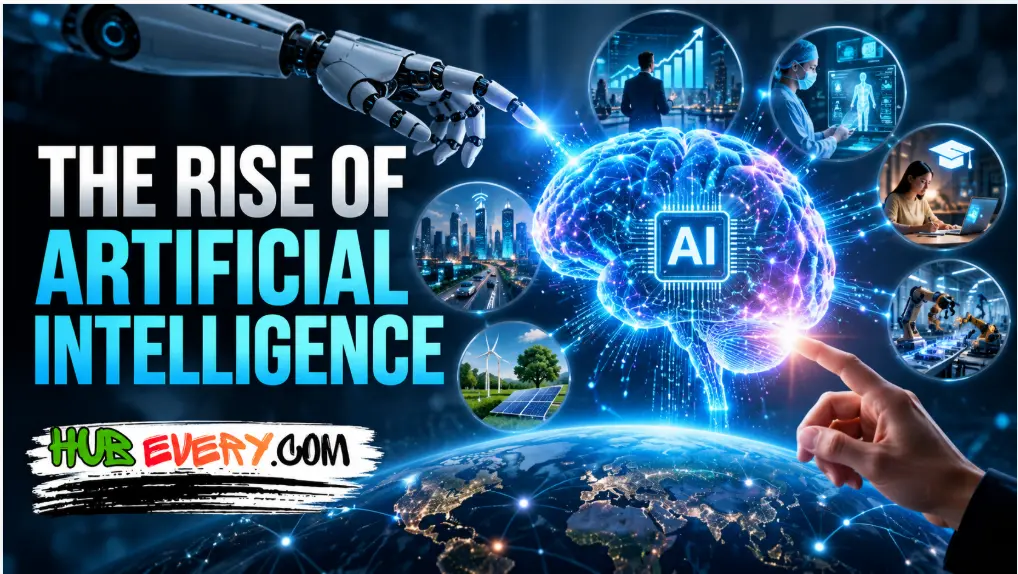
Explore the evolution of artificial intelligence, its real-world applications, business impact, emerging opportunities, potential risks, and what the future of AI means for individuals and organizations.
Artificial intelligence has moved from research laboratories into everyday life. It helps people write emails, analyze data, translate languages, create digital artwork, detect suspicious transactions, and solve complex problems. Businesses are integrating AI into their workflows, educators are experimenting with personalized learning, and researchers are using advanced models to investigate scientific questions.
But the rise of artificial intelligence is about more than chatbots and automated tasks. It represents a significant shift in how humans interact with technology and how organizations create value.
According to Stanford University’s 2026 AI Index Report, 88% of surveyed organizations reported using AI in 2025, while 70% reported using generative AI in at least one business function. These findings illustrate how quickly AI is becoming part of modern business operations.
In this guide, we will explore what artificial intelligence is, how it developed, why adoption is accelerating, how different industries are using it, and what individuals and businesses should consider as this technology continues to evolve.
What Is Artificial Intelligence?
Artificial intelligence, commonly known as AI, is a field of computer science focused on developing systems that can perform tasks associated with human intelligence.
These tasks include recognizing patterns, understanding language, interpreting images, making predictions, solving problems, and generating content.
Traditional software typically follows predefined rules written by developers. Many modern AI systems, by contrast, learn statistical patterns from training data and use those patterns to produce predictions or responses.
For example, an AI-powered email service may identify suspicious messages by recognizing patterns associated with spam. A language model can generate a draft email from a short instruction, while an image-generation model can create an illustration from a written description.
AI is a broad field that includes several important technologies:
- Machine learning: Enables computer systems to learn patterns from data.
- Deep learning: Uses multilayered neural networks to learn complex patterns.
- Natural language processing: Helps computers process and generate human language.
- Computer vision: Enables systems to interpret images and video.
- Generative AI: Produces new content, including text, images, audio, video, and code.
Understanding these categories helps explain why AI can perform such different tasks across industries.
A Brief History of Artificial Intelligence
The development of AI has taken decades. Its recent popularity builds on years of scientific research and improvements in computing.
The 1950s: Early Ideas About Machine Intelligence
In 1950, mathematician Alan Turing published a paper exploring whether machines could demonstrate intelligent behavior. In 1956, the Dartmouth summer research project helped establish artificial intelligence as a formal research field.
Early researchers developed programs that could solve specific logical problems. However, limited computing power, restricted data, and the complexity of real-world situations made progress difficult.
The 1980s and 1990s: Expert Systems and Machine Learning
During the 1980s, expert systems became an important AI approach. These programs used collections of rules to imitate decision-making in specialized fields.
Machine learning also developed as researchers explored methods that allowed computers to learn from examples rather than relying entirely on manually written rules.
In 1997, IBM’s Deep Blue defeated world chess champion Garry Kasparov, demonstrating the power of specialized computing and search techniques in a complex strategic game.
The 2010s: The Deep Learning Breakthrough
Improvements in graphics processors, larger datasets, and neural network techniques accelerated AI research.
In 2012, the AlexNet neural network achieved a major breakthrough in image classification. In 2016, DeepMind’s AlphaGo defeated Go champion Lee Sedol, showing how advanced learning techniques could tackle an exceptionally complex board game.
These achievements helped expand interest in AI across research institutions and technology companies.
The 2020s: Generative AI Goes Mainstream
Generative AI brought advanced machine learning capabilities to a much wider audience.
Tools such as ChatGPT and image generators made it possible for ordinary users to interact with AI through natural language.
Instead of requiring specialized programming knowledge, many tasks could be started by entering a simple prompt. This accessibility helped AI enter education, marketing, software development, customer service, and personal productivity.
For a broader historical overview, see Our World in Data’s history of artificial intelligence.
Why Is Artificial Intelligence Growing So Quickly?
Several technological and economic developments are driving the rise of AI.
1. Increasing Computing Power
Modern processors and specialized AI chips can perform enormous numbers of mathematical operations. Cloud computing also allows businesses to access computing resources without building their own large-scale infrastructure.
These improvements have made it easier to develop, deploy, and use sophisticated AI models.
2. Advances in Machine Learning
Researchers have developed more capable neural networks, improved training techniques, and systems that can process multiple types of information.
As a result, AI applications can now support tasks involving language, images, audio, and structured data.
3. Easy-to-Use Interfaces
AI tools increasingly accept everyday language instead of requiring users to write code.
A small business owner can ask an AI assistant to draft a product description. A student can request an explanation of a difficult concept. A developer can ask for help understanding a programming error.
The interface has become simpler, even though the underlying technology remains complex.
4. Business Competition and Investment
Organizations are exploring AI to improve productivity, reduce repetitive work, personalize customer experiences, and develop new products.
Stanford HAI’s 2026 AI Index Report documents rising organizational adoption and the expanding role of generative AI in business.
Adoption does not automatically mean every organization is achieving financial benefits. Companies still need to measure results, manage costs, and determine where AI genuinely improves their operations.
How Artificial Intelligence Is Transforming Different Industries
AI’s influence extends well beyond the technology sector. Its applications are growing across healthcare, education, finance, manufacturing, and digital commerce.
Healthcare
AI can help medical professionals analyze medical images, organize clinical information, identify patterns in research datasets, and support certain diagnostic processes.
For example, an AI-assisted imaging system may flag an area of a scan that deserves closer examination by a radiologist.
AI can also help researchers investigate potential drug candidates and organize scientific literature.
However, AI-generated medical suggestions are not automatically correct. Clinical validation, qualified professionals, privacy protections, and appropriate oversight remain essential.
Education
AI is creating new possibilities for personalized learning.
Students can use AI assistants to understand difficult concepts, generate practice questions, improve writing, and organize revision schedules.
Teachers can use AI to brainstorm lesson plans, create exercises, and adapt learning materials for different skill levels.
Consider a student struggling with algebra. Instead of simply asking for the answer to a problem, the student can ask the AI to explain each step, provide a similar question, and identify common mistakes.
This approach makes AI a learning companion rather than merely an answer generator.
Business and Marketing
Companies are using AI to support customer service, market research, content creation, data analysis, and administrative workflows.
A small online store, for example, could use AI to draft product descriptions, categorize customer questions, prepare promotional ideas, and summarize weekly sales data.
These applications can help smaller teams accomplish more with limited resources.
Businesses should still verify generated content, protect customer information, and measure whether AI actually improves productivity or customer satisfaction.
Finance and Banking
Financial institutions use AI-related technologies to identify suspicious transactions, detect fraud patterns, analyze risks, and assist with customer support.
An unusual transaction may trigger an automated alert for further investigation. The system does not necessarily prove that fraud occurred; it identifies a pattern that may require review.
Financial AI also presents challenges, including biased decisions, false alerts, security vulnerabilities, and the need for explainability in consequential decisions.
Manufacturing and Transportation
Manufacturers can use AI to identify defects, predict equipment maintenance needs, and optimize production schedules.
In transportation, AI supports route planning, traffic prediction, driver-assistance systems, and research into autonomous vehicles.
For example, a factory might analyze equipment sensor data to identify warning signs before a machine fails. This can help maintenance teams plan repairs before an unexpected breakdown.
High-risk applications still require rigorous testing and safety controls.
Content Creation and Digital Publishing
AI is changing how bloggers, designers, journalists, and digital marketers approach content production.
AI tools can help with topic research, outlines, headline variations, image concepts, editing, and content repurposing.
For a website such as Hubevery.com, a writer could use AI to brainstorm technology topics, develop an article structure, and prepare a first draft. The writer should then verify factual claims, add original insights, link to reliable sources, and edit the article for the intended audience.
The advantage comes from combining AI’s speed with human judgment and subject knowledge—not from publishing unreviewed content in large quantities.
The Major Benefits of Artificial Intelligence
AI offers several important opportunities when used appropriately.
Higher productivity: AI can accelerate repetitive tasks such as summarizing documents, drafting routine messages, and organizing information.
Faster data analysis: Machine learning systems can identify patterns in large datasets and help analysts investigate relationships that might otherwise go unnoticed.
Greater accessibility: Speech recognition, translation, text-to-speech, and other AI tools can make digital information easier to access.
Support for small businesses: Affordable tools can help small teams with marketing, customer communication, planning, and basic data analysis.
Personalized services: AI can adapt recommendations and educational materials to users’ needs and preferences.
These benefits are not automatic. Results depend on the quality of the system, the task being performed, and how carefully the technology is integrated into existing workflows.
The Risks and Challenges of Artificial Intelligence
The growth of AI also introduces risks that users and organizations need to understand.
Job Displacement and Changing Skills
AI can automate certain tasks, particularly repetitive work involving digital information, text processing, and routine analysis.
Some roles may shrink, while others may change or emerge. The impact will differ by occupation, industry, location, and the pace of adoption.
Rather than assuming that AI will eliminate every job, workers should examine which parts of their work can be automated and which skills remain valuable.
Communication, critical thinking, creativity, accountability, and domain expertise can complement AI capabilities.
Incorrect Information and Deepfakes
Generative AI can produce plausible but inaccurate statements, invented references, and misleading explanations. AI-generated audio, images, and videos can also be used to impersonate people or spread misinformation.
Users should verify important claims against reliable sources and avoid assuming that a confident answer is necessarily correct.
Privacy and Cybersecurity
AI applications may process the information users provide. Uploading confidential documents, customer records, passwords, or sensitive business information to an unapproved service can expose that information to unnecessary risk.
Organizations should establish clear policies for data access, retention, security, and approved AI tools.
Bias and Fairness
AI models can reflect biases present in training data or system design.
In areas such as recruitment, lending, and public services, these biases can lead to unfair outcomes.
Responsible AI development requires testing, monitoring, appropriate human oversight, and mechanisms for identifying and correcting harmful results.
Copyright and Accountability
AI-generated content raises questions about intellectual property, licensing, authorship, and responsibility.
Writers, businesses, and publishers should understand the terms of the tools they use, respect applicable laws, and verify that their published work is accurate and original.
How to Use AI Effectively: A Practical Example
Imagine you run a small technology blog and want to publish an article about AI tools for students.
A productive workflow might look like this:
- Choose a reader problem: Identify a specific question students need answered.
- Research the topic: Find current information from official product documentation and reliable sources.
- Create an outline: Use AI to organize the article into logical sections.
- Test the tools: Where possible, try the products and record your own observations.
- Write and edit: Use AI for drafting assistance, but add your own analysis, examples, and explanations.
- Verify every important claim: Check product capabilities, prices, availability, and other details against current sources.
- Optimize the page: Write a descriptive title, a useful meta description, meaningful headings, and relevant internal links.
- Review after publishing: Use analytics and search performance data to identify opportunities for improvement.
This workflow combines automation with research and editorial responsibility. It can also produce a more useful article than simply asking an AI model to generate a long post without verification.
How to Prepare for an AI-Powered Future
You do not need to become an AI engineer to benefit from this technology.
Start by learning the fundamentals and experimenting with tools relevant to your existing interests or profession.
Develop skills in prompt writing, research, data interpretation, communication, and critical thinking. Learn how to check AI outputs instead of accepting them blindly.
It is also useful to build practical projects. For example, create a spreadsheet workflow that uses AI to summarize data, prepare a research report comparing two tools, or develop a content plan for a small business.
Practical experience helps you understand both what AI can do and where it struggles.
The most useful goal is not to learn every new AI tool. It is to learn how to identify a real problem, select an appropriate tool, evaluate the result, and improve the workflow.
What Does the Future of Artificial Intelligence Look Like?
AI development is likely to continue across several areas.
AI assistants and agents: Some systems are moving beyond answering questions toward completing multi-step tasks, subject to their capabilities, permissions, and reliability.
Multimodal AI: Systems that work with text, images, audio, and video may create more natural ways to interact with software and information.
Scientific research: AI may help researchers explore complex datasets, investigate potential materials, and accelerate parts of scientific discovery.
Workplace integration: AI is likely to become more deeply embedded in everyday software, business processes, and professional tools.
Responsible AI governance: Privacy, security, transparency, fairness, and accountability will remain central concerns as AI systems become more influential.
The pace and impact of these developments remain uncertain. Future capabilities will depend on technical progress, economic conditions, regulation, infrastructure, and whether new applications deliver reliable benefits.
Frequently Asked Questions About Artificial Intelligence
What is artificial intelligence in simple terms?
Artificial intelligence is technology that enables computers to perform tasks associated with human intelligence, including recognizing patterns, processing language, analyzing data, and generating content.
Why is AI becoming so popular?
Improvements in computing power, machine learning, and user-friendly applications have made AI more accessible. Businesses and individuals can now apply it to a growing range of practical tasks.
Can artificial intelligence replace human workers?
AI can automate some tasks and change how many jobs are performed. Its overall employment impact will vary across industries and occupations. Learning to use relevant tools can help workers adapt to changing requirements.
Is AI-generated content good for SEO?
AI can assist with research, outlining, and writing, but using AI does not guarantee search rankings. Content should be accurate, original, useful, and reviewed by someone who can evaluate its quality. Google’s guidance emphasizes helpful, people-first content rather than content produced primarily to manipulate rankings.
Is artificial intelligence safe?
AI can be useful, but it may generate incorrect information, reflect biases, or introduce privacy and security risks. Users should verify important outputs and apply appropriate safeguards.
What skills are useful in the age of AI?
Useful skills include critical thinking, communication, problem-solving, digital literacy, data analysis, creativity, and the ability to evaluate AI-generated information.
What is the difference between AI and generative AI?
AI is the broader field of systems designed to perform intelligent tasks. Generative AI is a category of AI that produces new content, such as text, images, audio, video, or code.
Conclusion
The rise of artificial intelligence is reshaping how people learn, work, create, and solve problems. From healthcare and education to finance and digital publishing, AI is creating new possibilities while introducing important technical, ethical, and economic challenges.
The most effective approach is neither to accept every AI output blindly nor to dismiss the technology entirely. Instead, people and organizations should understand its capabilities, recognize its limitations, and apply it where it provides measurable value.
For individuals, this means developing practical AI skills and learning to verify information. For businesses, it means choosing appropriate use cases, protecting data, training employees, and measuring results. For publishers, it means using AI to support research and creativity while maintaining editorial quality and trust.
Artificial intelligence is a powerful tool, but its real value depends on how thoughtfully people use it.
As AI continues to evolve, the ability to combine technological tools with human judgment, creativity, and responsibility will remain essential.
Sources and Further Reading
- Stanford HAI — The 2026 AI Index Report: Economy
- Our World in Data — A Brief History of Artificial Intelligence
- Google Search Central — Creating Helpful, Reliable, People-First Content
- Google Search Central — Guidance on Generative AI Content
Frequently Asked Questions (FAQs) About Artificial Intelligence
1. What is artificial intelligence (AI)?
Artificial intelligence (AI) is a technology that enables computers to perform tasks such as understanding language, analyzing data, recognizing patterns, solving problems, and generating content.
2. How is artificial intelligence changing the world?
AI is transforming industries such as healthcare, education, finance, manufacturing, and marketing by improving efficiency, automating repetitive tasks, and supporting better decision-making.
3. Can artificial intelligence replace human jobs?
AI can automate certain tasks and change the way people work. However, many jobs still require human creativity, critical thinking, communication, and judgment. Learning AI skills can help professionals adapt to changing workplace demands.
4. What are the main benefits of artificial intelligence?
The main benefits of AI include increased productivity, faster data analysis, personalized learning, improved customer service, and support for innovation across different industries.
5. What is the future of artificial intelligence?
The future of AI may include smarter digital assistants, more personalized services, advanced scientific research, and greater workplace automation. Responsible development, privacy, security, and human oversight will remain important.