
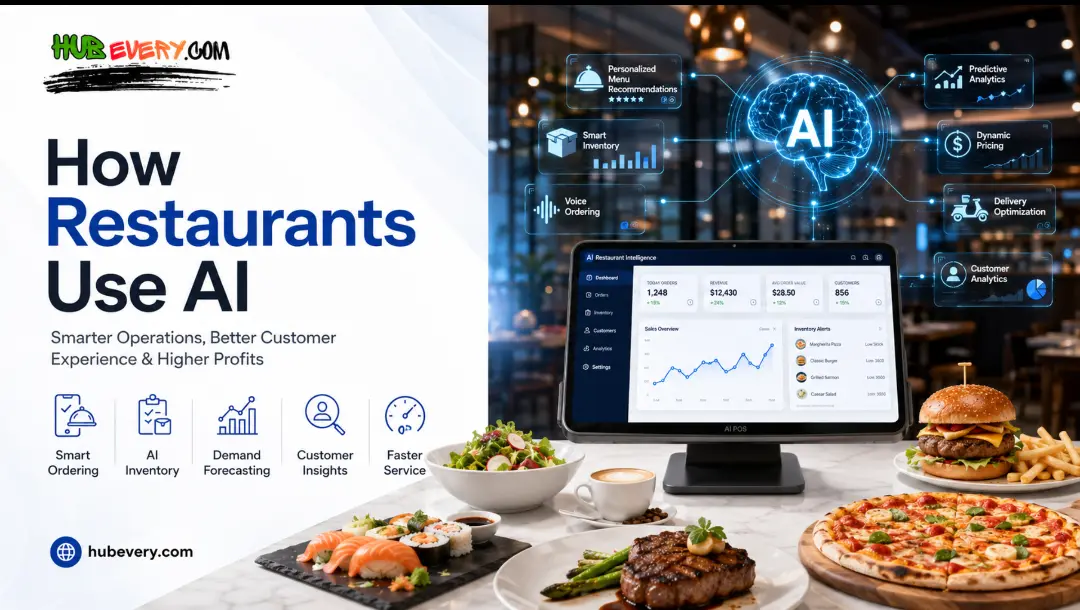
Artificial Intelligence is no longer something reserved for large technology companies. Today, it has quietly become one of the biggest competitive advantages in the restaurant industry. Whether customers realize it or not, AI is helping restaurants take orders faster, reduce food waste, improve customer service, and increase profits every single day.
If you still think AI is only about chatbots or robots serving food, you may be surprised. Modern restaurants across the United States are using AI in ways that directly improve customer experience while making operations smarter behind the scenes.
In this guide, you’ll discover how restaurants use AI, why it matters, and which AI tools restaurant owners can use to stay ahead of the competition.
Why AI Is Changing the Restaurant Industry
Running a successful restaurant has never been easy. Owners constantly struggle with rising labor costs, unpredictable customer demand, inventory management, online reviews, employee scheduling, and increasing competition.
However, AI is changing this reality.
Instead of relying solely on guesswork, restaurants can now make data-driven decisions within seconds. AI analyzes customer behavior, predicts busy hours, recommends menu items, and even helps reduce operational costs.
As customer expectations continue to rise, restaurants that embrace AI are finding themselves in a stronger position than those relying only on traditional methods.
AI Improves Customer Ordering Experience
One of the most noticeable ways restaurants use AI is during the ordering process.
Many restaurants now offer AI-powered ordering systems through mobile apps, websites, self-service kiosks, and voice assistants. These systems can recommend meals based on previous purchases, dietary preferences, and seasonal trends.
For example, if a customer frequently orders spicy chicken sandwiches, the AI may automatically suggest a new spicy combo meal or limited-time promotion.
As a result, customers enjoy a more personalized experience while restaurants increase their average order value without aggressive sales tactics.
AI Helps Restaurants Predict Customer Demand
One of the biggest financial challenges restaurants face is preparing the right amount of food.
Preparing too much food leads to waste. Preparing too little results in disappointed customers.
AI solves this problem by analyzing years of sales data, weather forecasts, local events, holidays, and customer purchasing patterns.
Instead of guessing how many burgers or pizzas will sell on Friday evening, restaurant managers receive accurate forecasts that help them order ingredients more efficiently.
Consequently, businesses reduce waste while protecting their profit margins.
Smarter Inventory Management
Inventory mistakes can quickly become expensive.
Restaurants often lose thousands of dollars each year because ingredients expire before they are used. On the other hand, running out of popular ingredients can damage customer satisfaction.
AI-powered inventory systems monitor stock levels in real time. They automatically predict future ingredient requirements and notify managers before supplies become critically low.
This level of automation reduces manual work while keeping kitchens fully prepared for busy service hours.
AI Makes Restaurant Marketing More Effective
Marketing has become far more competitive than it was just a few years ago.
Fortunately, AI helps restaurants understand exactly what customers want.
Instead of sending identical promotions to everyone, AI analyzes purchasing behavior and creates personalized marketing campaigns. A family that regularly orders pizza may receive family meal discounts, while coffee lovers may receive exclusive breakfast offers.
Because customers receive offers that actually match their interests, marketing campaigns become significantly more effective.
AI Improves Customer Service
Long waiting times remain one of the biggest reasons customers leave negative reviews.
AI-powered customer support systems can answer common questions instantly, including restaurant hours, reservation availability, menu details, allergens, and delivery updates.
This allows staff members to focus on serving guests inside the restaurant instead of answering repetitive phone calls.
As customer expectations continue to increase, faster service often becomes the deciding factor between earning a loyal customer and losing one.
Dynamic Pricing and Menu Optimization
Restaurants constantly need to adjust prices based on ingredient costs, seasonal demand, and competition.
AI helps managers understand which menu items generate the highest profits and which dishes underperform.
Instead of making pricing decisions based on intuition, restaurant owners receive detailed recommendations supported by real business data.
Some AI systems even suggest removing unpopular dishes while promoting high-profit menu items.
Over time, these small improvements can significantly increase restaurant revenue.
AI Helps Reduce Food Waste
Food waste remains one of the restaurant industry’s largest hidden expenses.
AI tracks ingredient usage, predicts demand more accurately, and identifies waste patterns across different locations.
When restaurants know exactly how much food customers are likely to order, they prepare more accurate quantities.
This not only saves money but also supports sustainability by reducing unnecessary waste.
Better Employee Scheduling
Managing employee schedules can quickly become complicated, especially during holidays or busy weekends.
AI scheduling software predicts customer traffic and recommends the ideal number of employees for each shift.
As a result, restaurants avoid overstaffing during slow periods while ensuring enough employees are available during peak hours.
Employees also benefit because schedules become more balanced and predictable.
AI Enhances Online Reputation Management
Online reviews directly influence restaurant sales.
AI tools monitor reviews across platforms like Google, Yelp, and social media. They analyze customer sentiment, identify recurring complaints, and highlight areas that need improvement.
Restaurant owners can respond more quickly to customer feedback while discovering opportunities to improve service before small problems become larger ones.
AI-Powered Voice Ordering
Voice AI has become increasingly popular in drive-thru restaurants.
Instead of waiting for an employee, customers can place orders through AI voice assistants that understand natural language and confirm orders automatically.
This technology reduces wait times while improving order accuracy.
Major restaurant chains across the United States have already started investing heavily in AI-powered drive-thru systems because even small improvements in speed can significantly increase daily revenue.
How AI Supports Restaurant Delivery Services
Food delivery has become an essential part of the restaurant business.
AI optimizes delivery routes, predicts delivery times, balances driver workloads, and improves order accuracy.
Customers receive faster deliveries, while restaurants reduce transportation costs.
As delivery demand continues to grow, AI becomes increasingly important for maintaining customer satisfaction.
Best AI Tools for Restaurants
Several AI platforms are helping restaurants modernize their operations.
Toast AI helps restaurants manage point-of-sale operations, online ordering, payment processing, and customer insights through an integrated platform.
Popmenu AI simplifies restaurant marketing by generating website content, answering customer questions, and improving online ordering experiences.
SoundHound AI provides advanced voice ordering technology that powers drive-thru and phone ordering systems.
OpenTable AI Features help restaurants manage reservations, analyze guest preferences, and improve customer experiences.
SevenRooms focuses on customer relationship management by using AI to personalize guest experiences and increase repeat visits.
ChatGPT assists restaurant owners with creating menus, writing marketing emails, generating social media content, training employees, and improving customer communication.
Canva AI enables restaurants to create professional promotional graphics, menus, advertisements, and social media visuals without hiring a designer.
Google Gemini helps restaurant managers research market trends, generate business ideas, summarize reports, and create operational documentation more efficiently.
Challenges Restaurants Should Consider
Although AI offers remarkable advantages, successful implementation requires careful planning.
Restaurants must protect customer data, ensure employees understand how to use new technologies, and regularly monitor AI-generated recommendations.
Additionally, AI should support human employees rather than replace genuine hospitality.
Customers still value friendly service, personal attention, and authentic dining experiences that technology alone cannot provide.
The Future of AI in Restaurants
Artificial Intelligence will continue transforming restaurants over the next decade.
Future AI systems may predict customer cravings before they place an order, automate kitchen operations, optimize supply chains in real time, and create highly personalized dining experiences.
Restaurants that begin adopting AI today will likely gain a significant competitive advantage as technology becomes increasingly integrated into everyday operations.
Rather than replacing restaurant owners and employees, AI is becoming a powerful business partner that helps teams work smarter, serve customers better, and build more profitable businesses.
Final Thoughts
Artificial Intelligence is no longer a futuristic concept in the restaurant industry. It is already helping businesses improve efficiency, increase customer satisfaction, reduce operational costs, and make smarter decisions every day.
Whether you own a small neighborhood café or manage a large restaurant chain, adopting the right AI tools can transform the way your business operates. As customer expectations continue to evolve, embracing AI is no longer just an option—it is becoming an essential strategy for long-term success.
Frequently Asked Questions (FAQs)
How do restaurants use AI?
Restaurants use AI for order management, customer support, inventory tracking, demand forecasting, marketing, employee scheduling, menu optimization, and delivery management.
Can AI improve customer service in restaurants?
Yes. AI-powered chatbots, voice assistants, and recommendation systems provide faster responses, personalized suggestions, and improved customer experiences.
Which AI tools are best for restaurants?
Popular AI tools include Toast AI, Popmenu AI, SoundHound AI, SevenRooms, OpenTable AI features, ChatGPT, Canva AI, and Google Gemini.
Does AI reduce food waste?
Yes. AI predicts customer demand, monitors inventory, and recommends purchasing quantities that reduce unnecessary food waste.
Is AI suitable for small restaurants?
Absolutely. Many affordable AI tools help small restaurants automate marketing, manage inventory, improve customer communication, and increase operational efficiency without requiring large technology investments.
| Tool | Official Website |
| Toast AI | Toast |
| Popmenu AI | Popmenu |
| SoundHound AI | SoundHound AI |
| OpenTable | OpenTable |
| SevenRooms | SevenRooms |
| ChatGPT | ChatGPT |
| Canva AI | Canva |
| Google Gemini | Google Gemini |