
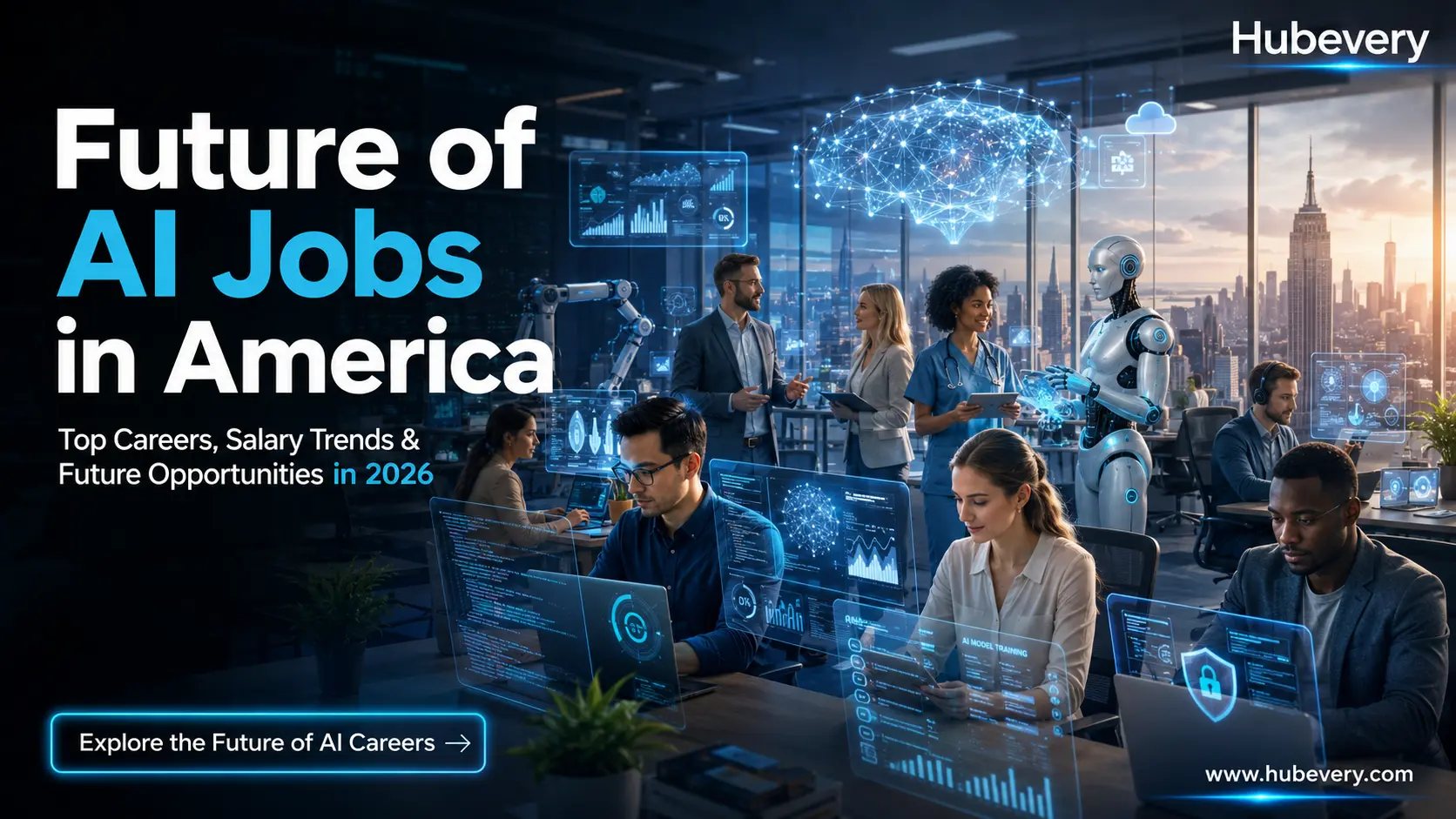
Discover the future of AI jobs in America in 2026. Learn about the fastest-growing AI careers, salary trends, remote opportunities, required skills, and how to prepare for an AI-powered future.
Artificial Intelligence is no longer a futuristic idea that exists only in science fiction movies. Today, it is transforming the way businesses operate, employees work, and customers interact with companies across the United States. From healthcare and finance to manufacturing, education, retail, and cybersecurity, AI has become one of the most influential technologies driving innovation and economic growth. As organizations continue investing billions of dollars in AI-powered solutions, one important question is becoming increasingly common: What is the future of AI jobs in America?
The answer is more encouraging than many people expect. Although Artificial Intelligence is automating repetitive tasks, it is also creating thousands of new career opportunities that require human creativity, technical expertise, critical thinking, and strategic decision-making. Rather than replacing the workforce entirely, AI is reshaping how people work and encouraging professionals to develop new skills that complement intelligent technologies.
If you are a student choosing a career path, a working professional considering a career change, or a business owner trying to understand future workforce trends, this guide will help you explore how Artificial Intelligence is transforming employment across the United States and what you can do to stay ahead in an AI-driven economy.
Why Artificial Intelligence Is Reshaping the American Workforce
Over the past few years, Artificial Intelligence has moved from research laboratories into everyday business operations. Companies are using AI to automate repetitive processes, analyze massive amounts of data, improve customer service, detect fraud, develop software, optimize supply chains, and even assist doctors in diagnosing diseases. As AI becomes more deeply integrated into business operations, employers are searching for professionals who can design, manage, improve, and responsibly use these technologies.
Unlike previous technological revolutions that mainly affected a few industries, AI is transforming nearly every sector of the American economy. Whether someone works in healthcare, banking, retail, manufacturing, transportation, agriculture, education, legal services, or marketing, AI is gradually becoming an essential part of daily work. This widespread adoption is creating new opportunities for professionals from both technical and non-technical backgrounds.
The Current State of AI Jobs in America
If you’re interested in the latest AI platforms transforming the industry, don’t miss our detailed guide on Mesh API AI and Dhruv Rathee’s new AI platform, where we explain its features, use cases, and why it’s gaining attention among developers and AI enthusiasts. Read more here: What Is Mesh API AI? Everything You Need to Know About Dhruv Rathee’s New AI Platform.
The demand for AI professionals has grown significantly over the last few years, and experts expect this trend to continue throughout the decade. Organizations of every size are investing in automation, machine learning, generative AI, robotics, and intelligent data analysis to remain competitive. As a result, companies are actively hiring professionals who understand both technology and business strategy.
One of the biggest changes in today’s job market is that AI careers are no longer limited to software engineers or data scientists. Businesses also need AI consultants, product managers, cybersecurity specialists, prompt engineers, marketing professionals, operations managers, and business analysts who know how to apply AI in real-world situations. This shift has expanded career opportunities for people from a wide variety of educational and professional backgrounds.
Another noticeable trend is the increasing importance of practical skills. Employers now value candidates who can demonstrate hands-on experience with AI tools, cloud platforms, automation software, and real business projects. While formal education remains valuable, practical knowledge and continuous learning have become equally important in the hiring process.
Industries Leading the AI Hiring Boom
Artificial Intelligence has expanded far beyond Silicon Valley. Today, organizations across the United States are integrating AI into nearly every aspect of their operations, creating strong demand for skilled professionals in multiple industries.
Healthcare has become one of the fastest-growing sectors for AI employment. Hospitals and medical research organizations use Artificial Intelligence to improve diagnostics, analyze medical images, predict patient outcomes, and accelerate drug discovery. As healthcare technology continues advancing, professionals who understand both medicine and AI will remain in high demand.
The financial sector has also embraced AI at an impressive pace. Banks, insurance companies, investment firms, and fintech startups rely on intelligent algorithms to detect fraud, manage financial risks, automate customer support, and deliver personalized financial services. Consequently, AI specialists with knowledge of finance continue to enjoy outstanding career opportunities.
Manufacturing companies are using intelligent automation and predictive maintenance to improve efficiency while reducing operational costs. Instead of replacing workers entirely, manufacturers are hiring professionals who can supervise AI-powered production systems, optimize industrial processes, and improve quality control.
Retail and e-commerce businesses increasingly depend on Artificial Intelligence to understand customer behavior, personalize shopping experiences, forecast inventory, and automate logistics. Likewise, cybersecurity has become one of the fastest-growing AI career fields because organizations require intelligent systems capable of identifying and preventing increasingly sophisticated cyber threats.
The Rise of Remote AI Jobs in the United States
One of the most exciting developments in today’s employment market is the rapid growth of remote AI careers. Since many AI professionals work with cloud platforms, machine learning models, and online collaboration tools, companies have become much more comfortable hiring employees regardless of where they live.
This shift has expanded opportunities for professionals outside traditional technology hubs such as Silicon Valley, Seattle, Boston, and New York. Talented individuals can now contribute to leading AI projects while working from smaller cities or even rural communities. Remote work has also enabled businesses to recruit highly skilled professionals from a much larger talent pool, making AI one of the most flexible career fields in the modern workforce.
For employees, remote AI jobs offer more than convenience. They provide improved work-life balance, greater career flexibility, reduced commuting costs, and access to high-paying positions that were once available only in major metropolitan areas. As organizations continue embracing hybrid and fully remote work models, experts believe remote AI careers will remain one of the defining employment trends of the next decade.
Why the Future Looks More Promising Than Many People Think
Public discussions about Artificial Intelligence often focus on automation and job displacement. While some repetitive tasks will certainly disappear, history suggests that technological innovation creates new opportunities alongside change. The internet, smartphones, and cloud computing all transformed the labor market, yet they also generated millions of jobs that previously did not exist.
Artificial Intelligence appears to be following the same pattern. Instead of eliminating the workforce, AI is changing the nature of work itself. Professionals who embrace continuous learning, develop AI-related skills, and adapt to new technologies are likely to discover more career opportunities than ever before.
In the next section, we will explore the highest-paying AI careers in America, expected salary trends for 2026, the most valuable technical and human skills employers are seeking, and expert predictions about how Artificial Intelligence will shape the American job market over the next decade.
The Highest-Paying AI Jobs in America
As Artificial Intelligence continues to transform industries, companies are offering highly competitive salaries to attract skilled professionals. The shortage of experienced AI talent means that organizations are willing to invest heavily in individuals who can design intelligent systems, solve complex business problems, and help companies adopt AI successfully.
One of the most sought-after positions is the Machine Learning Engineer. These professionals build predictive models, develop algorithms, and improve AI systems that can learn from data. Because the role requires expertise in programming, mathematics, and data science, it consistently ranks among the highest-paying technology careers in the United States.
Another rapidly growing profession is the AI Product Manager. Unlike software engineers, AI Product Managers focus on connecting business goals with technical development. They work closely with engineering teams, understand customer needs, and ensure AI-powered products solve real-world problems. As businesses continue launching AI-driven products, demand for experienced product managers is expected to rise significantly.
The emergence of generative AI has also created opportunities for Prompt Engineers. These professionals specialize in designing effective prompts that help AI models generate accurate, reliable, and high-quality responses. Although this career is relatively new, many organizations are already hiring prompt engineering specialists to improve productivity and automate business workflows.
Similarly, AI Security Specialists are becoming increasingly valuable. As companies deploy more AI systems, protecting sensitive data and preventing cyberattacks has become a major priority. Professionals who understand both cybersecurity and Artificial Intelligence are expected to remain in exceptionally high demand throughout the coming decade.
AI Salary Trends in 2026
Artificial Intelligence continues to be one of the highest-paying career fields in America. Entry-level professionals often earn salaries that exceed those of many traditional occupations because AI skills remain in limited supply. As individuals gain experience, compensation typically increases through performance bonuses, stock options, and leadership opportunities.
Location still influences salary levels, but remote work has reduced geographic limitations. Professionals living outside major technology hubs now have access to positions that once required relocation to cities such as San Francisco, Seattle, or New York. This shift has made high-paying AI careers more accessible to talented individuals across the country.
Employers are also investing in professional development by offering certification programs, flexible work arrangements, healthcare benefits, and learning budgets. These additional incentives demonstrate how valuable AI professionals have become in today’s competitive labor market.
The Skills Employers Will Value Most
Technical knowledge remains essential, but employers increasingly look for professionals who combine technology with business understanding and strong interpersonal skills.
Programming languages such as Python continue to dominate AI development, while knowledge of machine learning, cloud computing, data analytics, automation, and natural language processing provides a strong competitive advantage. At the same time, organizations also value professionals who understand how AI can solve practical business challenges rather than simply writing code.
Equally important are communication, adaptability, leadership, creativity, and critical thinking. Artificial Intelligence can automate repetitive work, but it cannot replace human judgment, emotional intelligence, or the ability to build meaningful relationships. Professionals who develop both technical expertise and strong soft skills will likely enjoy the greatest long-term career success.
Will AI Replace Jobs or Create More Opportunities?
This question remains one of the most debated topics in today’s workforce. While Artificial Intelligence will automate certain routine responsibilities, it is unlikely to replace the majority of professions entirely. Instead, it will redefine how work is performed.
Administrative tasks, repetitive data processing, scheduling, and basic reporting are becoming increasingly automated. However, these changes also allow employees to focus on strategic planning, innovation, customer relationships, and creative problem-solving.
History shows that every major technological revolution has created new industries and career opportunities. The internet generated millions of digital jobs, smartphones transformed software development, and cloud computing introduced entirely new technology careers. Artificial Intelligence is expected to follow a similar path by creating roles that require human expertise alongside intelligent systems.
Rather than competing with AI, future professionals will achieve greater success by learning how to collaborate with it.
Predictions for the Future of AI Jobs in America
Looking ahead, Artificial Intelligence is expected to become as common in the workplace as computers and the internet are today. Businesses across healthcare, education, finance, manufacturing, logistics, legal services, media, and government will continue integrating AI into their daily operations.
As AI adoption grows, demand for professionals who can implement, monitor, secure, and improve these systems will continue increasing. Hybrid careers that combine industry expertise with AI knowledge are also expected to become more common. For example, healthcare professionals with AI expertise, financial analysts familiar with machine learning, and marketers skilled in generative AI will likely enjoy significant competitive advantages.
Continuous learning will become one of the most valuable career investments. Technology evolves rapidly, and professionals who regularly update their knowledge through certifications, practical projects, and hands-on experience will remain competitive regardless of how the job market changes.
The future workforce will not be divided between people and AI. Instead, it will consist of people who know how to work effectively with Artificial Intelligence and those who do not. This distinction may become one of the defining factors of career success during the next decade.
Frequently Asked Questions
Is Artificial Intelligence a good career choice in America?
Yes. Artificial Intelligence is widely considered one of the fastest-growing and highest-paying career fields in the United States. Demand continues to increase as businesses adopt AI technologies across nearly every industry.
Can someone without a computer science degree work in AI?
Absolutely. Many professionals transition into AI from business, healthcare, finance, marketing, education, and other fields. Employers increasingly value practical experience, certifications, and real-world projects alongside formal education.
Are remote AI jobs expected to continue growing?
Yes. Because many AI roles rely on cloud-based technologies and digital collaboration tools, remote and hybrid work opportunities are expected to remain a major part of the AI job market for years to come.
Which industries will hire the most AI professionals?
Healthcare, finance, cybersecurity, manufacturing, retail, education, logistics, government, and technology companies are expected to remain among the largest employers of AI talent throughout this decade.
Conclusion
The future of AI jobs in America is filled with opportunity for individuals who are prepared to adapt and learn. Although Artificial Intelligence will continue changing the way businesses operate, it is also creating exciting career paths that did not exist only a few years ago. Organizations need professionals who can combine technical expertise with creativity, ethical decision-making, and business insight, making human skills more valuable than ever.
Whether you are a student planning your first career, an experienced professional considering a career transition, or an entrepreneur exploring new technologies, now is the ideal time to build AI literacy and invest in future-ready skills. Those who embrace innovation instead of fearing it will be better positioned to succeed in an economy increasingly shaped by intelligent technologies.
Artificial Intelligence is not simply changing jobs—it is redefining the future of work. By staying informed, continuously learning, and developing both technical and human-centered abilities, you can confidently prepare for the next generation of career opportunities in America.