
The artificial intelligence industry is evolving at an incredible pace. Every few weeks, a new AI model enters the market, promising faster responses, better reasoning, improved coding abilities, or more natural conversations. While this rapid innovation is exciting, it has also created an unexpected challenge for developers and businesses. Instead of focusing on building intelligent applications, they often spend countless hours managing different AI providers, multiple API keys, separate documentation, and completely different pricing systems.
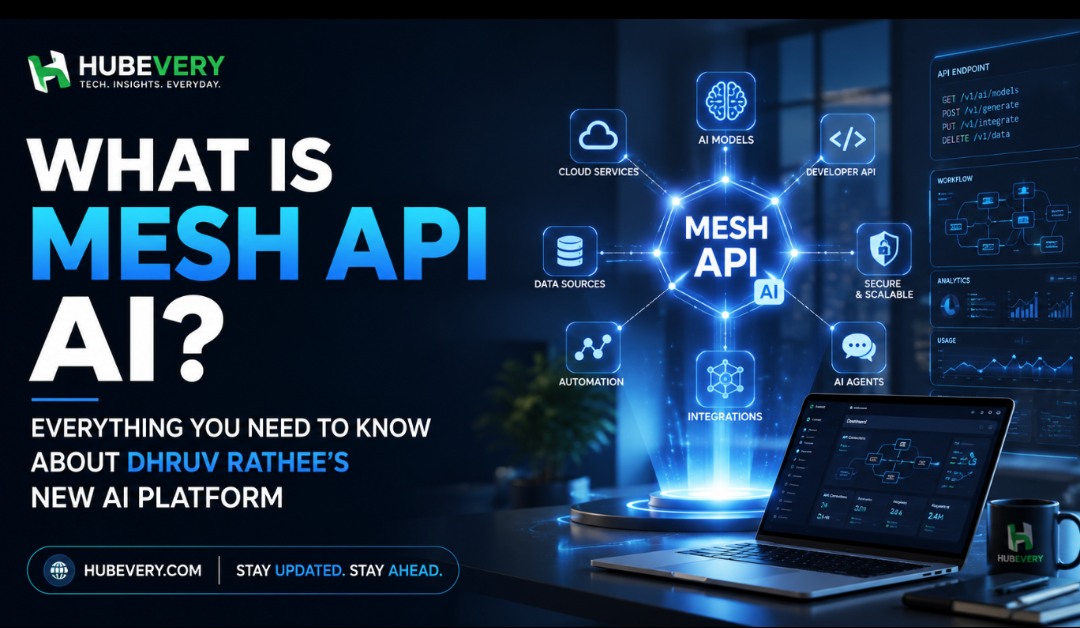
This growing complexity is exactly where Mesh API AI enters the conversation. Recently introduced by Dhruv Rathee’s AI initiative, Mesh API aims to simplify the way developers interact with artificial intelligence. Instead of integrating every AI provider separately, developers can connect to a single API and gain access to multiple AI models through one unified platform. According to the launch information, the platform is designed to provide access to more than 1,000 AI models through a single integration, making AI development significantly more flexible. Public information about the launch describes Mesh API as a unified gateway built to reduce integration complexity while improving developer productivity.
However, understanding Mesh API becomes much easier when you stop thinking about technology for a moment and instead imagine something you experience in everyday life.
What Is Mesh API AI?
Imagine visiting a large food court inside a shopping mall. The food court has dozens of restaurants, each offering different cuisines. One restaurant serves pizza, another specializes in burgers, while others prepare Chinese, Indian, or Italian food. Now imagine if every restaurant forced you to stand in a different queue, create a separate account, and pay using different payment methods. Ordering a simple meal would quickly become frustrating.
Fortunately, that’s not how modern food courts operate. You simply approach one counter, place your order, and the system takes care of everything behind the scenes. The staff forwards your request to the correct restaurant, collects the food, and delivers it back to you. From your perspective, the entire experience feels smooth because you interact with only one system instead of many.
Mesh API AI works in almost the same way. Instead of communicating individually with different AI providers such as OpenAI, Google Gemini, Anthropic Claude, or other language models, developers send every request to Mesh API. The platform then acts as an intelligent middle layer that connects the request to the most appropriate AI model and returns the response through the same interface. In simple words, Mesh API doesn’t replace AI models; it connects them in a way that makes them easier to use.
This approach is becoming increasingly important because the AI ecosystem is no longer dominated by a single company. Every model has unique strengths. Some models generate better content, while others excel at coding, reasoning, research, or image understanding. As a result, developers often need access to multiple AI systems instead of relying on just one. Mesh API is designed to make that process much simpler by providing a unified gateway instead of multiple independent integrations.
Why Did Dhruv Rathee Launch Mesh API AI?
The AI industry is becoming more competitive every month. New models are released regularly, pricing changes frequently, and developers constantly search for better performance at lower costs. Consequently, many software teams find themselves rewriting integrations whenever they decide to switch from one provider to another.
This creates a problem that is surprisingly expensive. Developers spend valuable time maintaining infrastructure instead of improving their products. Businesses pay engineers to manage integrations rather than building features that customers actually notice. Even independent developers struggle because learning the documentation of every AI provider requires significant effort.
Dhruv Rathee’s vision behind Mesh API appears to focus on solving this practical challenge. Instead of asking developers to learn different systems for every AI model, Mesh API introduces a single platform that can serve as the bridge between applications and multiple AI providers. The idea is not simply to make development easier today but also to prepare developers for a future where hundreds of new AI models continue to enter the market.
For businesses, this flexibility can reduce long-term maintenance costs. For startups, it can accelerate product development. For students and independent developers, it removes much of the complexity associated with experimenting across different AI models. That is one of the primary reasons why Mesh API has attracted attention soon after its introduction.
The Biggest Problem Mesh API AI Solves
Before understanding why Mesh API AI is generating so much excitement, it is important to understand the problem it is trying to solve. Today, the AI industry is more diverse than ever. OpenAI offers powerful conversational models, Google focuses on multimodal intelligence through Gemini, Anthropic builds safety-oriented models like Claude, while DeepSeek and several open-source alternatives continue to improve at an incredible pace. Although this competition benefits users, it also creates a serious challenge for developers.
Imagine you own a restaurant that receives orders from five different food delivery apps. Every app has a different dashboard, payment process, notification system, and customer support channel. Instead of concentrating on cooking delicious food, your staff spends most of its time switching between different tablets. Eventually, the business becomes harder to manage, even though the food itself is excellent.
The same situation exists in AI development today. Developers often maintain separate API keys, billing systems, SDKs, and documentation for multiple AI providers. Whenever a company wants to test a different model, engineers frequently have to rewrite parts of their application. Consequently, valuable development time is wasted on infrastructure instead of innovation.
Mesh API AI attempts to eliminate this unnecessary complexity. Rather than asking developers to connect with every provider individually, it creates a single connection point that communicates with multiple AI models behind the scenes. Public information about the launch describes Mesh API as a unified backend hub capable of connecting developers to more than 1,000 AI models through one API.
How Does Mesh API AI Work?
At first glance, Mesh API may sound like another AI platform. However, its role is very different. Instead of becoming another chatbot or language model, it acts as an intelligent bridge between your application and various AI providers.
Think about travelling through a large international airport. As a passenger, you don’t need to know how baggage is transferred, which runway your aircraft uses, or how air traffic controllers coordinate hundreds of flights every day. You simply check in, receive your boarding pass, and board the aircraft. The airport quietly manages thousands of complex operations without requiring your involvement.
Mesh API follows a similar philosophy.
When an application sends a request, the developer communicates only with Mesh API. The platform then determines how to process that request and forwards it to the appropriate AI model. After receiving the response, it sends the result back through the same API connection. From the developer’s perspective, the experience remains simple because there is only one integration to maintain, even if multiple AI providers are working in the background. Mesh API’s public messaging also highlights features such as smart routing and automatic failover to improve reliability at scale.
As AI continues evolving, this architecture could become increasingly valuable because developers would no longer need to redesign their applications every time a better model appears.
Understanding Mesh API AI with a Restaurant Example
Let’s return to the restaurant analogy because it perfectly explains why Mesh API matters.
Imagine you visit a premium food court with fifty restaurants. Every restaurant prepares a different cuisine. One specializes in Italian food, another serves authentic Chinese dishes, while another prepares traditional Indian meals. Naturally, each restaurant has its own chef, menu, and cooking style.
Now suppose every customer had to personally visit every kitchen before placing an order.
The experience would be chaotic.
Customers would waste time finding the correct restaurant, waiting in different queues, understanding different ordering systems, and making separate payments.
Instead, the food court introduces a professional waiter.
The waiter listens to your order once, understands exactly what you need, walks to the correct kitchen, communicates with the chef, collects your meal, and finally serves it at your table.
Notice something interesting.
The waiter never cooks the food.
The chefs still prepare every dish.
The waiter simply makes the entire experience smoother.
Mesh API AI works exactly like that waiter.
OpenAI, Gemini, Claude, DeepSeek, and other AI models remain the “chefs.” They continue generating answers using their own capabilities. Mesh API simply acts as the intelligent service layer that understands where your request should go and delivers the final response through one consistent interface.
This simple idea removes much of the operational complexity that developers currently face. Instead of worrying about which AI provider should receive every request, they can concentrate on creating better products for their users.
Why Developers Need Mesh API AI in 2026
Artificial intelligence is no longer limited to chatbots. Today, AI powers customer support systems, healthcare assistants, education platforms, coding tools, legal research software, marketing automation, and enterprise analytics. As these applications become more sophisticated, relying on a single AI model may not always deliver the best results.
For example, a content creation platform may prefer one model for writing articles, another for generating images, and a third for analysing large documents. Without a unified infrastructure, managing these workflows quickly becomes complicated.
Mesh API AI addresses this challenge by allowing developers to build flexible applications without constantly changing their backend architecture. Instead of redesigning systems whenever a new AI model outperforms existing alternatives, businesses can continue using the same integration while exploring better models as they become available. That flexibility could reduce maintenance costs, accelerate experimentation, and help companies adapt more quickly to the rapidly changing AI landscape. Public-facing information from Mesh API emphasizes exactly this vision by promoting one API for hundreds of models along with tools designed for production AI workloads.
Key Features of Mesh API AI That Make It Different
At first glance, Mesh API AI may appear to be just another API gateway. However, its real strength lies in the way it simplifies AI development without limiting flexibility. Instead of forcing developers to maintain separate integrations for every AI provider, Mesh API creates a unified environment where multiple models can be accessed through a single API key. According to the official launch information, the platform supports access to more than 1,000 AI models from providers including OpenAI, Anthropic, Google, Meta, DeepSeek, Alibaba, and Mistral through one integration.
One of its most valuable capabilities is automatic model routing. Imagine driving on a highway where Google Maps constantly checks traffic conditions. If one route becomes congested, the app automatically recommends a faster alternative. You don’t need to monitor every road yourself because the navigation system makes the decision for you.
Mesh API AI follows a similar principle. Instead of asking developers to manually decide which AI model should handle every request, the platform can intelligently route requests to the most suitable model based on performance and availability. This not only saves development time but can also improve the overall user experience. The Mesh team publicly describes this as an auto-router that dynamically selects the best model for different prompts.
Another important feature is its single API integration. Think about a universal remote control that can operate your television, air conditioner, speakers, and streaming device. Instead of carrying four different remotes, you only need one. Mesh API applies the same philosophy to AI infrastructure. Developers integrate once and can access a wide range of supported AI models without repeatedly changing their application’s backend.
The platform also focuses on high availability. In traditional systems, if one AI provider experiences downtime, developers often have to handle errors manually or switch services themselves. Mesh API is designed with automatic failover capabilities so that applications remain more reliable even if an individual provider encounters temporary issues. For businesses building production-grade AI products, this can significantly improve uptime and customer satisfaction.
Mesh API AI vs OpenAI API, Gemini API, and OpenRouter
A common question many developers ask is whether Mesh API replaces services like OpenAI API or Google Gemini API. The simple answer is no.
OpenAI API gives developers direct access to OpenAI’s own models. Similarly, Gemini API focuses on Google’s AI ecosystem, while Claude API provides access to Anthropic’s language models. Each platform is powerful within its own ecosystem, but each also requires its own authentication, documentation, billing system, and integration process.
Mesh API takes a different approach.
Instead of competing with these providers, it sits above them as a unified gateway. You can think of OpenAI, Gemini, Claude, and DeepSeek as individual airlines. If you want to travel with each airline separately, you’ll need different booking systems, loyalty programs, and customer portals.
Now imagine an online travel platform that allows you to search, compare, and book flights from all airlines in one place.
That platform doesn’t own the airplanes.
It simply makes travelling much easier.
Mesh API performs a similar role for AI development. Rather than replacing leading AI models, it provides one consistent interface for accessing many of them. As the number of available AI models continues to grow, this unified approach could become increasingly valuable for startups, enterprises, and independent developers alike. Official documentation and launch material emphasize this “one API, many models” philosophy as the platform’s core value proposition.
Who Should Use Mesh API AI?
Mesh API AI is not designed exclusively for experienced software engineers. Instead, it serves a broad range of users who want to build AI-powered applications more efficiently.
For startups, it reduces the complexity of experimenting with different AI providers while keeping infrastructure easier to manage. For established businesses, it offers greater flexibility because applications can evolve without repeatedly rebuilding backend integrations. Students learning artificial intelligence can also benefit since they only need to understand one integration workflow before exploring multiple AI models.
Independent developers may find even greater value. Instead of spending weeks maintaining separate APIs, they can focus on creating useful products, validating ideas, and improving customer experience. As AI continues becoming an essential part of modern software, tools that simplify infrastructure may become just as important as the AI models themselves.
Benefits and Limitations of Mesh API AI
Every technology solves a particular problem, but no solution is perfect. The same applies to Mesh API AI. Although it simplifies AI integration significantly, understanding both its strengths and its limitations helps developers make informed decisions before adopting it in production.
One of the biggest advantages of Mesh API AI is flexibility. The AI industry changes almost every month, with new models regularly outperforming older ones in specific tasks. If a company directly integrates with only one AI provider, switching to another model later can require additional engineering effort. However, a unified platform reduces that dependency by providing a consistent integration layer that can work with multiple supported providers.
Another major benefit is improved scalability. Imagine building an AI-powered customer support platform that suddenly receives ten times more traffic after going viral. Managing multiple AI providers manually during such growth can become complicated. A centralized platform is designed to simplify these operational challenges while allowing development teams to focus on improving their product instead of maintaining infrastructure.
Mesh API AI may also reduce development time. Rather than learning different authentication systems, SDKs, documentation styles, and API structures for every provider, developers can work with a single integration. This approach is particularly valuable for startups where engineering resources are often limited.
However, there are practical considerations as well. Because Mesh API acts as an additional layer between applications and AI providers, developers should evaluate factors such as latency, supported models, pricing, and service availability before deploying mission-critical workloads. As with any infrastructure platform, understanding its documentation and service guarantees is essential before building large-scale commercial applications.
What Does the Future Hold for Mesh API AI?
Artificial intelligence is moving toward an ecosystem rather than a single winner. A few years ago, most discussions focused on identifying the “best” AI model. Today, the conversation has changed. Different models excel at different tasks. Some are better at reasoning, others generate higher-quality code, while some deliver faster responses or lower operating costs.
This shift is creating demand for platforms that simplify access to multiple AI systems instead of locking developers into a single provider.
That is why many industry experts believe unified AI gateways could become an important part of the modern AI stack. If the number of commercially available AI models continues to grow over the next few years, developers will increasingly need solutions that reduce integration complexity while preserving flexibility.
Mesh API AI appears to be positioning itself around exactly this vision. Public launch materials describe the platform as an infrastructure layer built to help developers access a wide range of AI models through one consistent interface. As the platform evolves, its long-term success will likely depend on reliability, developer experience, model availability, and the pace at which it adapts to the rapidly changing AI ecosystem. (hack.meshapi.ai)
Final Thoughts
Artificial intelligence has already transformed the way software is built, but managing multiple AI providers remains one of the biggest challenges for developers. Mesh API AI attempts to solve this problem by introducing a unified gateway that simplifies access to numerous AI models through a single integration.
A simple restaurant analogy captures its purpose perfectly. Just as a waiter allows customers to order from different kitchens without entering each one individually, Mesh API allows developers to interact with multiple AI providers without building separate integrations for each service. The AI models still perform the actual work, but the platform makes the overall experience far more efficient.
For startups, businesses, students, and independent developers, this approach has the potential to reduce complexity, encourage experimentation, and speed up product development. While the platform is still in its early stages, its underlying idea reflects a broader trend in the AI industry—making powerful technologies easier to access without increasing technical overhead.
As artificial intelligence continues evolving, developers may spend less time managing APIs and more time building innovative products. If that vision becomes reality, platforms like Mesh API AI could play an increasingly important role in the future of AI development.
Frequently Asked Questions
Is Mesh API AI an AI model?
No. Mesh API AI is not a language model like ChatGPT or Gemini. Instead, it acts as a unified gateway that connects applications with multiple AI models through a single API.
Who created Mesh API AI?
Mesh API AI was launched as part of Dhruv Rathee’s AI initiative with the goal of making AI integration simpler for developers and businesses through a unified platform. Public launch announcements describe it as a developer-focused AI infrastructure product.
Can beginners use Mesh API AI?
Yes. Although developers will benefit the most, beginners can also understand and use the platform because its main objective is to simplify access to multiple AI models rather than increase technical complexity.
Does Mesh API AI replace OpenAI or Gemini?
No. Mesh API does not replace OpenAI, Gemini, Claude, or other AI providers. Instead, it works alongside them by providing a single interface that can connect to multiple supported models.
Why is Mesh API AI important?
Its biggest advantage is convenience. Instead of managing several APIs, authentication systems, and documentation portals, developers can work with one integration while accessing a broad selection of AI models.