
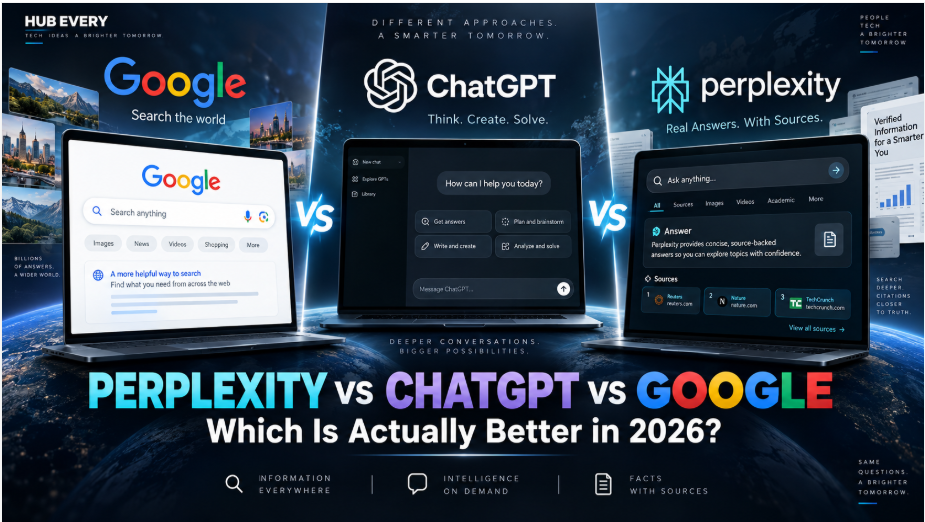
Imagine this.
It’s 10:47 p.m. You’re sitting on your couch with your laptop open.
Tomorrow morning, you have to make a decision.
Maybe you’re buying a new laptop.
Maybe you’re researching a health topic.
Maybe you’re planning a trip.
Or maybe you’re a creator trying to figure out whether a new AI tool is actually worth paying for.
So you open Google.
You type your question.
And suddenly you’re staring at a page filled with links.
One article says one thing.
Another says something completely different.
A Reddit thread gives you a third opinion.
A sponsored result appears near the top.
And after opening six tabs, you realize something slightly ridiculous:
You still don’t know what the answer is.
So you try something different.
You open ChatGPT.
You ask the question in plain English.
Instead of a list of links, you get an explanation.
Interesting.
Then you ask a follow-up question.
And another.
But now you’re wondering:
Where did all of this information come from?
That’s when you open Perplexity.
Suddenly, you’re looking at an answer with sources attached to it.
Now you’ve got three different ways to search the internet.
And that’s where things get interesting.
Because in 2026, the question isn’t simply:
“Which search engine is the best?”
The better question is:
“Which one should I use for what I’m trying to do?”
We’ve entered an era where Google, ChatGPT, and Perplexity are approaching search from very different directions.
Let’s break down what each one is actually good at—and where each one falls short.
Google vs ChatGPT vs Perplexity: The Short Answer
Before we go down the rabbit hole, here’s the quick version:
| If you want to… | Best choice |
| Find a specific website | |
| Find a local business | |
| Shop for something | |
| Explore lots of websites | |
| Have a conversation about a topic | ChatGPT |
| Understand something complicated | ChatGPT |
| Brainstorm ideas | ChatGPT |
| Conduct deep research | Perplexity |
| Find and compare sources | Perplexity |
| Research a blog topic | Perplexity + ChatGPT |
| Get the best overall workflow | Use all three |
That’s the simple answer.
The interesting part is why.
Search Used to Be a Destination. Now It’s Becoming a Conversation.
Think back to how you searched the internet ten years ago.
You didn’t usually type a full question.
You typed something like:
best coffee maker under $100
Or:
how to fix slow wifi
Or:
best restaurants NYC
Google then gave you pages of results.
You did the rest.
You opened the pages.
You read.
You compared.
You made the decision.
For a long time, this was the basic model of the internet:
Search → Click → Read → Decide
AI search is changing that.
Now the process increasingly looks like:
Ask → Understand → Follow up → Compare → Decide
Google itself is moving in this direction with AI Overviews and AI Mode, which add AI-generated responses and conversational exploration directly into Search. Google says its newer AI Search experiences are designed to help users explore complex questions and continue conversations around them. (blog.google)
And that creates a fascinating question:
If the internet can answer your question before you visit a website, what happens to search as we know it?
Meet the Three Players
Let’s imagine you’re hiring three research assistants.
You give each of them the same assignment:
“Help me find the best laptop for college.”
Google walks into the room carrying a giant filing cabinet.
It says:
“Here are thousands of places where you can find information.”
You now have options.
Lots of them.
ChatGPT
ChatGPT sits down and says:
“Okay. Tell me what you’re studying, your budget, and what you care about.”
You explain.
It asks—or answers—based on the context.
Then you can continue the conversation.
Perplexity
Perplexity walks in with a stack of research notes.
It says:
“Here’s what I found, and here’s where each piece of information came from.”
And suddenly you realize:
These three aren’t really trying to do exactly the same job.
1. Google: The Internet’s Giant Front Door
Google’s biggest advantage is still incredibly simple:
It helps you find things.
Need the official IRS website?
Google.
Looking for a restaurant nearby?
Google.
Want to compare ten laptop models?
Google.
Need to find a YouTube video showing how to replace a faucet?
Google.
Want to browse dozens of opinions?
Google.
The sheer breadth of Google’s ecosystem is difficult to replicate.
And Google isn’t standing still.
AI Overviews and AI Mode are bringing more conversational AI directly into Search. Google says AI Overviews are powered by Gemini models and can lead users into deeper exploration and follow-up questions. (blog.google)
So Google is becoming less like:
“Here’s a list of websites.”
and more like:
“Here’s an answer—and here’s the web behind it.”
Where Google Wins
Google is particularly strong for:
- Navigational searches
- Local businesses
- Shopping
- Maps
- News discovery
- Images
- Videos
- Finding specific websites
- Exploring many sources
The downside?
Sometimes Google gives you too much.
You don’t always need 14 tabs.
Sometimes you just want someone to explain the answer.
And that’s where ChatGPT enters the story.
2. ChatGPT: When Search Starts Talking Back
Let’s go back to our fictional laptop buyer.
Instead of typing:
best laptop college
they ask:
“I’m a college student studying computer science. I have a $1,000 budget, I travel between classes, and I want something that can handle programming without being painfully heavy. What should I look for?”
That’s a very different kind of search.
You’re no longer searching for keywords.
You’re explaining a problem.
ChatGPT is built around that kind of interaction.
With ChatGPT Search, the system can search the web for current information and provide citations and links to relevant sources. (help.openai.com)
But the real advantage isn’t simply that it searches.
It’s what happens after the first answer.
You can say:
“I don’t care about gaming.”
Then:
“What if I increase my budget to $1,300?”
Then:
“Which option has the best battery life?”
Then:
“Explain why you picked that one.”
The search doesn’t end after one question.
It evolves.
That’s ChatGPT’s Sweet Spot
ChatGPT is particularly useful when you want:
- Explanations
- Follow-up questions
- Brainstorming
- Planning
- Analysis
- Personalized recommendations
- Learning
- Turning information into something useful
It’s less like asking:
“Where is the information?”
and more like asking:
“Help me make sense of the information.”
But there is one question you may still have:
How do I know whether the answer is actually supported by reliable sources?
That’s where Perplexity gets interesting.
3. Perplexity: The Researcher With Receipts
Imagine you ask:
“How is AI changing the American job market in 2026?”
You don’t just want a five-paragraph answer.
You want:
- Government data
- Research
- Industry reports
- Recent developments
- Company announcements
- Multiple perspectives
And you want to know where everything came from.
That’s Perplexity’s territory.
Perplexity’s Pro Search is designed to handle complex questions by conducting multiple searches and synthesizing information from different sources. Its answers include citations that allow users to investigate those sources. (perplexity.ai)
Its Research mode is designed for even more extensive research, using multiple searches and sources to build a deeper report. (perplexity.ai)
That’s a major advantage when you’re doing serious research.
But here’s the catch.
A citation doesn’t automatically make a claim true.
You still need to open the source.
Read the relevant section.
Check the date.
Look at the context.
In other words:
AI can find the receipt. You still need to check the receipt.
The First Big Test: “I Just Need a Quick Answer”
Let’s say you’re sitting at work and suddenly wonder:
How many ounces are in a gallon?
This isn’t a research project.
You don’t need a five-source investigation.
You need the answer.
Google is perfectly suited to this kind of query.
ChatGPT and Perplexity can answer it too, but using a powerful research workflow for a simple question can be overkill.
Winner: Google
For simple, fast information retrieval, traditional search still makes a lot of sense.
The Second Test: “Explain This Like I’m Five”
Now change the question.
You’re trying to understand inflation.
You search Google.
You get:
- Federal Reserve pages
- News articles
- Economics websites
- Wikipedia
- YouTube videos
- Blogs
All useful.
But now you have to figure out how these pieces fit together.
With ChatGPT, you can simply ask:
“Explain inflation in simple terms.”
Then:
“Now explain how interest rates affect it.”
Then:
“Give me a real-world example.”
Then:
“Why does the Federal Reserve care about inflation?”
You’re learning through conversation.
Winner: ChatGPT
This is where conversational AI can feel dramatically different from traditional search.
The Third Test: “I Need to Research This Properly”
Now imagine you’re writing an article.
Your topic:
How AI is changing small businesses in America
You need credible information.
You might need:
- Statistics
- Government data
- Business surveys
- Academic research
- Company reports
- Recent news
- Expert opinions
This is where Perplexity becomes particularly useful.
You can ask it to investigate the topic and prioritize reputable and primary sources.
Instead of manually opening dozens of pages, you get a research starting point with citations.
Winner: Perplexity
For research-heavy questions, it has a natural advantage.
What About Breaking News?
Here’s where things get tricky.
Imagine something major happens at 8:00 a.m.
By 8:15, thousands of posts are circulating online.
Some are accurate.
Some are outdated.
Some are speculation.
Some are simply wrong.
An AI answer engine might summarize what it’s finding, but you shouldn’t stop there.
For breaking events, a smart workflow is:
Search widely → identify credible sources → check official statements → compare reports → then use AI to summarize
Google is particularly useful for discovering the latest reporting.
Perplexity and ChatGPT can help synthesize what has been reported.
But the final authority should be the underlying sources.
Winner?
No single winner.
For breaking news, source verification matters more than the interface.
Google vs ChatGPT vs Perplexity for Shopping
Imagine you’re buying a $1,200 laptop.
You ask:
“What’s the best laptop under $1,200?”
An AI tool can help narrow your choices.
But then reality enters the picture.
You need to know:
- Is it actually in stock?
- What’s the current price?
- Which retailer sells it?
- What’s the return policy?
- Is there a better deal?
- What do real customers say?
- Is the advertised configuration actually available?
This is where traditional web search and shopping ecosystems remain extremely useful.
Winner: Google
AI is great at helping you think about what to buy.
Google is still extremely useful for helping you find where to buy it.
What About Local Search?
Let’s say you’re in Austin and suddenly want tacos.
You search:
Best tacos near me
Now you care about:
- Distance
- Hours
- Reviews
- Directions
- Photos
- Current information
This is where Google’s broader local ecosystem gives it a major advantage.
Winner: Google
For local discovery, Google remains extremely hard to replace.
Which Is Best for Students?
This one is close.
Imagine you’re writing a college paper.
Use it to find:
- University resources
- Academic websites
- Government information
- Original publications
Perplexity
Use it to:
- Explore a topic
- Find relevant sources
- Compare viewpoints
- Build a research foundation
ChatGPT
Use it to:
- Understand difficult concepts
- Brainstorm
- Organize notes
- Build study plans
- Ask follow-up questions
Winner: All three
The smartest approach isn’t choosing one.
It’s giving each tool a specific job.
Which Is Best for Bloggers?
Now let’s talk about something that matters to anyone running a website.
If you’re a blogger, don’t use AI search the same way a casual user does.
You need more than an answer.
You need:
- A unique angle
- Reliable sources
- Search intent
- Content gaps
- Supporting facts
- Original examples
- A structure readers will actually enjoy
Here’s the workflow I’d recommend.
Step 1: Start With Google
Search your topic.
Don’t write yet.
Look at what already exists.
Ask yourself:
What are the top-ranking articles missing?
Maybe they’re too generic.
Maybe they don’t include real examples.
Maybe they haven’t been updated.
Maybe nobody is answering the question readers actually care about.
That gap is your opportunity.
Step 2: Move to Perplexity
Now research the topic deeply.
Ask:
Research [TOPIC] using recent and authoritative sources. Prioritize government websites, academic papers, official company documentation, industry reports, and reputable publications. Identify important statistics, competing viewpoints, recent developments, and unanswered questions. Cite every important claim.
Perplexity can help you collect and organize the research faster.
But don’t copy its answer.
Open the sources.
Read them.
Take notes.
Step 3: Use ChatGPT to Think
Now bring your research into ChatGPT.
Ask:
Based on this research, what is the most useful and original angle for a reader? Identify the biggest content gaps and suggest a structure that would be more helpful than a generic SEO article.
This is where you can move from:
information
to:
insight.
Step 4: Add the Human Layer
This is the part AI can’t simply hand you.
Test the product.
Take screenshots.
Run an experiment.
Interview someone.
Compare real results.
Share your own observations.
Explain what surprised you.
Tell the reader what you would actually choose—and why.
That’s what gives your content a reason to exist.
Here’s the Problem AI Creates for Bloggers
There’s an uncomfortable question hiding underneath all of this:
If AI can summarize information from the entire internet, why would anyone visit another generic blog post?
That’s a very important question.
Imagine ten websites publish:
“10 Best AI Tools for Students”
An AI system can read those ten articles and summarize them.
The eleventh website doesn’t automatically add value just because it has a different headline.
But now imagine a blogger actually tests those ten tools.
They spend two weeks using them.
They compare:
- Accuracy
- Price
- Speed
- Features
- Ease of use
- Limitations
- Real-world results
And they publish screenshots and original findings.
That’s different.
The article isn’t simply repeating information.
It’s producing information.
That’s a much stronger position for a publisher.
The Future of Search Isn’t “AI vs Google”
This is probably the biggest misconception.
The future isn’t necessarily:
Google dies → ChatGPT wins
or:
Perplexity wins → everyone stops using Google
Real life is messier.
People use different tools for different jobs.
You might:
- Google something.
- Open a Reddit discussion.
- Ask ChatGPT about it.
- Use Perplexity to research it.
- Go back to Google to find the product.
- Open the original source to verify the claim.
That’s not one search engine replacing another.
That’s an ecosystem of search tools.
So, Who Actually Wins?
Let’s settle it.
🏆 Google — Best for Discovering the Web
Use Google when you want to:
- Find websites
- Find local businesses
- Shop
- Find maps
- Explore news
- Browse many sources
- Navigate directly to a known website
Google’s strength: breadth.
🧠 ChatGPT — Best for Conversation and Understanding
Use ChatGPT when you want to:
- Understand something
- Ask follow-up questions
- Brainstorm
- Analyze information
- Build a plan
- Work through a complicated problem
ChatGPT’s strength: conversation.
🔎 Perplexity — Best for Research
Use Perplexity when you want to:
- Investigate a topic
- Compare sources
- Find citations
- Research a complicated question
- Build a research foundation
Perplexity’s strength: research.
Our Final Scorecard
| Category | Winner |
| Traditional web search | |
| Website discovery | |
| Local search | |
| Shopping | |
| Conversational questions | 🏆 ChatGPT |
| Explanations | 🏆 ChatGPT |
| Brainstorming | 🏆 ChatGPT |
| Follow-up questions | 🏆 ChatGPT |
| Deep research | 🏆 Perplexity |
| Source discovery | 🏆 Perplexity |
| Citation-focused research | 🏆 Perplexity |
| Blogging research | 🏆 Perplexity + ChatGPT |
| Overall workflow | 🏆 Google + Perplexity + ChatGPT |
The Best Way to Use All Three
Here’s the simplest mental model to remember:
Find it.
↓
Perplexity
Research it.
↓
Original sources
Verify it.
↓
ChatGPT
Understand it and work with it.
↓
You
Add judgment, experience, and originality.
That last step matters more than people realize.
Because AI can summarize what already exists.
Your advantage is being able to test something, experience something, notice something, and explain something in a way that hasn’t been done before.
Final Verdict: Which One Should You Use?
If you want one simple answer:
Use Google when you want to explore.
Use ChatGPT when you want to understand.
Use Perplexity when you want to research.
And if you’re a serious blogger or content creator?
Use all three.
The real winner isn’t the person who picks the “best” AI search engine.
It’s the person who knows which tool to use at which moment.
Because search is no longer just about finding information.
It’s becoming about asking better questions, evaluating better sources, and turning information into better decisions.
And honestly, that’s a much more interesting future for the internet than simply replacing one search box with another.
Frequently Asked Questions
Is Perplexity better than Google?
Not for every search. Perplexity is particularly strong for research and source-backed answers, while Google remains excellent for web discovery, local search, shopping, maps, and navigating directly to websites.
Is ChatGPT Search better than Google?
It depends on what you’re trying to do. ChatGPT is especially useful for conversational questions, explanations, follow-up discussions, and working with information. Google remains extremely useful for discovering websites, products, businesses, news, and other resources.
Is Perplexity better than ChatGPT for research?
Perplexity has a strong advantage when your priority is multi-source research and citations. ChatGPT can be especially useful after the research stage for analyzing information, explaining it, and turning it into a structured plan.
Which is best for bloggers?
A combination is usually better than choosing one. Google is useful for discovering existing content and original sources, Perplexity is useful for research, and ChatGPT is useful for analysis, organization, brainstorming, and content development.
Can Perplexity replace Google?
Not completely. Perplexity can replace traditional search for some research-heavy questions, but Google’s broader ecosystem—including local search, shopping, maps, images, videos, and web discovery—makes it useful for many situations.
Can ChatGPT replace Google?
Not completely. ChatGPT is excellent for conversation and understanding, but Google remains valuable when you want to explore the wider web or find a specific website, business, product, video, or location.
Should I trust AI-generated search answers?
You should treat them as a starting point, not unquestionable truth. For important information, open the cited sources and verify the claim, date, and context yourself.
What is the best AI search engine in 2026?
There is no universal winner. Google is strongest for broad web discovery, ChatGPT is strong for conversational search and understanding, and Perplexity is particularly strong for research and citations.