
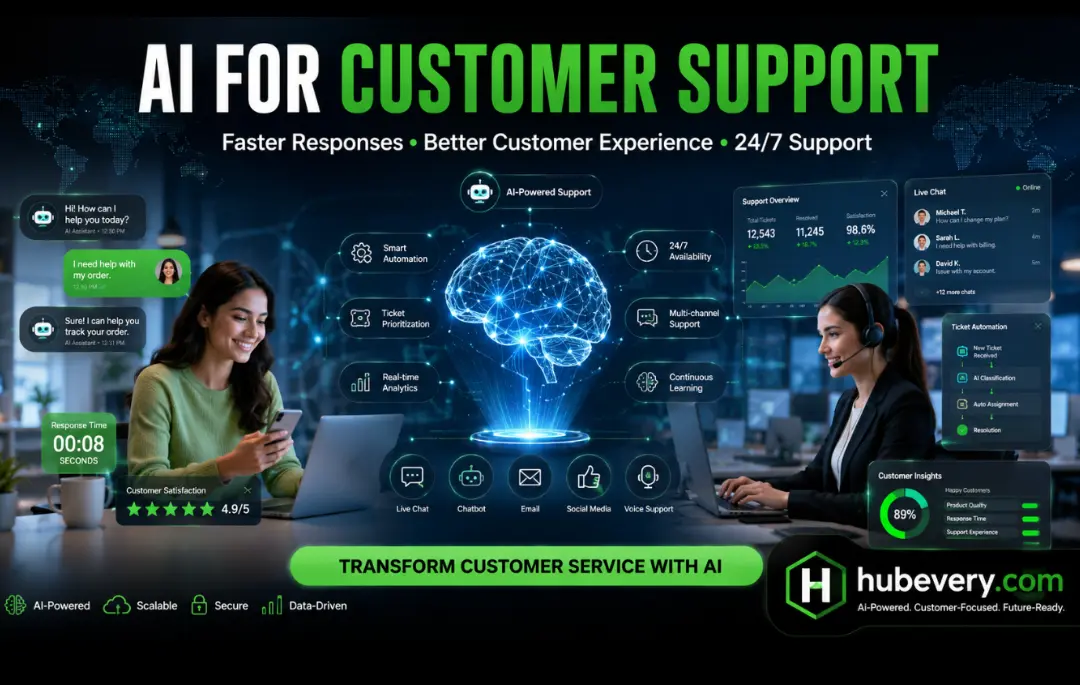
Introduction: The Customer Service Crisis Most Businesses Don’t See Coming
Imagine this scenario.
A customer has a simple question about an order. They visit your website expecting a quick answer. Instead, they are forced to wait on hold for twenty minutes, repeat their problem to three different agents, and still leave without a clear solution.
Frustrating?
Absolutely.
Now imagine the same customer visiting a competitor’s website. Within seconds, they receive an accurate answer, personalized assistance, and a smooth experience from start to finish.
Who do you think will earn that customer’s trust—and future business?
The answer is obvious.
Today’s customers are no longer comparing your business only to your direct competitors. Instead, they compare every experience to the best experience they have ever had. Whether it’s ordering from Amazon, streaming on Netflix, or chatting with a bank’s support team, consumers have become accustomed to speed, convenience, and personalization.
As a result, customer expectations have reached historic highs.
This shift has created a difficult challenge for businesses. Support teams are under pressure to handle more inquiries, customers expect immediate responses, and operational costs continue to rise. Consequently, many organizations are discovering that traditional customer support models are no longer enough.
This is where Artificial Intelligence enters the picture.
AI is not merely another technology trend. Rather, it represents one of the most significant transformations in customer service history. Businesses that embrace AI are finding new ways to deliver faster responses, reduce costs, increase customer satisfaction, and strengthen loyalty. Meanwhile, those that hesitate risk falling behind in an increasingly competitive marketplace.
The question is no longer whether AI will influence customer support.
The real question is whether businesses can afford to ignore it.
What Is AI for Customer Support?
At its core, AI for customer support refers to the use of artificial intelligence technologies to assist customers, automate repetitive tasks, analyze customer behavior, and improve service experiences.
However, many people mistakenly assume that AI customer support simply means chatbots.
The reality is far more powerful.
Modern AI systems can understand customer questions, detect emotions, predict future problems, personalize responses, analyze large amounts of data, and even assist human agents during conversations.
In other words, AI is becoming the invisible engine that powers exceptional customer experiences.
More importantly, it allows businesses to scale customer service without sacrificing quality.
This matters because customer expectations are changing faster than ever before.
Why Customer Expectations Have Changed Forever
A decade ago, customers were willing to wait several days for support responses.
Today, that patience has almost disappeared.
People live in an on-demand world. Food arrives in minutes. Movies start instantly. Products can be delivered the next day. Consequently, customers now expect support to operate at the same speed.
Psychologists describe this behavior through a concept known as Instant Gratification. Human beings naturally prefer immediate rewards over delayed ones. Therefore, when customers receive quick answers, they experience satisfaction and relief. Conversely, delays often trigger frustration and disappointment.
This psychological reality has reshaped customer service.
Businesses are no longer judged solely by product quality or pricing. Instead, they are increasingly judged by how quickly and effectively they solve customer problems.
Unfortunately, many organizations continue relying on outdated support systems that cannot keep pace with these expectations.
As a result, customer loyalty is becoming harder to earn and easier to lose.
The Hidden Psychology Behind Customer Loyalty
Many business owners believe customers stay loyal because of discounts or low prices.
While pricing certainly matters, customer psychology tells a different story.
People remain loyal to brands they trust.
Trust develops when customers consistently feel understood, valued, and supported.
Think about your own experiences.
You may forgive a company for making a mistake. However, you are far less likely to forgive a company that ignores your concerns or wastes your time.
This phenomenon is connected to a psychological principle called the Peak-End Rule. Research suggests that people judge experiences largely based on their most emotional moment and how the experience ends.
Therefore, even a negative situation can become a positive memory if customer support handles it exceptionally well.
AI helps create these positive endings by reducing wait times, providing accurate information, and ensuring customers receive assistance when they need it most.
Over time, these experiences build trust.
And trust ultimately becomes the foundation of loyalty.
How AI Is Revolutionizing Customer Support
The traditional customer support model often suffers from a common problem: limited scalability.
As customer inquiries increase, businesses must hire additional staff, invest in training, and manage growing operational costs.
However, AI changes this equation dramatically.
Instead of requiring human agents to answer every question manually, AI can handle routine inquiries instantly. Customers can receive assistance twenty-four hours a day, seven days a week, regardless of time zones or holidays.
Furthermore, AI never becomes tired, distracted, or overwhelmed during peak demand periods.
This consistency creates a smoother customer experience while allowing support teams to focus on more complex issues.
As a result, businesses can serve more customers without proportionally increasing expenses.
The impact is not merely operational.
It is transformational.
Predictive Customer Support: Solving Problems Before Customers Complain
Perhaps one of the most exciting developments in customer service is predictive support.
Traditionally, customer service has been reactive.
A problem occurs.
The customer notices.
The customer complains.
The company responds.
However, AI is changing this model entirely.
By analyzing customer behavior, purchase patterns, service history, and usage data, AI can often identify potential issues before customers even recognize them.
Imagine receiving a message that says:
“We noticed your shipment may be delayed. We have already taken steps to resolve the issue.”
That small proactive action can dramatically change how customers perceive a brand.
Psychologically, this activates the principle of Reciprocity. When customers feel that a company genuinely cares about their success, they naturally become more willing to trust and support that business.
In a marketplace crowded with competitors, this advantage can be enormous.
AI and Human Agents: The Winning Formula
One of the biggest fears surrounding artificial intelligence is the belief that it will replace human jobs.
However, customer support demonstrates why this fear is often exaggerated.
AI excels at speed, consistency, and data processing.
Humans excel at empathy, creativity, judgment, and emotional intelligence.
These strengths complement each other.
When customers face highly emotional or complex situations, human agents remain irreplaceable. At the same time, AI can eliminate repetitive tasks that consume valuable time.
Rather than replacing support professionals, AI often empowers them.
It allows agents to spend less time searching for information and more time helping customers solve meaningful problems.
Consequently, both customers and employees benefit.
The future of customer support is not humans versus AI.
It is humans and AI working together to create extraordinary experiences.
The Business ROI of AI Customer Support
Every business investment ultimately leads to one important question:
Will it generate results?
Fortunately, AI customer support often delivers measurable returns.
First, it reduces operational costs by automating repetitive inquiries.
Second, it improves productivity by helping agents work more efficiently.
Third, it increases customer retention by improving service quality.
These benefits create a powerful compounding effect.
Consider a company receiving thousands of support requests every month. If AI resolves a significant portion of routine inquiries automatically, human agents can dedicate their attention to higher-value interactions.
Over time, this leads to faster resolutions, happier customers, and stronger profitability.
Perhaps most importantly, AI helps businesses protect their most valuable asset: customer relationships.
In an era where negative reviews can spread instantly across the internet, protecting customer trust is more important than ever.
Best AI Customer Support Tools in 2026
As AI adoption continues to accelerate, several platforms have emerged as industry leaders.
OpenAI’s ChatGPT has become a popular solution for generating support responses, automating conversations, and assisting customer service teams. Meanwhile, Zendesk AI helps organizations streamline ticket management and improve service efficiency.
Intercom has built a reputation for delivering highly conversational customer experiences, while Freshdesk offers affordable AI-powered support solutions for growing businesses. Larger enterprises often turn to Salesforce Einstein because of its advanced predictive capabilities and deep customer insights.
Similarly, HubSpot Service Hub provides an integrated ecosystem that combines customer support with CRM functionality.
Each platform serves different business needs. Therefore, selecting the right tool depends on factors such as budget, customer volume, and operational goals.
The most expensive solution is not always the best one.
The best solution is the one that genuinely improves customer experiences.
Common Mistakes Businesses Make When Implementing AI
Despite its potential, AI is not a magic solution.
Many organizations rush into implementation without a clear strategy.
As a result, they fail to achieve expected outcomes.
One common mistake is over-automation. Customers appreciate convenience, but they also want access to human support when necessary. When businesses force customers through endless automated systems, frustration often increases.
Another challenge involves poor training data. AI systems are only as effective as the information they learn from. If data is inaccurate or outdated, customer experiences can suffer.
Finally, some companies focus heavily on technology while ignoring customer feedback.
This can be a costly mistake.
The most successful AI implementations continuously evolve based on customer needs and real-world performance.
The Future of AI Customer Support
The next decade promises extraordinary change.
AI systems are becoming increasingly intelligent, conversational, and context-aware.
Soon, customer support may become largely proactive rather than reactive.
Businesses will not simply respond to problems.
They will prevent them.
Future AI systems may recognize customer frustration through voice analysis, anticipate needs before questions arise, and provide personalized assistance on an unprecedented scale.
For customers, this means less effort and greater convenience.
For businesses, it means stronger loyalty and improved efficiency.
Those who embrace these innovations today will likely become tomorrow’s industry leaders.
Frequently Asked Questions
Will AI replace human customer support agents?
No. While AI can automate repetitive tasks and improve efficiency, human empathy, creativity, and judgment remain essential for handling complex situations. The future lies in collaboration between humans and AI.
Is AI customer support secure?
Most leading AI platforms use advanced security measures, encryption, and compliance frameworks. However, businesses should always choose trusted providers and follow data protection best practices.
Can small businesses benefit from AI?
Absolutely. Modern AI tools have become increasingly affordable, making them accessible to startups and small businesses seeking to improve customer experiences without dramatically increasing costs.
What is the biggest benefit of AI in customer support?
The greatest advantage is the ability to provide fast, personalized, and consistent support at scale while improving operational efficiency.
How do I choose the right AI support platform?
The ideal solution depends on your business size, budget, customer volume, and integration requirements. Businesses should evaluate tools based on their specific goals rather than simply choosing the most popular option.
Conclusion
Customer support is no longer a back-office function.
It has become one of the most powerful drivers of customer loyalty, brand reputation, and long-term business growth.
Customers today expect immediate responses, personalized experiences, and effortless problem resolution. Businesses that fail to meet these expectations face a difficult reality: customers now have more choices than ever before.
AI offers a powerful solution.
It enables organizations to respond faster, work smarter, reduce costs, and build stronger relationships with customers. Yet the true power of AI is not found in automation alone.
Its greatest value lies in helping businesses create experiences that feel more human, more responsive, and more trustworthy.
The companies that understand this balance will not simply improve customer support.
They will redefine it.
And in a world where trust has become one of the most valuable currencies, that advantage may prove impossible to ignore.
Best AI Customer Support Tools in 2026: Detailed Guide
1. ChatGPT
Official Website: https://openai.com/chatgpt
ChatGPT is one of the most powerful AI assistants available today. Businesses use it to automate customer conversations, generate support replies, create knowledge base content, answer FAQs, and assist support agents. Its ability to understand natural language makes customer interactions feel more human and personalized.
For example, an online store can use ChatGPT to answer questions about shipping, refunds, product details, and order tracking without requiring a human agent for every inquiry.
Best For: Small businesses, startups, e-commerce stores, and SaaS companies.
2. Zendesk AI
Official Website: https://www.zendesk.com
Zendesk AI helps businesses automate customer service operations while maintaining high-quality support. It can automatically categorize support tickets, suggest responses to agents, and route customer issues to the correct department.
One of its strongest features is its ability to centralize customer conversations from multiple channels, including email, chat, social media, and phone support.
Best For: Medium-sized businesses and enterprises handling large customer volumes.
3. Intercom
Official Website: https://www.intercom.com
Intercom is a customer messaging platform that combines AI chatbots with live customer support. Its AI assistant can answer questions using company-specific knowledge and automatically handle routine customer inquiries.
Intercom is particularly popular among SaaS companies because it helps businesses guide users throughout the customer journey, from onboarding to support.
Best For: SaaS companies and online businesses.
4. Freshdesk AI
Official Website: https://www.freshworks.com/freshdesk
Freshdesk is known for being easy to use and affordable. It provides AI-powered chatbots, ticket automation, workflow automation, and omnichannel support capabilities.
Many small businesses choose Freshdesk because it offers enterprise-level features without requiring a large budget.
Best For: Small and medium-sized businesses.
5. Salesforce Einstein AI
Official Website: https://www.salesforce.com
Salesforce Einstein integrates artificial intelligence directly into customer relationship management (CRM) systems. It can predict customer behavior, analyze customer interactions, and recommend the next best actions for support agents.
Large organizations often use Einstein AI to gain deeper customer insights and improve customer retention.
Best For: Large enterprises and multinational organizations.
6. HubSpot Service Hub AI
Official Website: https://www.hubspot.com/products/service
HubSpot Service Hub combines customer support tools with CRM functionality. The platform helps businesses automate support tickets, analyze customer feedback, and provide personalized customer experiences.
Because it integrates with the HubSpot ecosystem, it is especially useful for businesses already using HubSpot for marketing and sales.
Best For: Growing businesses and CRM-focused teams.
7. Tidio
Official Website: https://www.tidio.com
Tidio is a beginner-friendly AI chatbot platform that helps businesses provide instant customer support through websites and online stores.
The platform can answer customer questions, collect leads, and automate routine conversations. Its simple setup process makes it attractive for small businesses that want to start using AI quickly.
Best For: Small businesses, bloggers, and e-commerce websites.
8. Drift
Official Website: https://www.drift.com
Drift focuses on conversational marketing and customer engagement. Instead of simply answering customer questions, it helps businesses qualify leads, book appointments, and guide potential customers through the sales process.
This makes it particularly valuable for B2B companies that rely on website visitors to generate new business opportunities.
Best For: B2B businesses and sales-focused organizations.
9. Ada
Official Website: https://www.ada.cx
Ada is a powerful AI-driven customer support platform designed to automate large volumes of customer interactions. It allows businesses to build sophisticated self-service experiences without requiring customers to wait for human assistance.
Many enterprise brands use Ada to reduce support costs while maintaining high customer satisfaction levels.
Best For: Large customer support teams and enterprise organizations.
10. LivePerson
Official Website: https://www.liveperson.com
LivePerson specializes in conversational AI and messaging-based customer support. It enables businesses to communicate with customers through websites, SMS, mobile apps, and social media channels.
Its AI capabilities help automate conversations while ensuring customers can easily transition to human agents when necessary.
Best For: Enterprises that prioritize messaging-based customer experiences.
Which Tool Should You Choose?
If you are a small business owner, ChatGPT, Tidio, and Freshdesk are excellent starting points because they are relatively affordable and easy to implement.
If your company is growing rapidly and handling a higher volume of customer inquiries, Intercom, Zendesk, and HubSpot Service Hub offer more advanced automation and integration capabilities.
For enterprise organizations managing thousands of customer interactions daily, Salesforce Einstein, Ada, and LivePerson provide the scalability and advanced analytics required to deliver exceptional customer experiences.
Ultimately, the right AI customer support tool is the one that helps your customers get answers faster while making your support team more productive.