
Are Students Who Ignore AI Falling Behind?
Imagine two students sitting in the same classroom. They attend the same lectures, use the same textbooks, and take the same exams. Yet, one consistently finishes assignments faster, understands difficult concepts more easily, and seems less stressed during exam season. What makes the difference?
In many cases, the answer is not intelligence, luck, or even extra study hours. The difference is how effectively they use technology.
Artificial Intelligence is rapidly changing the educational landscape across the United States. While some students continue to rely solely on traditional study methods, others are learning how to use AI as a powerful academic partner. This shift is creating a new reality: students who learn to work alongside AI may gain a significant advantage over those who choose to ignore it.
This doesn’t mean AI replaces hard work. In fact, students who expect AI to do all the work for them often struggle in the long run. The real advantage comes from using AI to learn faster, understand deeper, and study smarter. That is where the true challenge begins.
The Education System Is Changing Faster Than Most Parents Realize
For decades, success in school followed a predictable formula. Students attended classes, completed homework, studied for exams, and hoped their efforts translated into good grades. However, today’s students are growing up in a world where information is available instantly.
The challenge is no longer finding information. The challenge is understanding it, organizing it, and applying it effectively.
This is precisely why AI has become such a transformative force in education. Instead of spending hours searching for explanations across dozens of websites, students can receive personalized guidance within seconds. Complex topics that once felt overwhelming can be broken down into simple, understandable lessons tailored to a student’s learning style.
For parents, this shift can feel both exciting and concerning. On one hand, AI offers opportunities that previous generations never had. On the other hand, many families worry that students may become dependent on technology.
The truth lies somewhere in the middle. AI is neither a miracle solution nor a threat to education. It is a tool, and like every powerful tool, its impact depends entirely on how it is used.
Why Traditional Study Methods Are No Longer Enough
Many students still believe that spending more hours studying automatically leads to better results. While dedication remains important, the modern academic environment demands something more valuable: efficiency.
Consider a student preparing for a difficult biology exam. In the past, they might spend hours rereading textbook chapters, highlighting notes, and hoping the information sticks. Today, AI can generate personalized quizzes, explain difficult concepts in multiple ways, and identify knowledge gaps that require additional attention.
As a result, students can focus their energy where it matters most instead of wasting time on ineffective study habits.
This creates an uncomfortable question for students: if technology can help you learn faster and understand more, is refusing to use it really a sign of discipline—or a disadvantage?
The students who answer this question correctly may gain a competitive edge not only in school but also in future careers.
ChatGPT: The Academic Assistant Available 24/7
One of the biggest frustrations students face is getting stuck when no help is available. A difficult math problem at midnight or a confusing science concept before an exam can quickly lead to stress and frustration.
This is where ChatGPT has become a game-changer.
Rather than acting as a simple answer machine, ChatGPT can function as a personal tutor that explains concepts, answers questions, and provides step-by-step guidance. Students can ask follow-up questions as many times as necessary without fear of judgment.
What makes this particularly powerful is the ability to adapt explanations to different learning levels. A complicated topic can be transformed into language that feels approachable and easy to understand.
However, there is a challenge. Students who use ChatGPT merely to copy answers miss its greatest benefit. The students who gain the most are those who use it to improve their understanding rather than avoid effort.
Grammarly Is Quietly Improving Student Writing Across America
Strong writing skills have always been valuable, but in today’s competitive academic environment, they are becoming increasingly important.
Unfortunately, many students struggle to communicate their ideas clearly. They may understand a topic perfectly yet lose points because their writing lacks structure, clarity, or grammatical accuracy.
Grammarly addresses this challenge by providing real-time feedback that helps students strengthen their writing abilities. Instead of simply correcting mistakes, it teaches students why certain improvements matter.
Over time, this creates a powerful effect. Students begin developing stronger communication skills, which benefits not only academic performance but also future college applications and professional opportunities.
In a world where communication often determines success, writing well is no longer optional. It is a competitive advantage.
The Hidden Reason Students Are Turning to AI Study Tools
Many parents assume students use AI primarily because they want easier assignments. Surprisingly, that is often not the case.
The real reason many students embrace AI is because they feel overwhelmed.
Modern students face academic pressure unlike any previous generation. Advanced coursework, standardized tests, extracurricular commitments, social expectations, and college admissions competition create a constant demand for high performance.
AI tools help reduce this pressure by providing clarity during moments of confusion.
Instead of spending hours feeling stuck, students can continue making progress. This creates momentum, and momentum is one of the most powerful forces in learning.
When students experience small victories consistently, they become more motivated to keep going.
The Biggest Mistake Students Can Make with AI
While AI offers incredible advantages, it also introduces a serious risk.
The temptation to let technology think on your behalf is stronger than ever.
Students who blindly accept AI-generated responses without questioning them may unintentionally weaken their critical thinking abilities. Over time, this habit can become a major obstacle to genuine learning.
The most successful students understand a simple principle: AI should enhance thinking, not replace it.
Every answer generated by AI should be treated as a starting point for deeper understanding rather than a final destination.
The future belongs to students who know how to ask better questions, evaluate information critically, and think independently. AI can support these skills, but it cannot develop them automatically.
Parents Have a Bigger Role Than They Think
Many parents wonder whether they should allow their children to use AI tools. The better question might be whether they can afford not to teach their children how to use them responsibly.
Technology will continue advancing regardless of personal opinions. The students entering college and the workforce over the next decade will encounter AI in nearly every aspect of life.
Instead of resisting this reality, parents can help children develop healthy habits around AI usage. Open conversations about ethics, responsibility, and independent thinking are often more effective than strict restrictions.
When parents stay involved and students remain accountable, AI becomes a powerful educational ally rather than a distraction.
The Future Will Reward Students Who Learn Differently
The world is entering a new era where information is abundant, but understanding remains rare.
The students who thrive will not necessarily be those who memorize the most facts. Instead, they will be the ones who learn how to think critically, adapt quickly, and use technology intelligently.
AI is not eliminating the need for education. If anything, it is raising the standard.
Students who learn how to leverage AI responsibly will have access to opportunities that previous generations could only imagine. Those who ignore these tools entirely may eventually find themselves competing against peers who can learn faster, solve problems more efficiently, and adapt more quickly to change.
That reality may sound challenging, but it is also incredibly exciting.
The question is no longer whether AI will influence education.
The question is whether students are prepared to use it wisely.
And for many families across America, the answer to that question may determine academic success for years to come.
AI Tools Mentioned in the Article
As technology continues to reshape education, students are discovering that AI is useful for much more than homework assistance and exam preparation. Many are now using AI to create presentations, design school projects, generate visual content, and enhance their creativity in ways that were unimaginable just a few years ago. In fact, AI-powered image generation has become one of the fastest-growing technologies among students, content creators, and young entrepreneurs. Understanding these tools can give students an additional advantage in both academic and creative environments.
add FAQ section of 5 questions
Frequently Asked Questions (FAQs)
1. What are the best AI tools for students in 2026?
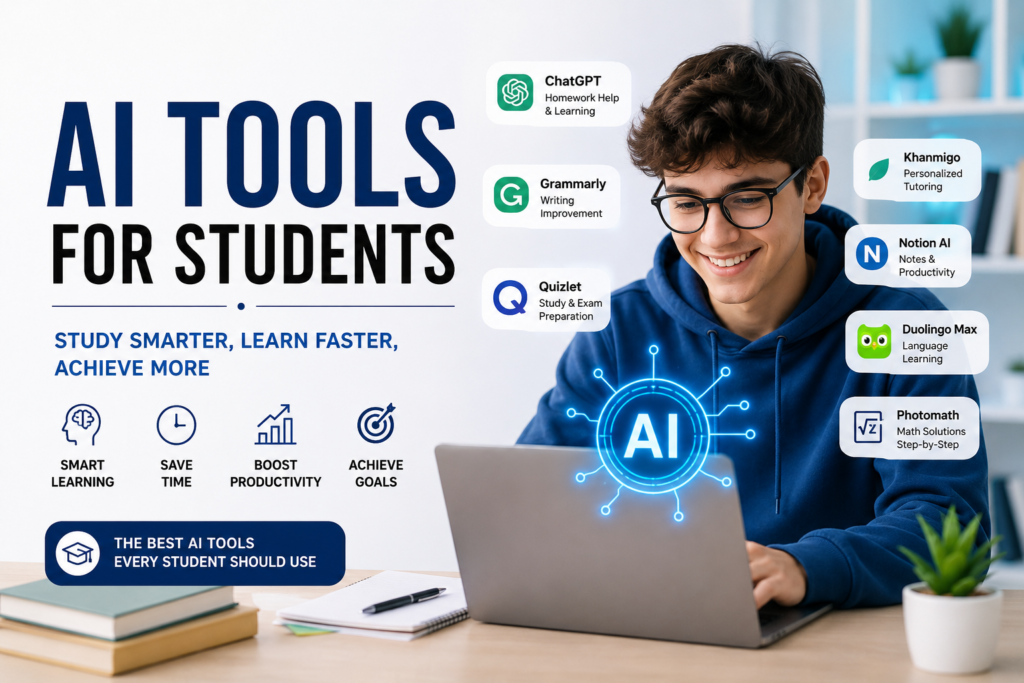
Some of the best AI tools for students in 2026 include ChatGPT for homework assistance and learning support, Grammarly for writing improvement, Khanmigo for personalized tutoring, Quizlet AI for exam preparation, Notion AI for productivity, Duolingo Max for language learning, and Photomath for solving math problems step by step. Each tool serves a different purpose and can help students improve both academic performance and study efficiency.
2. Are AI tools safe for students to use?
Most popular AI tools are generally safe when used responsibly and under appropriate supervision. Parents and students should review privacy policies, avoid sharing sensitive personal information, and use trusted educational platforms. AI should be treated as a learning assistant rather than a replacement for teachers or independent thinking.
3. Can AI tools help students improve their grades?
AI tools can help students improve their grades by providing personalized explanations, instant feedback, better organization, and more effective study methods. However, the greatest benefits come when students use AI to understand concepts rather than simply copy answers. Consistent effort and critical thinking remain essential for academic success.
4. Will AI replace teachers in the future?
No, AI is unlikely to replace teachers. While AI can provide tutoring, explanations, and personalized learning support, teachers offer mentorship, emotional guidance, classroom management, and real-world experience that technology cannot fully replicate. AI is best viewed as a tool that supports both students and educators.
5. How can parents encourage responsible AI use?
Parents can encourage responsible AI use by discussing academic integrity, setting clear expectations, and teaching students how to verify information independently. Instead of using AI as a shortcut, students should learn how to use it as a tool for research, learning, creativity, and problem-solving. Open communication and guidance are key to ensuring a healthy balance between technology and education.