
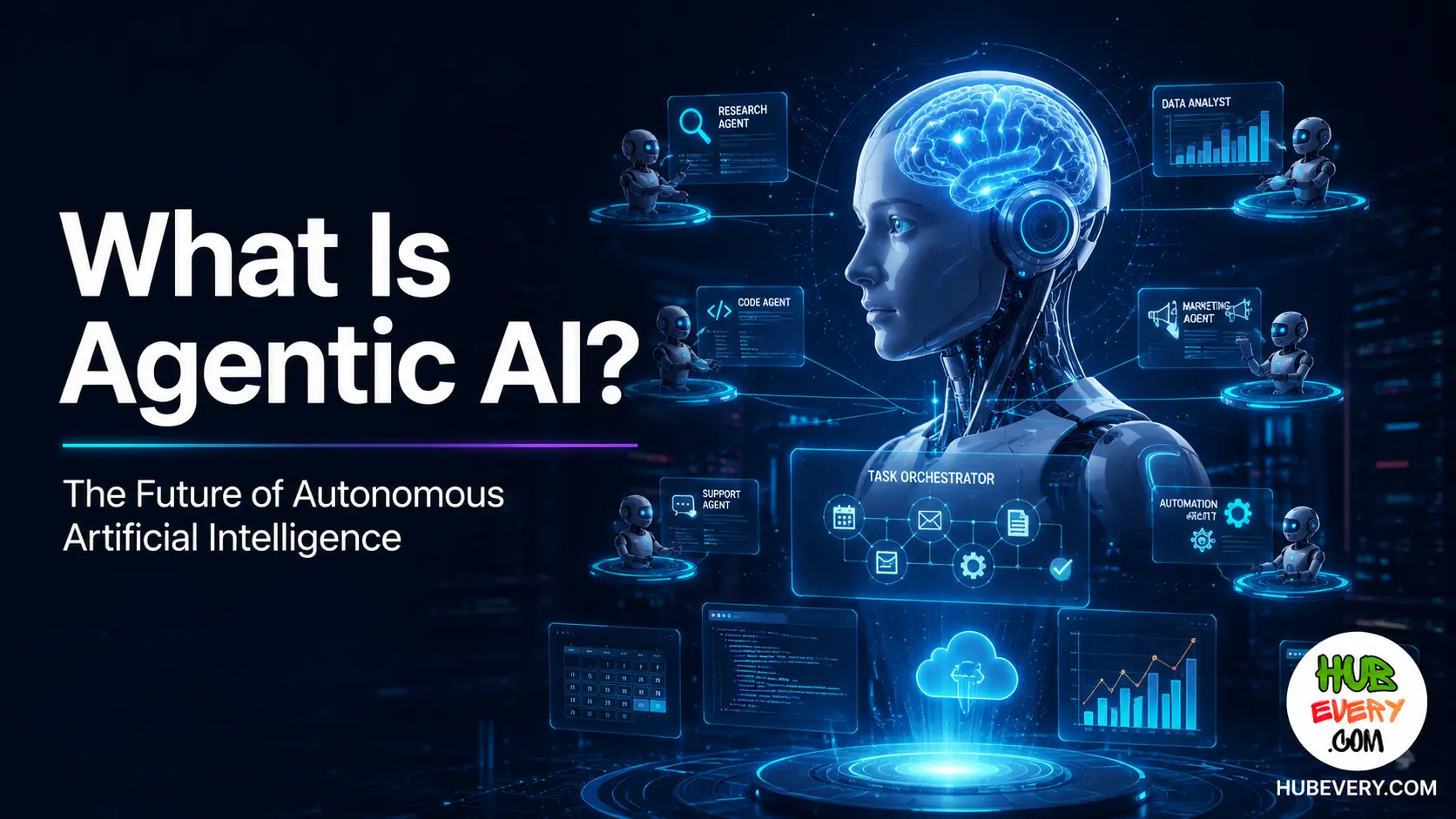
Artificial Intelligence has transformed the way people work, communicate, and solve problems. Over the last few years, AI has evolved from simple rule-based systems to advanced models capable of generating text, images, videos, and even software code. However, technology is now entering a new phase known as Agentic AI, which is widely considered the next major step in the evolution of artificial intelligence.
Unlike traditional AI systems that only respond to prompts or questions, Agentic AI is designed to understand goals, make decisions, create plans, use digital tools, and complete tasks with minimal human involvement. In other words, instead of acting like a chatbot that waits for instructions, Agentic AI behaves more like a highly skilled digital assistant that can independently work toward achieving a specific objective.
As businesses continue to embrace automation and digital transformation, Agentic AI is becoming one of the most discussed topics in the technology industry. Leading companies are investing billions of dollars in AI agents capable of handling complex workflows that previously required human intelligence. Consequently, understanding Agentic AI has become essential for business owners, students, developers, marketers, and professionals who want to stay ahead in the rapidly changing digital landscape.
In this comprehensive guide, you will learn what Agentic AI is, how it works, why it is different from traditional AI, and why experts believe it will redefine the future of work.
What Is Agentic AI?
Want to build your own AI-powered website? Read our detailed guide on the best AI website builders here: https://hubevery.com/ai-website-builders-compared/
Agentic AI is a type of artificial intelligence that can independently pursue a goal by planning, reasoning, making decisions, and taking actions without requiring constant human guidance. Rather than waiting for every individual instruction, an Agentic AI system identifies what needs to be done, determines the best strategy, and continues working until the objective is achieved.
To understand this concept more clearly, imagine asking a traditional AI chatbot to organize a business trip. Most chatbots would provide suggestions for flights, hotels, and travel destinations. Although this information is useful, the responsibility of comparing prices, selecting options, making reservations, and creating an itinerary still falls on the user.
An Agentic AI system approaches the same request very differently. After understanding the objective, it researches available flights, compares ticket prices, identifies hotels that match the budget, prepares a detailed travel schedule, books reservations through connected services, adds important events to the calendar, and even sends reminders before departure. Throughout this process, it continuously evaluates new information and adjusts its decisions whenever necessary.
This ability to think through multiple steps, adapt to changing circumstances, and complete an entire workflow is what separates Agentic AI from previous generations of artificial intelligence.
The word “agentic” comes from the concept of an “agent,” which refers to an entity capable of acting independently to achieve a desired outcome. Therefore, Agentic AI is not simply designed to answer questions. Instead, it is built to accomplish meaningful tasks by combining intelligence, planning, reasoning, memory, and action into one coordinated system.
Because of these capabilities, many technology experts believe Agentic AI represents a shift from reactive AI to proactive AI. Rather than waiting for users to explain every detail, these intelligent systems anticipate requirements, evaluate available options, and execute appropriate actions on behalf of the user.
How Does Agentic AI Work?

Although Agentic AI appears highly intelligent, its operation follows a structured process that combines several advanced AI technologies. Every successful AI agent begins by understanding the user’s objective instead of merely interpreting individual instructions. This difference allows the system to focus on achieving a final result rather than simply completing isolated commands.
For example, suppose a business owner instructs an AI agent to increase website traffic over the next three months. Instead of asking for additional guidance after every step, the AI first analyzes the objective and identifies possible strategies that could contribute to the desired outcome. It may determine that improving search engine optimization, publishing high-quality articles, updating older content, increasing social media engagement, and monitoring competitors are all necessary parts of the overall plan.
Once the objective has been understood, the AI creates a detailed execution strategy. Rather than performing random actions, it organizes tasks into a logical sequence. This planning capability allows the system to prioritize activities, estimate their impact, and allocate available resources efficiently. As a result, complex projects become easier to manage because every action contributes toward the final goal.
Reasoning plays an equally important role in Agentic AI. During execution, the system constantly evaluates information, compares alternatives, predicts outcomes, and selects the most effective course of action. If new circumstances arise, such as unexpected market changes or updated user preferences, the AI modifies its strategy without requiring complete reprogramming. Consequently, it remains flexible even when working in dynamic environments.
Another defining characteristic of Agentic AI is its ability to interact with external digital tools. Modern AI agents are capable of connecting with search engines, databases, email platforms, calendars, cloud storage services, customer relationship management software, productivity applications, and numerous APIs. Instead of simply generating text-based recommendations, these systems perform meaningful actions within real software environments. This capability enables them to automate complex workflows that previously demanded significant human effort.
Memory also contributes significantly to the effectiveness of Agentic AI. Unlike basic chatbots that often forget previous interactions, advanced AI agents maintain contextual awareness throughout long tasks. They remember earlier decisions, track completed activities, monitor remaining objectives, and use accumulated information to improve future decisions. Because of this persistent memory, the quality and consistency of task execution improve considerably over time.
Perhaps the most remarkable feature of Agentic AI is its continuous feedback mechanism. After completing each action, the system evaluates whether the result moves it closer to the intended objective. If the outcome is satisfactory, it proceeds to the next stage. However, if the result falls short of expectations, the AI revises its strategy, explores alternative solutions, and continues working until it achieves the desired outcome. This iterative process closely resembles the way experienced professionals solve real-world problems by learning from each step and refining their approach.
Taken together, these capabilities enable Agentic AI to function as far more than a conversational assistant. It becomes an intelligent digital collaborator capable of planning, reasoning, adapting, and executing sophisticated workflows with minimal human supervision. As organizations increasingly seek efficient ways to automate knowledge-based work, these qualities are expected to make Agentic AI one of the most influential technologies of the coming decade.
What Is Agentic AI? The Future of Autonomous Artificial Intelligence
Agentic AI vs Traditional AI
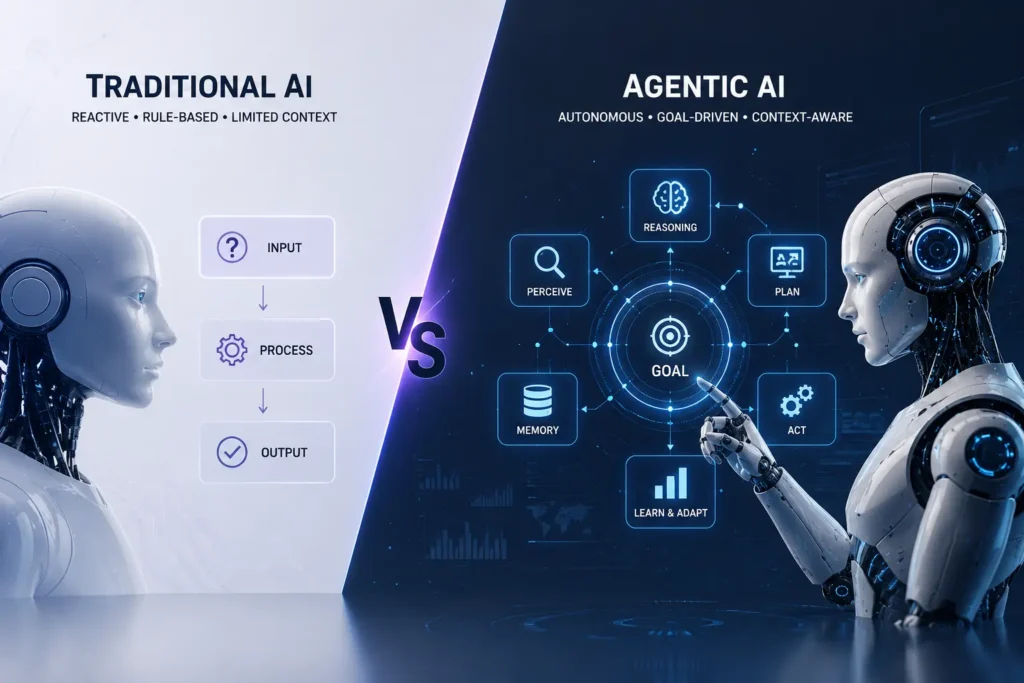
To fully understand the significance of Agentic AI, it is important to compare it with traditional artificial intelligence. Although both technologies rely on machine learning, natural language processing, and advanced algorithms, their objectives and capabilities differ considerably.
Traditional AI is primarily designed to respond to user inputs. It waits for a question, processes the available information, and then generates an appropriate answer. While this approach works well for chatbots, recommendation systems, and content generation tools, it has a major limitation. Every new task usually requires another prompt or additional human guidance. Consequently, users remain responsible for planning the workflow, making decisions, and carrying out most of the actions.
Agentic AI, on the other hand, focuses on achieving a goal rather than simply responding to instructions. After receiving an objective, it creates a structured plan, determines the best sequence of actions, evaluates available options, and continuously adapts its strategy based on new information. Instead of stopping after generating an answer, it keeps working until the assigned objective is completed.
For instance, if someone asks a traditional AI to launch a marketing campaign, it may produce advertising ideas, write promotional content, or suggest keywords. However, an Agentic AI system can go much further. It may analyze competitors, identify the target audience, create marketing content, schedule social media posts, monitor campaign performance, adjust advertising strategies, and generate detailed reports without requiring constant supervision. Therefore, Agentic AI transforms artificial intelligence from a passive assistant into an active digital collaborator capable of handling complex workflows.
This shift from reactive intelligence to proactive decision-making is one of the primary reasons why businesses around the world are rapidly investing in AI agents.
Real-World Applications of Agentic AI
The practical applications of Agentic AI extend across nearly every major industry. As organizations continue to automate repetitive processes and improve operational efficiency, AI agents are becoming valuable digital workers capable of managing increasingly sophisticated responsibilities.
In the healthcare sector, Agentic AI has the potential to simplify administrative operations while allowing medical professionals to focus more on patient care. Intelligent agents can organize medical records, coordinate appointments, assist with clinical documentation, monitor treatment schedules, and analyze research data. Furthermore, they can identify unusual patterns in patient information and provide timely recommendations that support healthcare professionals in making informed decisions.
The financial industry is also embracing Agentic AI to improve speed, accuracy, and security. Banks and investment firms use intelligent agents to detect fraudulent transactions, evaluate financial risks, monitor market conditions, generate investment insights, and automate compliance reporting. Since financial institutions process enormous volumes of data every second, Agentic AI enables them to identify valuable patterns much faster than traditional software systems.
Software development represents another area where Agentic AI is creating significant change. Modern AI agents can assist developers throughout the entire software lifecycle by writing code, reviewing programs, identifying bugs, suggesting improvements, testing applications, and even deploying updates. As a result, development teams can complete projects more efficiently while maintaining high-quality standards.
Marketing departments are increasingly relying on Agentic AI to automate complex digital campaigns. Rather than simply generating content, AI agents can research customer behavior, analyze competitor strategies, identify high-performing keywords, optimize websites for search engines, schedule promotional content, monitor engagement metrics, and continuously improve campaign performance based on real-time analytics. Consequently, businesses achieve better results while reducing the amount of manual work required from marketing professionals.
Customer service has also become one of the most promising applications of Agentic AI. Instead of answering only simple questions, intelligent agents can resolve complaints, process refunds, update customer records, coordinate follow-up communications, and escalate complex situations to human representatives whenever necessary. This combination of automation and intelligent decision-making allows organizations to deliver faster, more personalized customer experiences.
Educational institutions are beginning to explore the benefits of Agentic AI as well. Personalized learning assistants can evaluate a student’s progress, recommend study materials, generate practice exercises, answer questions, and adapt lesson plans according to individual learning styles. Therefore, education becomes more flexible, engaging, and accessible for learners with different abilities and academic goals.
Supply chain management is another field experiencing rapid transformation through Agentic AI. Intelligent agents can monitor inventory levels, forecast product demand, optimize delivery routes, coordinate suppliers, identify potential disruptions, and recommend alternative solutions before problems affect business operations. As global supply chains become increasingly complex, these capabilities help organizations reduce costs while improving efficiency and reliability.
Benefits of Agentic AI
The growing popularity of Agentic AI is largely driven by the substantial benefits it offers to businesses, governments, and individual users. Unlike conventional automation systems that follow fixed rules, Agentic AI combines reasoning, planning, adaptability, and decision-making to deliver more intelligent outcomes.
One of its most significant advantages is improved productivity. By automating repetitive and time-consuming activities, AI agents enable professionals to concentrate on creative thinking, strategic planning, and complex problem-solving. Instead of spending hours managing administrative tasks, employees can dedicate their efforts to work that generates greater value for their organizations.
Another important benefit is faster decision-making. Agentic AI can analyze enormous quantities of structured and unstructured information within seconds, identify meaningful patterns, compare multiple scenarios, and recommend the most effective course of action. Consequently, organizations can respond more quickly to changing market conditions and customer demands.
Cost reduction also represents a major advantage. Since AI agents can perform many routine tasks continuously without requiring breaks, businesses often reduce operational expenses while maintaining consistent performance. Although implementing Agentic AI may require an initial investment, the long-term savings associated with automation frequently outweigh the upfront costs.
Accuracy is equally important. Human workers naturally experience fatigue and occasional errors, particularly when performing repetitive activities for extended periods. Agentic AI minimizes these mistakes by following structured reasoning processes and continuously verifying its progress. As a result, organizations achieve greater consistency across a wide range of business operations.
Scalability further distinguishes Agentic AI from traditional approaches. As business demands increase, intelligent agents can manage larger workloads without requiring organizations to expand their workforce at the same rate. This flexibility allows companies to grow more efficiently while maintaining service quality.
Finally, Agentic AI contributes to a significantly better customer experience. Modern consumers expect quick responses, personalized recommendations, and uninterrupted service. Because AI agents operate around the clock and continuously learn from previous interactions, they can deliver highly responsive and customized support that strengthens customer satisfaction and long-term loyalty.
Taken together, these advantages explain why Agentic AI is rapidly becoming a strategic priority for organizations worldwide. As the technology continues to mature, its ability to improve productivity, reduce costs, enhance decision-making, and automate sophisticated workflows is expected to reshape the future of work across virtually every industry.
What Is Agentic AI? The Future of Autonomous Artificial Intelligence
Challenges and Limitations of Agentic AI
Despite its enormous potential, Agentic AI is not without challenges. Although these intelligent systems can perform increasingly sophisticated tasks, they still depend on the quality of the data, tools, and instructions they receive. Therefore, organizations must carefully evaluate both the opportunities and the risks before deploying AI agents on a large scale.
One of the most significant concerns is data privacy. Since Agentic AI often requires access to sensitive information such as customer records, financial data, healthcare information, and internal business documents, protecting this data becomes a top priority. Companies must implement strong security measures, encryption standards, and strict access controls to ensure that confidential information remains protected. Moreover, compliance with international privacy regulations such as the GDPR and other regional laws is becoming increasingly important as AI adoption grows.
Another challenge involves accuracy and reliability. While Agentic AI can reason through complex problems, it is not infallible. Occasionally, AI systems may generate incorrect conclusions, misunderstand user intentions, or rely on outdated information. Consequently, human oversight remains essential, especially in industries such as healthcare, finance, law, and public safety, where even minor mistakes can have serious consequences.
Ethical considerations also play a crucial role in the development of Agentic AI. As these systems become more autonomous, important questions arise regarding accountability, transparency, and fairness. Organizations must establish clear governance policies that define how AI agents make decisions and who is responsible when unexpected outcomes occur. In addition, developers must work to minimize algorithmic bias so that AI systems treat individuals fairly regardless of their background or circumstances.
Cybersecurity presents another important concern. Because Agentic AI can interact directly with digital tools, software platforms, and online services, malicious actors may attempt to exploit vulnerabilities if appropriate safeguards are not in place. For this reason, businesses should continuously monitor AI activities, perform regular security audits, and implement robust authentication mechanisms to reduce potential risks.
Furthermore, organizations may encounter implementation challenges during the early stages of adoption. Integrating Agentic AI into existing business systems often requires technical expertise, employee training, workflow redesign, and ongoing maintenance. Although the long-term benefits are substantial, successful implementation depends on careful planning and continuous improvement.
The Future of Agentic AI
The future of Agentic AI appears exceptionally promising. As advances in machine learning, natural language processing, robotics, and cloud computing continue to accelerate, AI agents are expected to become significantly more capable, reliable, and adaptable than they are today.
In the coming years, businesses are likely to rely on teams of specialized AI agents that collaborate with one another to accomplish complex objectives. Instead of assigning every responsibility to a single system, organizations may deploy multiple AI agents, each with expertise in a specific domain such as finance, marketing, customer support, software development, legal research, or supply chain management. These intelligent agents will communicate, share information, and coordinate their efforts much like human departments working together within a company.
The workplace itself is also expected to change dramatically. Rather than replacing human professionals entirely, Agentic AI will most likely function as an intelligent partner that handles repetitive, data-intensive, and administrative responsibilities. This shift will allow employees to devote more time to creativity, innovation, strategic planning, leadership, and relationship building. Consequently, human expertise and AI automation will increasingly complement one another instead of competing directly.
Advancements in robotics may further expand the capabilities of Agentic AI beyond digital environments. Intelligent robots equipped with autonomous decision-making abilities could assist in manufacturing, warehouse management, agriculture, disaster response, scientific research, and healthcare support. As these technologies mature, AI agents may become valuable contributors in both virtual and physical workplaces.
Governments and international organizations are also expected to introduce more comprehensive regulations governing autonomous AI systems. These policies will likely focus on transparency, accountability, cybersecurity, privacy protection, and ethical decision-making. As a result, businesses adopting Agentic AI will need to balance innovation with responsible governance to maintain public trust and regulatory compliance.
Although the technology is still evolving, many experts believe that Agentic AI represents one of the most important developments in the history of artificial intelligence. Its ability to reason, plan, adapt, and execute complex workflows has the potential to reshape industries, redefine productivity, and transform the relationship between humans and machines.
Frequently Asked Questions
Many readers wonder whether Agentic AI is the same as Generative AI. While the two technologies are closely related, they serve different purposes. Generative AI focuses primarily on creating content such as text, images, videos, and computer code. Agentic AI builds upon these capabilities by adding planning, reasoning, decision-making, memory, and autonomous task execution. In simple terms, Generative AI creates information, whereas Agentic AI uses that information to achieve specific goals.
Another common question concerns job replacement. Although Agentic AI will automate many repetitive and administrative tasks, it is unlikely to eliminate the need for human professionals altogether. Instead, it will change the nature of work by allowing people to focus on activities that require creativity, emotional intelligence, critical thinking, and strategic judgment. Therefore, professionals who learn to collaborate effectively with AI agents are expected to remain highly valuable in the future workforce.
Readers also frequently ask whether Agentic AI is safe to use. The answer depends largely on how the technology is designed, implemented, and supervised. When supported by strong cybersecurity practices, transparent governance, responsible development, and human oversight, Agentic AI can operate safely and efficiently across a wide variety of industries. Nevertheless, continuous monitoring remains essential to ensure reliable and ethical performance.
Finally, many people are curious about which industries will benefit the most from Agentic AI. While technology companies have been among the earliest adopters, healthcare, finance, education, manufacturing, retail, logistics, customer service, software development, legal services, and digital marketing are all expected to experience significant transformation as autonomous AI systems become more sophisticated.
Conclusion
Agentic AI represents a major milestone in the ongoing evolution of artificial intelligence. Unlike traditional AI systems that simply respond to prompts, Agentic AI possesses the ability to understand objectives, develop strategic plans, make informed decisions, adapt to changing circumstances, and execute complex tasks with minimal human intervention. These capabilities position it as one of the most powerful technologies shaping the future of business, education, healthcare, finance, and countless other industries.
As organizations continue to pursue greater efficiency and innovation, the demand for intelligent AI agents will only continue to grow. However, responsible adoption will require careful attention to privacy, cybersecurity, ethics, transparency, and regulatory compliance. Businesses that successfully balance technological advancement with responsible governance will be better prepared to unlock the full potential of autonomous artificial intelligence.
Ultimately, Agentic AI should not be viewed as a replacement for human intelligence but rather as a powerful partner that enhances human capabilities. By automating repetitive work, supporting informed decision-making, and enabling professionals to focus on creativity and innovation, Agentic AI has the potential to redefine productivity and reshape the future of work for generations to come.
Frequently Asked Questions (FAQs)
1. What is Agentic AI?
Agentic AI is an advanced type of artificial intelligence that can understand goals, make decisions, create plans, and complete multi-step tasks with minimal human intervention. Unlike traditional AI, it doesn’t just answer questions—it actively works toward achieving specific objectives.
2. How is Agentic AI different from traditional AI?
Traditional AI mainly responds to user prompts and performs individual tasks, whereas Agentic AI can independently plan, reason, adapt, and execute complex workflows. It uses memory, external tools, and continuous decision-making to achieve long-term goals.
3. What are the real-world applications of Agentic AI?
Agentic AI is used across industries such as healthcare, finance, customer service, software development, marketing, education, logistics, and e-commerce. It helps automate repetitive tasks, improve productivity, streamline business operations, and support faster decision-making.
4. What are the benefits of Agentic AI?
The key benefits of Agentic AI include increased productivity, reduced operational costs, improved accuracy, faster decision-making, 24/7 task automation, and enhanced customer experiences. It allows businesses and professionals to focus more on strategic and creative work instead of repetitive tasks.
5. What is the future of Agentic AI?
The future of Agentic AI is expected to be transformative as organizations continue adopting autonomous AI systems. Experts believe AI agents will become more intelligent, collaborative, and capable of managing complex workflows, making them an essential part of business operations, digital transformation, and workplace productivity in the years ahead.
For a deeper understanding of Agentic AI, explore IBM’s official guide, which explains its concepts, architecture, and real-world applications in detail: https://www.ibm.com/think/topics/agentic-ai