
Imagine walking through a new city while your glasses quietly translate street signs into English, answer your questions about nearby landmarks, remind you about your next meeting, and even help you identify a product simply by looking at it. Just a few years ago, this sounded like science fiction. However, in 2026, it is quickly becoming a reality. Artificial intelligence is no longer limited to smartphones and computers. Instead, it is moving directly into wearable technology, and AI smart glasses are leading this exciting transformation.
If you have been wondering, what are AI smart glasses, you are not alone. Millions of people across the United States are becoming curious about this next generation of wearable devices. As AI continues to evolve, more consumers are asking whether smart glasses could eventually replace smartphones or simply become a powerful companion for everyday life.
In this beginner-friendly guide, you will learn exactly what AI smart glasses are, how they work, what makes them different from traditional smart glasses, and why experts believe they could become one of the biggest technology trends of the decade.
Artificial intelligence has changed the way we search online, communicate with others, and complete everyday tasks. Now, that same intelligence is becoming part of something you can wear comfortably throughout the day. Rather than pulling out your phone every few minutes, AI smart glasses allow you to interact naturally with technology while keeping your hands free and your attention focused on the world around you.
Before diving deeper into wearable AI, you may also enjoy reading our detailed comparison of AI Search vs Google Search, which explains how intelligent search technology is reshaping the internet and everyday digital experiences:
https://hubevery.com/ai-search-vs-google-search-which-one-is-better-in-2026/
What Are AI Smart Glasses?
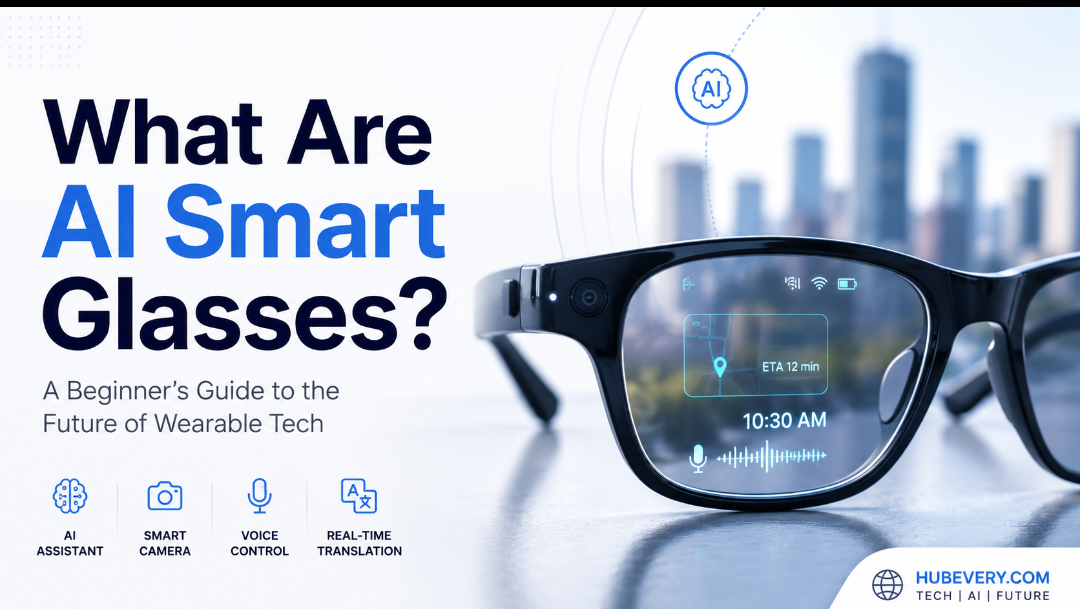
AI smart glasses are wearable devices that combine traditional eyewear with artificial intelligence, cameras, microphones, speakers, wireless connectivity, and advanced sensors. Unlike ordinary glasses, these devices can understand voice commands, recognize objects, provide real-time information, translate conversations, summarize what they see, and answer questions almost instantly.
Instead of simply displaying notifications like early smart glasses did, modern AI glasses actively understand your surroundings. They use powerful AI models together with cloud computing and on-device processing to interpret what the camera sees and respond intelligently.
For example, imagine walking into a grocery store and asking, “Which cereal has the least sugar?” Your AI glasses can analyze the shelves, identify products, compare nutrition labels, and provide a spoken answer within seconds. That level of contextual understanding is what separates AI smart glasses from previous generations of wearable technology.
This remarkable capability is possible because artificial intelligence combines computer vision, natural language processing, machine learning, and voice recognition into one seamless experience. As a result, users interact with technology in a way that feels much more natural and intuitive.
How Do AI Smart Glasses Work?
Although AI smart glasses may seem incredibly advanced, the basic concept is surprisingly easy to understand. Every pair contains several important components working together at the same time.
A tiny camera continuously captures visual information whenever you choose to activate it. Multiple microphones listen for voice commands while advanced speakers deliver responses privately without disturbing people nearby. Built-in sensors monitor movement and orientation, allowing the glasses to understand where you are looking.
Once the glasses collect information, artificial intelligence begins analyzing it almost immediately. Some processing happens directly inside the device, making simple tasks faster while protecting privacy. More advanced requests are securely processed in the cloud, where larger AI models generate highly accurate responses.
For instance, if you ask, “What building am I looking at?” the camera captures the image, AI identifies the landmark, retrieves relevant information, and then speaks the answer back to you within moments. This entire process feels almost effortless from the user’s perspective.
Because AI continues learning from enormous amounts of data, these systems become increasingly accurate at recognizing objects, understanding speech, and responding naturally. Consequently, the experience feels less like using a gadget and more like talking to a knowledgeable assistant walking beside you.
Why Are AI Smart Glasses Becoming So Popular?
Several years ago, wearable technology struggled to gain mainstream attention because many products felt bulky, expensive, or difficult to use. Fortunately, today’s AI smart glasses are significantly more comfortable, stylish, and intelligent.
One major reason for their growing popularity is convenience. Instead of constantly checking a smartphone, users can receive information instantly without interrupting conversations or daily activities. This hands-free experience feels incredibly natural, especially while driving, cooking, traveling, exercising, or working.
Another important factor is the rapid improvement of artificial intelligence. Modern AI assistants understand natural conversations much better than earlier voice assistants. Rather than memorizing specific commands, users can simply speak normally, making interactions smoother and less frustrating.
Battery technology, lightweight materials, and compact processors have also improved dramatically. As a result, many modern AI smart glasses look surprisingly similar to ordinary eyewear, making people feel more comfortable wearing them throughout the day.
At the same time, companies are investing billions of dollars into wearable AI because they believe it represents the next major computing platform after smartphones. This intense competition is accelerating innovation, bringing consumers better features every year.
Real-Life Uses of AI Smart Glasses
One of the biggest reasons people are excited about AI smart glasses is their ability to solve everyday problems in practical ways. Instead of existing as futuristic gadgets with limited usefulness, these devices are becoming valuable companions in countless situations.
Consider someone traveling abroad. Language barriers often create stress and confusion. AI smart glasses can translate conversations almost instantly, helping travelers communicate more confidently while enjoying richer cultural experiences.
Students are also discovering exciting possibilities. During study sessions, AI glasses can explain complex concepts, identify objects in science laboratories, summarize information, or answer educational questions without forcing students to stop their work and search manually.
Professionals benefit in different ways. Engineers can receive technical instructions while repairing equipment. Healthcare workers can access patient information more efficiently. Warehouse employees can locate products faster. Customer service representatives can receive real-time assistance during conversations.
Even ordinary daily routines become easier. Whether identifying plants during a hike, reading restaurant menus in another language, finding nearby attractions, remembering shopping lists, or recognizing unfamiliar products, AI smart glasses simplify countless small tasks that previously required reaching for a smartphone.
Perhaps most importantly, these devices help users stay connected with the real world instead of constantly looking down at a screen. That subtle shift creates a more natural relationship between people and technology, making everyday experiences feel less interrupted and more enjoyable.
The Most Popular AI Smart Glasses in 2026
The AI smart glasses market has grown rapidly, and several companies are competing to define the future of wearable technology. Each brand brings a unique vision, but they all share one goal: making artificial intelligence more accessible in everyday life.
One of the most recognized products is the Ray-Ban Meta Smart Glasses. These glasses combine the iconic Ray-Ban design with Meta AI, allowing users to capture photos and videos, listen to music, make calls, and ask AI-powered questions using simple voice commands. Their familiar appearance has made them especially popular among people who want advanced technology without wearing something that looks futuristic.
Google has also returned to the wearable technology space with its Android XR platform, introducing AI-powered experiences that focus on navigation, productivity, language translation, and contextual assistance. By combining Google’s AI capabilities with Android’s ecosystem, the company aims to create smart glasses that work naturally with everyday apps and services.
Meanwhile, companies such as XREAL continue to push the boundaries of augmented reality. Their devices are designed to provide immersive entertainment, virtual workspaces, and productivity features while remaining lightweight enough for regular use. As augmented reality and artificial intelligence become more closely connected, these devices are expected to become even more capable.
Although Apple Vision Pro is technically a mixed reality headset rather than traditional smart glasses, it has influenced the entire wearable AI industry. Many experts believe future Apple smart glasses will eventually bring AI-powered experiences into a much smaller and more comfortable design.
As competition increases, consumers can expect better battery life, improved comfort, faster AI processing, and more affordable prices over the next several years.
Benefits of AI Smart Glasses
One of the biggest advantages of AI smart glasses is the ability to access information instantly while keeping your hands free. Instead of unlocking a smartphone, opening an app, and searching manually, users can simply ask a question naturally and receive an immediate response. This saves time while making daily tasks feel much more effortless.
Another significant benefit is improved productivity. Professionals across industries can complete tasks more efficiently because relevant information appears exactly when it is needed. Whether someone is repairing machinery, assisting customers, or managing inventory, AI can provide valuable guidance without interrupting the workflow.
Accessibility is another area where AI smart glasses are making a meaningful difference. People with visual impairments can receive spoken descriptions of their surroundings, identify objects, read printed text aloud, and navigate unfamiliar environments with greater confidence. These capabilities have the potential to improve independence and quality of life for millions of users.
Communication also becomes easier through real-time translation. Travelers, business professionals, and multicultural families can communicate across different languages more naturally, reducing misunderstandings and creating stronger connections.
Perhaps the greatest long-term benefit is convenience. As artificial intelligence becomes increasingly personalized, smart glasses will learn user preferences and provide proactive assistance throughout the day. Instead of waiting for commands, future AI systems may remind users about appointments, recommend healthier habits, or provide helpful suggestions based on their environment.
Are There Any Downsides?
Despite their impressive capabilities, AI smart glasses are not perfect. Like any emerging technology, they come with challenges that consumers should understand before making a purchase.
Privacy remains one of the biggest concerns. Since many smart glasses include built-in cameras and microphones, some people worry about being recorded without their knowledge. Manufacturers have responded by adding recording indicators and stronger privacy controls, but public discussions about responsible use continue.
Battery life is another limitation. Because artificial intelligence, cameras, wireless connectivity, and voice processing require considerable power, most devices still need regular charging. Although battery technology continues to improve, it remains an area where manufacturers are investing heavily.
Price is also an important factor. Premium AI smart glasses can still be expensive, making them less accessible for some consumers. However, as production increases and competition grows, more affordable options are expected to enter the market.
Finally, artificial intelligence is incredibly advanced, but it is not flawless. Occasionally, AI may misunderstand questions, provide incomplete answers, or misidentify objects. Fortunately, these systems improve continuously through software updates and ongoing AI development.
Will AI Smart Glasses Replace Smartphones?
🚀 Experience the power of AI right from your eyewear! These AI Smart Glasses let you capture moments, get hands-free assistance, and stay connected wherever you go. Click below to explore the latest features and today’s best deal.
👉 Buy Now: https://fktr.in/BBS9WTh
This is one of the most common questions people ask, and the answer is more nuanced than a simple yes or no.
In the near future, AI smart glasses are unlikely to replace smartphones completely. Smartphones remain powerful devices for activities such as gaming, professional content creation, detailed document editing, and extended media consumption.
However, smart glasses may gradually reduce how often people need to use their phones. Quick searches, navigation, messaging, reminders, translations, photography, and AI conversations can all happen through wearable devices without requiring users to look at a screen.
Many technology analysts believe the future will involve multiple connected devices working together. Smartphones, smartwatches, AI smart glasses, and other wearable devices will complement one another rather than compete directly. As artificial intelligence becomes more deeply integrated into everyday life, users will simply interact with whichever device is most convenient in the moment.
The Future of AI Smart Glasses
Looking ahead, the future of AI smart glasses appears incredibly promising. Artificial intelligence is advancing at an extraordinary pace, and wearable hardware continues to become smaller, lighter, and more powerful.
Within the next several years, AI glasses may provide advanced health monitoring, personalized tutoring, intelligent travel assistance, real-time collaboration, and even more immersive augmented reality experiences. Improvements in battery technology and custom AI chips will likely make these devices faster while extending daily usage.
As developers create new AI-powered applications, smart glasses could become as common as smartphones are today. Instead of viewing technology through handheld screens, people may experience information naturally through lightweight eyewear that understands both their surroundings and their intentions.
Although widespread adoption will take time, the direction is becoming increasingly clear. Artificial intelligence is moving beyond traditional devices, and wearable technology is becoming one of the most exciting frontiers in modern computing.
Final Thoughts
So, what are AI smart glasses? They are much more than ordinary eyewear with digital features. They represent a new way of interacting with technology that is faster, more natural, and increasingly intelligent. By combining artificial intelligence, computer vision, voice recognition, and wearable design, these devices are changing how people search for information, communicate, work, learn, and explore the world around them.
While challenges such as privacy, battery life, and affordability still exist, the pace of innovation suggests these limitations will continue to improve. As more companies invest in wearable AI, consumers can expect smarter, lighter, and more capable devices in the years ahead.
Whether you are a student, professional, traveler, or simply someone who loves emerging technology, understanding AI smart glasses today will help you prepare for the future of computing. What once seemed like science fiction is rapidly becoming part of everyday life, and that journey has only just begun.
Frequently Asked Questions
What are AI smart glasses used for?
AI smart glasses are used for voice assistance, real-time translation, navigation, photography, object recognition, hands-free communication, and accessing information without using a smartphone.
Do AI smart glasses require an internet connection?
Many AI features work best with an internet connection because cloud-based AI models process complex requests. However, some functions, such as basic voice commands and certain offline features, can still operate without internet access.
Are AI smart glasses worth buying in 2026?
For people who value hands-free productivity, travel assistance, language translation, and AI-powered convenience, AI smart glasses offer significant benefits. As the technology continues to mature, they are becoming increasingly practical for everyday use.
Can AI smart glasses replace smartphones?
Not entirely. While AI smart glasses can handle many daily tasks, smartphones remain better suited for activities like gaming, long-form content creation, and advanced productivity. Today, both devices work best together.
Which AI smart glasses are the best in 2026?
Some of the most popular options include Ray-Ban Meta Smart Glasses, Google Android XR-based smart glasses, and XREAL devices. The best choice depends on your budget, preferred features, and how you plan to use them.