
For more than two decades, Google has been the gateway to the internet. Whether people wanted to find the best laptop, learn a new skill, compare products, or research a complex topic, Google Search became the first destination for billions of users worldwide. It transformed the way we access information and made searching the web faster than ever before.
However, the way people search online is changing rapidly. Instead of scrolling through dozens of websites, users increasingly expect direct, conversational, and personalized answers. This shift has given rise to AI-powered search engines, which combine large language models with real-time web data to deliver complete answers rather than just a list of links.
As tools like ChatGPT Search, Perplexity AI, Google AI Mode, Claude, and Microsoft Copilot continue to evolve, many people are beginning to ask an important question: Is traditional search becoming outdated? More importantly, could AI Search eventually replace Google Search?
The answer is more nuanced than a simple yes or no. While both technologies help users find information, they do so in fundamentally different ways. One focuses on discovering relevant web pages, while the other focuses on understanding questions and generating meaningful responses.
In this guide, you’ll learn exactly how AI Search and Google Search work, what makes them different, where each one excels, and which option is better depending on your needs in 2026.
What Is AI Search?

AI search is only one part of the next wave of artificial intelligence. To understand how autonomous AI systems can plan, reason, and complete tasks with minimal human input, read our comprehensive guide on Best Agentic AI Platforms.
Link: https://hubevery.com/https-hubevery-com-best-agentic-ai/
AI Search is a new generation of search technology that uses artificial intelligence to understand user intent rather than simply matching keywords. Instead of presenting a page filled with blue links, AI Search analyzes information from multiple sources and generates a comprehensive response that directly addresses the user’s question.
Unlike traditional search engines, AI Search is powered by technologies such as Large Language Models (LLMs), Natural Language Processing (NLP), semantic search, and machine learning. These technologies enable AI systems to understand context, recognize relationships between ideas, and communicate information in natural human language.
For example, imagine someone searching for “What’s the best laptop under $1,000 for video editing and programming?” A traditional search engine would typically return review websites, shopping pages, YouTube videos, and forum discussions. The user would need to compare those sources manually before making a decision.
An AI-powered search experience approaches the problem differently. Instead of forcing the user to gather information from multiple pages, it evaluates relevant sources, summarizes the findings, compares available options, and explains the reasoning behind its recommendations in a conversational format.
As a result, users spend less time clicking through websites and more time understanding the information they actually need.
This represents one of the biggest changes in the history of online search. Instead of searching for information, users are increasingly having conversations with intelligent systems capable of interpreting complex questions and delivering meaningful answers.
How Does Google Search Work?
Although AI-powered search has gained significant attention, Google Search remains the world’s most widely used search engine. Its strength comes from an incredibly sophisticated infrastructure that continuously crawls, indexes, and ranks billions of web pages across the internet.
Whenever someone enters a search query, Google’s algorithms evaluate hundreds of ranking signals to determine which pages are most relevant. These signals include content quality, page authority, backlinks, freshness, user experience, website performance, and many other factors developed over years of continuous research.
Rather than answering every question directly, Google’s primary objective is to connect users with the most trustworthy and relevant sources available online. That’s why search results often include news articles, videos, shopping listings, images, maps, discussion forums, featured snippets, and official websites.
This approach gives users access to original sources, allowing them to verify information independently and explore multiple perspectives before reaching a conclusion.
Google has also integrated artificial intelligence into its own search ecosystem through features such as AI Overviews and AI Mode. However, its core philosophy remains different from dedicated AI search assistants. Google’s primary responsibility is still helping users discover content across the web rather than replacing the web itself.
Consequently, Google continues to be exceptionally valuable when users need official documentation, breaking news, academic research, government resources, local businesses, product availability, or highly time-sensitive information.
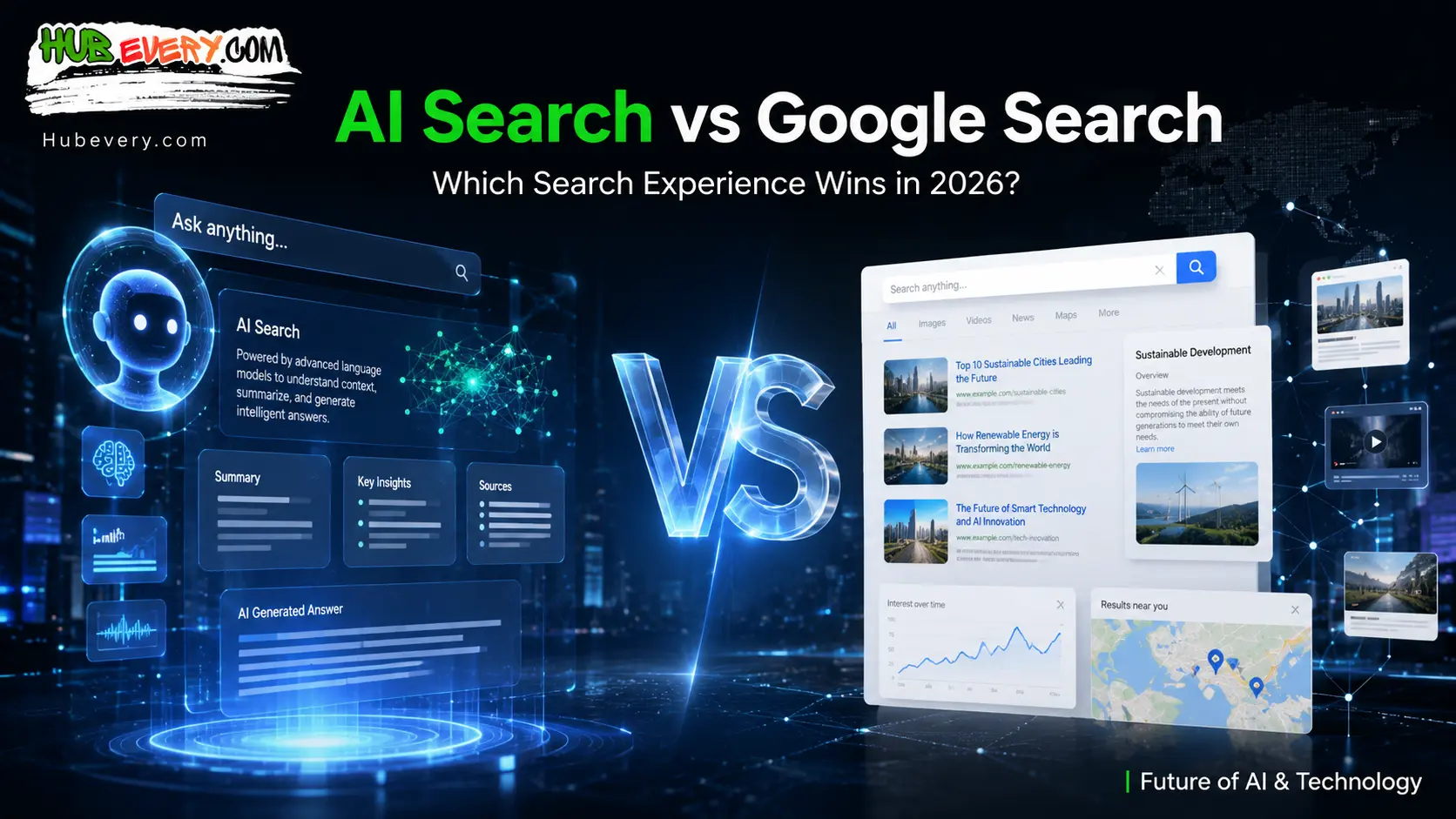
AI Search vs Google Search: Understanding the Fundamental Difference
At first glance, AI Search and Google Search appear to accomplish the same goal. Both help users find information online. Nevertheless, the experience they provide is fundamentally different because they solve different problems.
Google Search is designed to help users discover information across the internet. It identifies relevant websites and allows users to decide which sources deserve their attention. The responsibility for reading, comparing, and interpreting information ultimately remains with the user.
AI Search, on the other hand, focuses on understanding the user’s intent and producing a complete response. Instead of presenting dozens of links, it analyzes available information, identifies patterns, summarizes key insights, and delivers a coherent answer that often feels like talking with a knowledgeable assistant.
This difference becomes especially noticeable during complex research. Suppose a small business owner wants to compare different CRM platforms, evaluate pricing models, understand implementation challenges, and identify the best solution for a growing company. Using Google Search would likely require visiting multiple review sites, vendor websites, industry blogs, and discussion forums before reaching a conclusion.
With AI Search, much of that preliminary research can be completed within a single conversation. The AI can explain the differences, highlight important considerations, answer follow-up questions, and adapt its responses based on the user’s specific situation.
However, this convenience does not necessarily make AI Search superior in every scenario. There are still many situations where accessing original sources, verifying facts, reviewing official documents, or exploring diverse viewpoints is essential. In those cases, Google Search remains an indispensable tool.
Ultimately, the debate should not be framed as AI Search versus Google Search in the sense of choosing only one. Instead, the real question is how each technology complements the other. As search continues to evolve, users who understand the strengths of both platforms will be better equipped to find accurate information, make informed decisions, and work more efficiently in an increasingly AI-driven digital world.
Which One Provides Better Search Results?
Choosing between AI Search and Google Search ultimately depends on what you’re trying to accomplish. Neither technology is universally better because each serves a different purpose.
If your goal is to understand a topic quickly, summarize lengthy information, brainstorm ideas, compare products, or simplify complex concepts, AI Search often delivers a faster and more convenient experience. Since it provides direct answers in conversational language, users can spend less time searching and more time learning.
On the other hand, Google Search remains the stronger option when accuracy, transparency, and source verification are essential. Journalists, researchers, students, healthcare professionals, lawyers, and financial analysts frequently need to review original documents instead of relying solely on AI-generated summaries. In these situations, Google’s ability to surface authoritative sources continues to be invaluable.
Another important consideration is freshness. While modern AI search platforms increasingly access real-time information, Google still excels at discovering breaking news, newly published content, local businesses, live events, and rapidly changing information from across the web.
Therefore, the best search experience often comes from combining both technologies rather than replacing one with the other.
How AI Search Is Changing SEO
The rise of AI Search is reshaping search engine optimization in ways that would have seemed impossible just a few years ago. For decades, SEO primarily focused on ranking web pages higher in traditional search results. Businesses invested heavily in keyword optimization, backlinks, technical improvements, and content creation to attract organic traffic from Google.
Today, that strategy is evolving.
AI-powered search engines increasingly generate answers directly from trusted content instead of sending users to multiple websites. As a result, publishers must create content that demonstrates genuine expertise, answers questions clearly, and provides original insights rather than simply repeating information already available elsewhere.
Search visibility is no longer measured solely by rankings. Instead, content creators are beginning to compete for inclusion within AI-generated answers. This means that credibility, topical authority, factual accuracy, and content quality are becoming even more important than keyword density alone.
Google has also emphasized the importance of creating helpful, people-first content through its ranking systems. Websites that genuinely educate readers, provide first-hand experience, and establish trust are likely to remain successful regardless of how search technology continues to evolve.
For bloggers and businesses, this represents an opportunity rather than a threat. High-quality content will continue to matter because both traditional search engines and AI systems rely on reliable information to serve users effectively.
Will AI Search Replace Google Search?
This question has become one of the most discussed topics in the technology industry. Although AI Search is advancing rapidly, replacing Google Search entirely is unlikely in the near future.
Google’s greatest strength lies in the enormous scale of the open web. It indexes billions of pages, continuously updates its search index, and connects users directly with publishers, businesses, governments, universities, and countless other authoritative sources.
AI Search, by contrast, excels at understanding language, simplifying research, and generating personalized responses. Rather than functioning as a directory of websites, it acts more like an intelligent research assistant capable of synthesizing information from multiple sources.
These strengths complement each other instead of competing directly.
In fact, the future of search is likely to combine both approaches. Google itself has introduced AI-powered search experiences, while AI assistants increasingly integrate web search into their responses. Instead of choosing between AI and traditional search, users will benefit from systems that intelligently blend conversational assistance with access to reliable source material.
The future is not about replacing search engines. It is about making search significantly smarter.
What This Means for Content Creators and Businesses
The emergence of AI Search carries significant implications for publishers, bloggers, marketers, and businesses that depend on organic traffic.
Simply producing large volumes of content will no longer guarantee visibility. Instead, organizations must focus on publishing original research, practical experience, expert analysis, and genuinely valuable insights that AI systems can recognize as trustworthy.
Content should answer user questions naturally while maintaining depth and accuracy. Articles that demonstrate real expertise, cite credible sources, and provide unique perspectives are more likely to remain competitive in both traditional search rankings and AI-generated responses.
Businesses should also strengthen their brand identity. As AI becomes better at summarizing information, recognizable brands with established authority may enjoy greater visibility because users are more likely to trust familiar names.
For independent bloggers, this shift creates an opportunity to compete through quality rather than sheer volume. Well-researched niche content can often outperform generic articles that offer little original value.
The Future of Online Search
Search technology is entering one of its most transformative periods since the launch of Google itself.
Over the next several years, search experiences will likely become increasingly conversational, personalized, and context-aware. Instead of typing isolated keywords, users will ask complex questions, continue discussions naturally, upload documents for analysis, compare multiple products simultaneously, and receive responses tailored to their individual needs.
Artificial intelligence will make searching faster, but human expertise will remain essential. Trustworthy journalism, expert analysis, academic research, and authoritative publications will continue to provide the foundation upon which AI systems generate reliable answers.
Rather than eliminating websites, AI is expected to change how people discover and interact with them. Publishers who prioritize originality, credibility, and user value will be best positioned to succeed in this evolving digital landscape.
Frequently Asked Questions
Is AI Search more accurate than Google Search?
AI Search can provide faster and more conversational answers, but its accuracy depends on the quality of its underlying data and reasoning. Google Search often remains more reliable when users need official documents, primary sources, or independently verified information.
Can AI Search completely replace traditional search engines?
Not at this time. AI Search and traditional search engines solve different problems. AI is excellent for summarizing and explaining information, while search engines remain essential for discovering original sources and accessing the broader web.
Which is better for research?
For introductory research, AI Search offers a faster way to understand unfamiliar topics. However, comprehensive research should still include reputable primary sources found through Google Search.
How does AI Search affect SEO?
AI Search is encouraging publishers to focus on authoritative, experience-based, and high-quality content. Instead of optimizing only for keywords, successful SEO increasingly emphasizes trust, expertise, and user satisfaction.
Should businesses optimize for AI Search?
Yes. Businesses should continue following SEO best practices while also creating detailed, trustworthy, and genuinely helpful content that AI systems can confidently reference when generating answers.
Final Thoughts
The debate surrounding AI Search vs Google Search is not about identifying a single winner. Instead, it reflects the evolution of how people interact with information online.
Google Search continues to excel at discovering authoritative sources across the web, while AI Search delivers a faster, more conversational experience that helps users understand information with greater efficiency. As these technologies continue to evolve, the distinction between them will likely become less pronounced because both are increasingly adopting each other’s strengths.
For everyday users, the smartest approach is to leverage both tools depending on the task at hand. Use AI Search to accelerate learning, simplify research, and explore ideas. Use Google Search to verify facts, access original sources, and discover the broader web.
Ultimately, the future of search will belong not to one technology, but to the intelligent combination of both. Users who understand when and how to use each approach will be better equipped to navigate an internet that is becoming more dynamic, conversational, and AI-powered every year.